

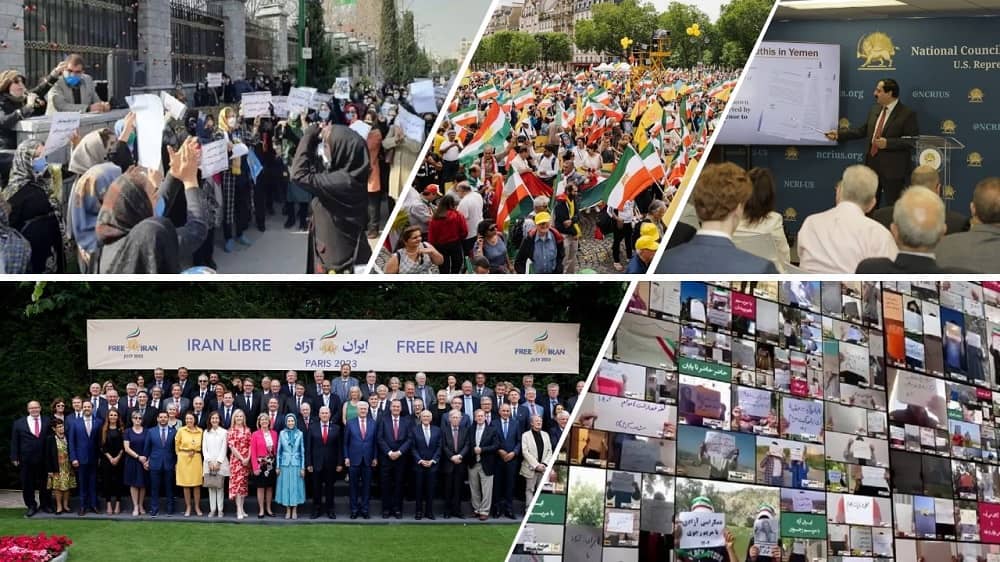
In the Iranian calendar year of 1402 (March 2023 to March 2024), the clerical dictatorship faced a tumultuous period marked by setbacks and devastating blows both domestically and internationally.
Despite the international community’s inaction to the regime’s evasion of sanctions, Iranians experienced a worsening of poverty and ongoing backing for Tehran’s proxy forces, resulting in disastrous outcomes regionally with global implications. Throughout the year, Iranians expressed their discontent with the regime through nationwide protests spanning various societal sectors and unprecedented boycotts of elections. Moreover, Iran’s organized resistance movement demonstrated its proficiency in mobilizing domestic networks and garnering international support in its pursuit to overthrow the regime.
Tehran’s regional warfare in 1402
On October 7, 2023, a disastrous war broke out in the region. Soon, one of the most tragic events in modern history began, which continues to this date. Since the beginning, many observers and numerous pieces of evidence indicated the Iranian regime’s role in this devastating war. The regime’s officials initially bragged about their power in “organizing” the so-called “axis of resistance.” Yet, soon, none other than the regime’s supreme leader, Ali Khamenei, denied culpability in the October 7 attack.
Desperate to face a restive society, Iran’s crisis-riddled regime tried to escalate tensions by using its Houthi proxies in Yemen and Hezbollah in Lebanon.
#Iranian Regime’s Fourfold Objectives in the #GazaCrisishttps://t.co/UXfRouGv2b
— NCRI-FAC (@iran_policy) November 9, 2023
In late 2023, Houthis began attacking ships in the Red Sea. In response, an international coalition led by the United States was formed to secure maritime trade routes. After attacks by the U.S. and Israel targeted several commanders of the Quds Force in Lebanon and Syria, the Iranian regime practically found itself in a proxy war with the West.
On January 29, three American soldiers were killed in an attack by the Iraqi paramilitaries on a US base in Jordan. In the wake of a deadly American response, Iraqi paramilitaries announced a halt to attacks on US bases.
With an impending escalation of a regional war, the endangering of global shipping routes and other far-reaching geopolitical consequences, the events of October 7 demonstrated to the world’s deliberate neglection that the primary regional and international security threat, the Islamic fundamentalism centered in Tehran, has turned out to be a fatal mistake.
As a result, there is a mounting international consensus calling for a shift in approach. Rather than merely addressing the regime’s proxies, there is a growing demand to hold the leadership in Tehran accountable for their actions. In other words, to target the head of the snake in Iran.
Economic Crisis
Recent reports reveal a nation grappling with soaring inflation, widespread poverty, and a collapsing currency. The past year has witnessed a dramatic downturn in living standards for many Iranians, with the mullahs’ economic policies bearing a heavy toll on ordinary citizens.
According to economic analysts, the country has seen staggering price hikes across essential commodities, pushing nearly 70% of the population below the poverty line. From the start of the year, where inflation stood at 45%, it skyrocketed to 55% by year’s end, leaving many struggling to afford even the most basic necessities and consumer goods.
The plight of the average worker further illustrates the severity of the crisis. In the year 1402, a worker’s salary amounted to around 8 million tomans, but with the poverty line now surpassing 25 million tomans, roughly $408 based on the free market exchange rate, that income barely covers one-third of monthly expenses. A grim reality emerges as workers face the prospect of toiling for 120 years, diligently saving every penny, just to realize the dream of owning a modest 50-square-meter home in southern Tehran.
Watch and judge how #Iran's economy is run by the regime pic.twitter.com/k2QtOj9KqS
— NCRI-FAC (@iran_policy) December 17, 2023
The situation has forced many Iranians into unconventional means of survival, with reports indicating a rise in activities like collecting garbage to make ends meet. Meanwhile, the value of the Iranian rial [toman equals 10 IRR] has plummeted, with the dollar exchange rate soaring from 25,000 tomans at the beginning of the year to over 61,000 tomans by year’s end.
Despite Iran boasting the world’s second-largest gas reserves, the regime’s failure to provide adequate gas supplies has only compounded the crisis. Furthermore, reliance on mazut in power plants has exacerbated urban air pollution, further impacting the health and well-being of citizens.
However, amidst the widespread suffering, one sector appears to thrive—corruption. Shocking revelations have emerged of embezzlement reaching unprecedented levels, with reports indicating billions of dollars siphoned off, exemplified by the recent scandals where billions of dollars were illicitly acquired by state-affiliated corporations.
As Iranians grapple with the dire economic realities, discontent simmers beneath the surface, with growing frustration directed towards the government’s failure to address the fundamental needs of the people. As the nation stands on the brink of an economic abyss, the resilience of its citizens faces its sternest test yet.
Iran Protests in 1402
Despite escalating repression and frequent executions throughout 1402, the flame of public dissent against the regime burned brightly, with protests continuing on an upward trajectory. Various segments of society across the nation took to the streets, staging rallies, marches, and strikes to assert their rights.
- Continuation of Protests in Zahedan: Among the most prominent displays of dissent in 1402 were the ongoing Friday gatherings in Zahedan, which persisted for months.
- Protests Over Economic Hardships: Many protests across different segments of the population centered on economic grievances and poverty. Citizens targeted government corruption and embezzlement by regime officials and agents.
- Retiree Protests: Retirees protested due to disparities in pensions, non-receipt of payments, and deteriorating living conditions.
- Oil and Steel Industry Strikes: Workers in the oil and gas industry, as well as steelworkers in Isfahan and Ahvaz, staged strikes.
- Labor Unrest: Workers protested job terminations, lack of job security, non-receipt of wages and benefits, low wages, and harsh working conditions.
- Educators’ Protest: Teachers protested the poisoning of schoolgirls, school closures, non-employment of experienced teachers, and non-receipt of wages and benefits.
- Nurses’ Demonstrations: Nurses protested job terminations, tariff policies, non-receipt of nursing fees, poor living conditions, and excessive mandatory overtime.
NCRI Commentary | Iran Protests in 2023: A Year of Persistent Discontent
These protests stand out for their duration and geographic range, as well as deep political undercurrents with powerful chants like “Death to Khamenei.”#IranRevoIution #FreeIran2024https://t.co/63SpCSfsfv— NCRI-U.S. Rep Office (@NCRIUS) January 6, 2024
- Market Traders’ Outcry: Market traders protested exorbitant taxes, new tax laws, rent increases for businesses, dollar price hikes, exchange rate instability, shop closures, power cuts, and new tax regulations in economic conditions.
- Environment Protests: Extensive demonstrations in many cities across Iran protested air pollution and the systemic negligence of Iran’s water resources.
- Student Protests: Students protested executions, the poisoning of schoolgirls, security pressures, dormitory conditions, food quality, and the expulsion of students and professors.
- Agricultural Protests: Farmers protested non-receipt of subsidies, low agricultural product prices, power cuts, and water transfer plans.
Despite attempts at suppression, these protests underscore a deeply rooted dissatisfaction among Iranians, challenging the regime’s stability and foreshadowing potential future upheaval.
The surge in defiance and resistance
In the past year (March 2023 – March 2024), the Iranian Resistance witnessed significant achievements amidst ongoing challenges posed by the regime.
Despite the regime’s attempts to consolidate power through orchestrated elections, the overwhelming rejection by the Iranian people sent a clear message of defiance to the regime and a resolute call for regime change.
Furthermore, the Iranian Resistance demonstrated its resilience and organizational strength in the face of regime-sponsored attacks and propaganda campaigns. Despite attempts to undermine the People Mojahedin Organization of Iran (PMOI/MEK) and its supporters, including sham trials inside Iran and terrorist attacks in Europe, the Resistance not only remained steadfast in its commitment, but also saw substantial growth in its network throughout Iran.
#IranianResistance, Achievements and Activities in 2023https://t.co/tolMEoH6TG
— NCRI-FAC (@iran_policy) January 4, 2024
Moreover, there was a growing acknowledgment and international support for the PMOI-led Resistance Units’ battle against the regime’s Islamic Revolutionary Guard Corps (IRGC). Western parliaments increasingly voiced support for the Iranian people’s efforts to overthrow the regime, highlighting the global significance of the Iranian Resistance’s struggle for freedom and democracy.
In summary, the preceding year witnessed notable triumphs for the Iranian Resistance alongside a string of setbacks experienced by the regime on domestic, regional, and international fronts. As the regime’s vulnerabilities become increasingly apparent and its grip on power weakens, the determination of the Iranian people and their organized Resistance intensifies. May the continuum of these efforts lead to a 1403 where freedom, democracy, and equality comes to Iran, reshaping the equation not only for the country but also for global and regional stability.