


THIS PAGE WILL BE UPDATED WITH THE LATEST NEWS
UPDATE: 9:30 PM CEST
Treasury Targets Iranian Liquified Petroleum Gas Magnate
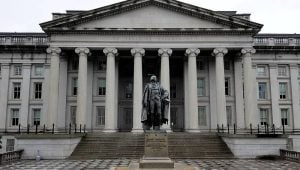
WASHINGTON — Today, the Department of the Treasury’s Office of Foreign Assets Control (OFAC) is designating Iranian national and liquified petroleum gas (LPG) magnate Seyed Asadoollah Emamjomeh and his corporate network, which is collectively responsible for shipping hundreds of millions of dollars’ worth of Iranian LPG and crude oil to foreign markets. Emamjomeh’s expansive network includes a vessel, the TINOS I, which intended but failed to load cargo in 2024 off the coast of Houston, Texas. In addition to crude oil, LPG continues to be a major source of revenue for the Iranian regime, the proceeds of which fund Iran’s nuclear and advanced conventional weapons programs, as well as regional proxy groups and partners such as Hizballah, the Houthis, and Hamas.
U.S. Strikes Kill Over 500 Houthis in Month-Long Campaign Targeting Militant Infrastructure

The United States has killed at least 500 Houthi fighters in Yemen over the past month, including senior drone operators, missile experts, and military commanders, U.S. officials told Al Arabiya English on Monday, April 21, 2025. The ongoing air and naval campaign, launched in mid-March, has seen nearly 1,000 strikes on Houthi-controlled regions in northern and western Yemen.
Intelligence assessments suggest the strikes have crippled key Houthi military assets, targeting command centers, training camps, arms depots, and communication hubs. Recent raids included 23 coordinated strikes across three provinces, hitting sites in al-Hosn and Sanhan districts near Sanaa, and a major weapons storage facility in Jabal Naqm.
U.S. Central Command (CENTCOM) also confirmed the destruction of a key fuel port in western Yemen, part of efforts to cut off the Houthis’ revenue streams. Officials say the strikes are paving the way for a possible ground offensive by Yemeni government forces to reclaim territory and secure critical port cities.
Despite Washington’s limited public statements, Yemeni Information Minister Moammar Al-Eryani praised the campaign as a “strategic shift” and confirmed the deaths of numerous high-ranking Houthi leaders linked to Iran-backed arms smuggling and maritime attacks.
“The decline in missile and drone attacks, especially in the Red Sea and Bab al-Mandab, is proof of the operation’s effectiveness,” Al-Eryani said. He emphasized that U.S. action is not only in defense of Yemen but part of a broader effort to counter Iranian influence and safeguard global trade routes.
While some U.S. lawmakers have raised concerns over the cost and transparency of the operation—especially after the confirmed loss of five MQ-9 Reaper drones—officials maintain that the campaign has delivered significant strategic gains.
Civilian casualties have been reported on both sides, though precise figures remain unclear. The Houthis, meanwhile, have sought to suppress public knowledge of their losses, pressuring families into silence and flooding social media with disinformation. Yemen’s government says continued U.S. support is essential, framing the conflict as “a battle for the international order” against Iranian-backed militias thriving on instability.
UPDATE: 7:30 PM CEST
The Iranian Execution Machine

Living in Paris means witnessing beauty every single day. I step out of the metro station near the magnificent Louvre and find myself in the middle of a jazz street concert, the kind that makes strangers dance together. A few steps later, I turn a corner, and the atmosphere changes completely.
I see makeshift gallows adorned with bright red tulips and photographs of those facing imminent execution. Today, in the square just beside the majestic Louvre, I find myself adrift in the sorrow of the Iranian people, their hearts breaking under the weight of unrelenting violence back home.
Iran Ramps Up State Executions Amid Nuclear Talks with US

Iran has carried out 1,051 state executions since President Masoud Pezeshkian took office on July 8, 2024 – a surge that security experts say the U.S. must weigh as it resumes nuclear negotiations with Tehran. The figure, reported to Fox News Digital by the National Council of Resistance of Iran (NCRI), represents a more than 20% increase from the number of Iranians killed in 2023, which saw 853 Iranians executed by the regime.
In his race for the presidency, Pezeshkian aligned himself with moderates and reformists angry with the regime following the 2022 death of Mahsa Amini and the subsequent protests.
UPDATE: 7:30 AM CEST
The Resistance and Transformative Power of Women Is Splitting the Iranian Regime Apart

In every society ruled by a dictatorship, internal and popular resistance stands as the most decisive force that damages the foundation and structure of the dominant order, eventually leading to its fragmentation and downfall. While external factors related to international politics and the relationships of other governments with a dictatorship are not entirely without influence, the primary force that determines and transforms the conditions against dictatorship is internal, national, and popular resistance.
If we examine the history of splits within the structure of Iran’s ruling system, we see that there has always been a force outside the regime that has stood firm and refused to surrender, and the impacts of that resistance have inflicted major blows on the regime’s structure. Resistance against Ruhollah Khomeini’s fundamentalist absolutism, political prisoners’ defiance in the 1980s, women’s resistance against the clerical regime’s misogyny, opposition to its foreign belligerence and terrorism, the resistance against the regime’s cultural coup in universities, and the national struggle against forced religion, compulsory hijab, and theocratic rule — all of these have turned the clerical regime into a patchwork of ruptures.
New Push to Enforce Mandatory Hijab: Iran Regime Deploys Police to Schools
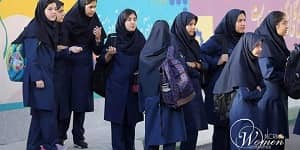
In a move that has sparked outrage among civil society and human rights advocates, Iranian state media reported on Sunday, April 20, that a new agreement has been signed between Iran’s Chief of Police (The State Security Force), Ahmad Reza Radan, and the Minister of Education, Alireza Kazemi. The memorandum grants the SSF new authority within the education system, allowing them to enforce Mandatory hijab regulations in schools.
At the signing ceremony, Education Minister Alireza Kazemi openly pledged allegiance to the notorious police chief, referring to himself as a “proud soldier” of Radan. Kazemi described violations of “hijab and chastity” as cultural “threats” that require targeted educational and cultural interventions.
Phone Access Cut Off for 5 Iranian Political Prisoners on Death Row
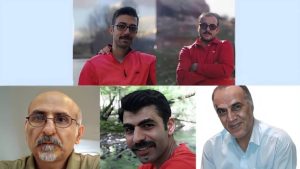
Iranian regime authorities have cut off phone access for five political prisoners sentenced to death; pressure is increasing to forcibly transfer them to Ghezel Hesar prison
Five political prisoners sentenced to death in Evin Prison—Akbar Daneshvarkar, Seyed Mohammad Taghavi Sang-dehi, Babak Alipour, Pouya Ghobadi Bistonī, and Vahid Bani-Amerian—have been denied the right to phone communication with their families since Sunday, April 20, 2025.
A source close to the families told HRANA (Human Rights Activists News Agency) that prison authorities have blocked these inmates’ phone and bank cards. According to the source, this is part of a broader pressure campaign to forcefully transfer them to Ghezel Hesar prison in Karaj.
Iran’s Regime “Killing Its People” by Removing Subsidized Currency for Medicine

Amid growing concerns over a new wave of rising healthcare costs in Iran, Salman Es’haghi, spokesman for the Health Committee of Iran’s regime Majlis (parliament), said that by removing the state-subsidized exchange rate for medicine in the new year, the government is effectively killing its own people.
In an interview with ILNA, a state-affiliated news agency, on Sunday, April 20, Es’haghi said: “The government must refrain from killing its people. I am saying this seriously—if the state-subsidized exchange rate is removed from medicine, equipment, and medical supplies, the government will be killing its own people.”
Es’haghi added: “We will witness people’s desperation and helplessness in the healthcare sector. Since treatment costs will increase by 20 to 30 times, people will certainly avoid seeking medical care, and we will face a situation similar to the COVID pandemic, which led to the death of many people.”
Two More Executions in Iran: Poor, Defenseless Woman Among the Victims of the Gallows

In a continuation of the alarming wave of executions in Iran, two more prisoners — including a woman — were executed in Zahedan and Qazvin prisons in recent days. According to human rights sources, at least 81 people have been executed in Iran since the beginning of the Persian New Year on March 20, 2025. This amounts to more than two executions per day on average.
On Sunday, April 20, 2025, Saadollah Gorgij, a 29-year-old man from the village of Sejou in Saravan County, was executed in Zahedan Central Prison. He had been arrested four years earlier on drug-related charges and was sentenced to death following a flawed judicial process.
A few days earlier, on Wednesday, April 15, 2025, Marzieh Esmaeili, a 39-year-old woman, was executed in Qazvin Prison. She was convicted of carrying 600 grams of narcotics in exchange for 10 million tomans (approximately $170 USD), driven by severe poverty. Marzieh, a mother of one, had no family or legal representation. Sources say she had no choice but to take such a risk due to her dire living conditions. After her execution, her body was claimed by the only person remaining in her life — her adoptive daughter, Soudabeh.
Arrest of Protest Composer Rasam Sohrabi
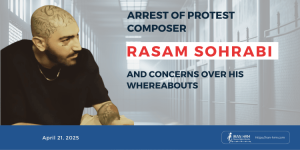
On Saturday, April 19, 2025, Rasam Sohrabi, an independent composer and artist, was arrested in Tehran by security forces. Since his detention, no official information has been released regarding his place of detention or the authority responsible for his arrest. This complete lack of transparency has sparked widespread concern about his fate, physical well-being, and mental health.
According to informed sources, Sohrabi managed to make only a brief phone call to one of his friends after his arrest, during which he confirmed that he had been detained but stated he had no knowledge of his location. The absence of any official acknowledgment and lack of contact with family members strongly suggests a case of enforced disappearance—a method systematically used against cultural, political, and civil activists in Iran.
No News on the Whereabouts of Danial Meshki

Amid the growing wave of repression against dissenting voices in Iran, reports have emerged about the abduction of Danial Meshki, a young dissident rapper. The 23-year-old artist, known for his critical lyrics against the theocratic regime, was reportedly arrested by security forces in Tehran about ten days ago. Since then, there has been no information about his condition or whereabouts. The complete lack of communication has significantly heightened concerns about his health and safety.
Danial Meshki was among the artists who played an active role during the nationwide uprising of 2022, using his protest music—such as the song “Hashashin”—to reflect state violence and demand justice for victims. In that track and others, he harshly criticized the suppression, torture, and killing of unarmed protesters, calling for an end to the cycle of structural violence.
Global Rallies by Iranian Resistance Mark Historic Anniversary, Demand a Democratic Republic: No to the Shah, No to the Mullahs

Supporters of the Iranian Resistance held coordinated rallies over the weekend to mark the anniversary of the April 1972 and April 1975 executions of political prisoners by the Shah’s dictatorship. These events, remembered by Iranians as “30 Farvardin,” commemorate two brutal moments in modern Iranian history when 13 members of the opposition — including members of the People’s Mojahedin Organization of Iran (PMOI/MEK) and the Iranian People’s Fedai Guerrillas — were executed by the Shah’s regime.
Iranian Resistance Rallies in Canada Honor Fallen Heroes of April 19, 1972, and 1975

Canada, April 19, 2025 – Supporters of the People’s Mojahedin Organization of Iran (PMOI/MEK) and the National Council of Resistance of Iran (NCRI) held rallies in Toronto and Vancouver to commemorate the fallen heroes of April 19, 1972, and 1975. These dates mark the execution of 13 brave members of Iran’s opposition by the Shah‘s regime, remembered by Iranians as “30 Farvardin.”