

THIS PAGE WILL BE UPDATED WITH THE LATEST NEWS
UPDATE: 08:30 PM CEST
Costa Rica Declares Iran’s Revolutionary Guard a terrorist

The Costa Rican government declared the Iranian Islamic Revolutionary Guards, Hezbollah, Hamas and Yemeni Ansarallah as terrorist organizations on Wednesday (08.04.2026), because it considers them a risk to international security.
The decision was announced Wednesday by Costa Rican President Rodrigo Chaves, Security Minister Mario Zamora and Foreign Minister Arnoldo André during the president’s weekly press conference.
Zamora said that this categorization is the result of “international cooperation work with intelligence counterparts” and that from now on Costa Rica will reinforce its security measures to prevent the entry of people related to these organizations and capital into the banking system.
Bolivia Canceled the Military Cooperation Agreement with Iran Signed by the Arce Government in 2023

The Bolivian government confirmed on Wednesday the cancellation of the military cooperation agreement that the then president Luis Arce signed with Iran in July 2023. Defense Minister Marcelo Salinas indicated that the agreement was denounced approximately four months ago and that it is no longer in force. The statement, made to journalists who consulted about the status of the agreement, is the first official public confirmation of its termination.
“About four months ago, that military cooperation agreement has been denounced, so that contract no longer exists,” Salinas said, according to the agency EFE. The minister added that the agreements with Tehran “have simply been concluded and no longer exist,” without offering details on which actors formally promoted the termination or whether there was any external pressure.
The agreement was signed on July 20, 2023, in Tehran by the then Minister of Defense, Edmundo Novillo, and his Iranian counterpart at the time, Brigadier General Mohamad Reza Qaraee Ashtiani. The document established a framework for cooperation in security and defense which included assistance for border surveillance, the fight against drug trafficking and smuggling, and the possible supply of Iranian military drones. The opacity with which it was handled generated questions within Bolivia and a reaction of alarm in Argentina, a country that in the 1990s suffered two attacks that the Argentine justice system attributed to Iran.
UPDATE: 09:30 AM CEST
War Within War: Repression In the Shadow of the Conflict in Iran

The recent spate of executions in Iran should force us to rethink one of the most persistent assumptions in the European debate: that war, by weakening a regime, brings democratic change closer. It is not like that. Military pressure can expose vulnerabilities, but it does not in itself generate political transformation. In authoritarian systems, it usually produces the opposite effect. That is precisely what happened in Iran. The external conflict did not open up room for change, but rather reduced it: it allowed the authorities to present dissent as a matter of national security, justify harsher repression and act preemptively against organized opposition.
The recent executions must be understood in that context. Between 30 March and 4 April, six political prisoners, including engineers such as Vahid Bani Amerian (33), Abolhassan Montazer (66), a former political prisoner from the Shah’s time, and Pouya Ghobadi (33), were executed for their links to the country’s main resistance movement, the People’s Mujahideen of Iran (MEK). In the days that followed, several young people arrested during the January 2026 national uprising suffered the same fate. These are not isolated acts, but a deliberate strategy to contain a society marked by deep malaise.
The Iranian Opposition Warns That Peace Will Only Come If the Regime Falls

Iran’s National Council of Resistance (NCRI) on Wednesday expressed its satisfaction with the ceasefire, but warned that lasting peace will only come when the theocratic dictatorship established in Tehran in 1979 is overthrown.
In a statement made public in Paris, the president-elect of the NCRI for the transitional period, Maryam Rajavi, welcomed the truce, “in particular the cessation of attacks on civilian infrastructure and facilities”, and said that “it was the most appropriate decision of the United States at the most sensitive time”.
Rajavi was however skeptical about the true intentions of the leaders of the Islamic Republic, as well as of “the remnants” of the Shah’s regime, regarding the agreement in extremis reached with Washington. The opposition leader insisted that, “as the Iranian resistance has stressed for the past 45 years, lasting peace will only be achieved if the absolute clerical, terrorist and bellicose dictatorship is overthrown, through the Iranian people, organized resistance and the establishment of a democratic republic.”
UPDATE: 07:30 AM CEST
Executions Of PMOI Members Only Fuel the Resolve of Iran’s Resistance Units
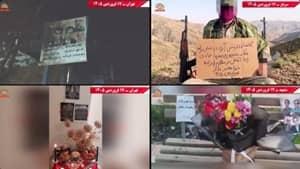
The Iranian regime’s desperate attempt to terrorize the youth and crush the People’s Mojahedin Organization of Iran (PMOI/MEK) through a brutal wave of executions has backfired. Instead of instilling fear, the state-sanctioned murders have ignited a fierce response from PMOI Resistance Units across the country, proving that the ruling clerics’ strategy of intimidation has failed and only deepened the resolve of the youth to overthrow the dictatorship.
In the span of just a few days, between March 30 and April 4, 2026, the regime hanged six PMOI political prisoners: Mohammad Taghavi, Akbar Daneshvarkar, Babak Alipour, Pouya Ghobadi, Vahid Bani Amerian, and Abolhassan Montazer. Driven by profound weakness, the authorities hoped these heinous acts would physically eliminate their organized opposition and terrorize a restless society. On the contrary, PMOI Resistance Units immediately commemorated their martyred comrades and publicly vowed to continue the fight against the regime.
Iran’s Defining Crisis: War or Executions?
What defines Iran’s current crisis? War—or executions?
At first glance, the answer may seem obvious. War dominates the landscape. Its scale, its noise, and its psychological weight stretch across the horizon, capturing attention and shaping perception. It darkens the future and fixes the public gaze upward—toward missiles, aircraft, and geopolitical confrontation.
Executions, however, operate differently. They unfold on the ground, often in silence, yet with far greater strategic precision. Beneath the shadow and noise of war, executions can be carried out more systematically, with reduced scrutiny and diminished immediate backlash. While war distracts, executions proceed.
The Iranian regime has undoubtedly absorbed significant blows from aerial conflict. Yet its primary threat does not come from the sky. It comes from the ground—an Iran in which a vast majority of the population is disillusioned, oppositional, and increasingly oriented toward regime change.
Fluorspar Miners Dismissed in Tabas as Labor Crisis Deepens Amid Economic Turmoil
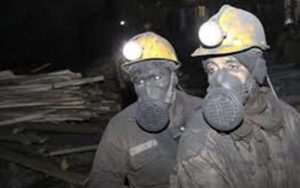
The wave of layoffs and job insecurity sweeping across Iran’s industrial sectors has reached the fluorspar mines of Tabas, where dozens of experienced workers have recently been dismissed. Reports indicate that many of those affected are long-serving, skilled laborers—some only months away from retirement—raising serious concerns among workers and labor activists about the deepening employment crisis. According to a report published on April 6, 2026, by the state-affiliated ILNA news agency, the executive secretary of the Tabas Workers’ House announced that between 20 and 25 specialized workers at a fluorspar mining company have been laid off. These dismissals disproportionately affect individuals who have spent years working under harsh and hazardous mining conditions, only to now face economic uncertainty at the final stage of their careers.
Ebrahim Rahimian, the local labor official, attributed the layoffs to the company’s significant unpaid “government dues.” He warned that the mining license could be revoked and reassigned to another operator, a development that has directly contributed to the workers’ dismissal. Rahimian placed responsibility squarely on the employer, questioning why these obligations had gone unpaid for years—inaction that has now translated into job losses.
Ceasefire Sparks Hope for Change: Resistance Welcomes Trump’s Move Amid Tehran’s Struggles
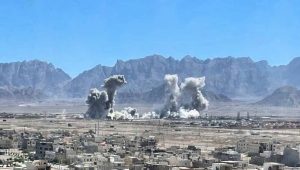
WASHINGTON / TEHRAN / ISLAMABAD — In a fast‑moving development, U.S. President Donald Trump announced his approval of Pakistan’s request to suspend all American military operations against Iran for two weeks. The move, described by Trump as a “mutual ceasefire,” aims to create space for potential negotiations while maintaining strong conditions on the Iranian regime, including the full and safe reopening of the Strait of Hormuz.
Trump said the United States had “achieved and exceeded” its military objectives, adding that Tehran had submitted a ten‑point proposal through Pakistan that could serve as a basis for talks. Sources close to the administration say the temporary truce is intended to test whether Iran’s regime is prepared for genuine engagement or simply seeking relief under military pressure.
Oil markets reacted sharply, with prices dropping below $100 per barrel after news of the ceasefire. Israeli officials confirmed their commitment to maintaining the truce, while analysts noted renewed diplomatic activity between Washington and Islamabad aimed at stabilizing regional tensions.
The Command to Accelerate Executions and Systematic Suppression in Iran
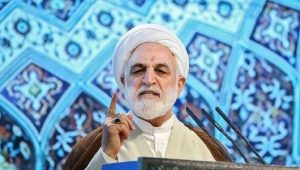
Contrary to international norms where governments focus on border protection during military conflicts, recent statements by high-ranking officials of the Islamic Republic reveal that the “streets of Iran” and “political dissidents” are the primary and ultimate targets of the sovereignty.
- Gholam-Hossein Mohseni-Eje’i (Head of the Judiciary – Rokna & Mizan, April 7, 2026): He explicitly issued the command to accelerate state killings. Addressing his First Deputy (Khalili), he stated:
“Our sentences, Mr. Khalili, must be issued more frequently. Both regarding the confiscation of assets and the issuance of death sentences—you must truly accelerate these.”
- Haji-Sadeghi (Supreme Leader’s Representative in the IRGC – Shabakeh Khabar, April 3, 2026): In a threatening tone directed at protesters, he declared:
“I give the youth one piece of advice… the era of mercy is over.”
- Mohammad Movahedi-Azad (Attorney General – Rokna, April 5, 2026): He revealed the creation of a public espionage network, announcing that over 7,000 public reports against “elements linked to foreign entities” have been received, with orders issued for their rapid processing. It is noteworthy that judicial officials recently declared that the punishment for “espionage and communication with foreign media” is asset confiscation and death. These statements represent a systematic effort to police society and criminalize civic activities.
Global Rallies Across U.S., Canada, and Europe Condemn Execution of PMOI Political Prisoners
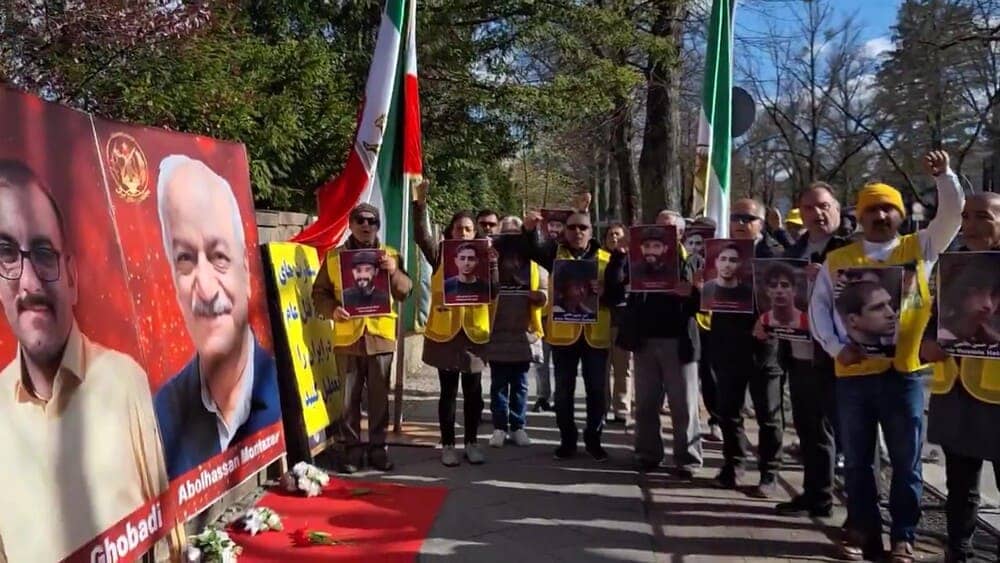
March 30 – April 5, 2026 — Supporters of the Iranian Resistance organized a coordinated series of rallies and demonstrations across major cities in the United States, Canada, and Europe to protest the execution of six political prisoners affiliated with the People’s Mojahedin Organization of Iran (PMOI/MEK).

In the United States, protests took place in Washington, D.C., Atlanta, Berkeley (California), and Los Angeles. In Canada, demonstrators gathered in Toronto, Ottawa, Vancouver, and Montreal. Similar rallies were held in key European cities, including Paris, Rome, Berlin, Gothenburg, Stockholm, Oslo, London, Geneva, Munich, and Hamburg. Several of these gatherings were organized in front of Iranian embassies and consulates, highlighting the protesters’ opposition to the Iranian regime.
Iranian Resistance Supporters Rally in Berlin to Condemn Execution of PMOI Political Prisoners

Berlin, Germany – April 7, 2026 — Supporters of the Iranian Resistance organized a rally outside the Iranian regime’s embassy in Berlin to protest the execution of six political prisoners affiliated with the People’s Mojahedin Organization of Iran (PMOI/MEK): Mohammad Taghavi, Akbar Daneshvar Kar, Babak Alipour, Pouya Ghobadi, Vahid Bani-Amerian, and Abolhassan Montazer.