


THIS PAGE WILL BE UPDATED WITH THE LATEST NEWS
UPDATE: 9:00 PM CEST
Iraqi State Bank Accused of Processing Payments for Houthi Terrorists Who Disrupt Red Sea Commerce

The Iraqi state-owned bank Rafidain faces accusations that it processed payments for the U.S.-designated Yemen-based Houthi terrorist movement at its branch in Yemen’s capital city, Sanna. FOX Business obtained exclusive information from an Iraqi official about an April 29 meeting between Dr. Michael Faulkender, a deputy secretary of the U.S. Treasury, and Iraq’s foreign minister, Fuad Hussein, who also serves as deputy prime minister. Iraq’s ambassador to the U.S., Nazar Al Khirullah, was also at the meeting.
According to minutes of the April 29 meeting, which was held in Washington at the U.S. Treasury Department, Treasury officials warned Hussein that the Iraqi state-controlled bank Rafidain needs to stop conducting business with the Iranian regime-backed Houthi organization. The U.S. also asked that the Rafidain branch relocate to the Yemen city of Aden, where the internationally recognized government of Yemen resides. The Iranian-backed proxy Houthi movement has plunged Yemen into a civil war and caused one of this century’s worst humanitarian crises.
UPDATE: 8:00 PM CEST
Stop the Executions in Iran

Five political prisoners in Iran are in imminent danger of being executed. Norway must act immediately – before the regime carries out another massacre like the one in 1988. The political prisoners – Vahid Bani Amerian, Pouya Ghobadi, Shahrokh Daneshvarkar, Babak Alipour, and Mohammad Taghavi – have been transferred to Ghezel Hesar Prison, a notorious execution site. All have been sentenced to death for affiliation with the People’s Mojahedin Organization of Iran (PMOI/MEK), the country’s leading opposition movement, and have been subjected to brutal torture. Their lives are in immediate danger, which has triggered reactions from both the UN and Amnesty International.
In connection with Arendalsuka, prominent Norwegian politicians from a wide range of parties have signed a declaration demanding that the government intervene to save these political prisoners. Among the signatories are one of the vice presidents of the Storting, former party leaders, as well as leaders and members of key committees such as the Justice Committee and the Energy and Environment Committee. They represent parties including the Conservative Party (Høyre), Progress Party (Fremskrittspartiet), Christian Democratic Party (Kristelig Folkeparti), Centre Party (Senterpartiet), Liberal Party (Venstre), and the Green Party (Miljøpartiet De Grønne).
UPDATE: 7:00 AM CEST
Why Iran’s Regime Is Desperate to Erase Its History of Massacres

In a move that reeks of desperation, the Iranian regime has dispatched heavy machinery to Behesht-e Zahra, Tehran’s largest cemetery. But this is no urban development project. On the direct orders of Supreme Leader Ali Khamenei, bulldozers are working to completely level Section 41, the hallowed resting place of thousands of members of the People’s Mojahedin Organization of Iran (PMOI/MEK) who were systematically executed in the 1980s.
This is not an act of strength by a confident government. It is the frantic work of a criminal cabal terrified of its past, haunted by its victims, and desperate to bulldoze the evidence of its crimes against humanity before its inevitable day of reckoning arrives.
Tehran in Turmoil as European Deadline Exposes Deep Divisions over Nuclear Program

In a letter, the foreign ministers of France, Germany, and the United Kingdom have issued an ultimatum to the Iranian regime regarding its nuclear program: return to the diplomatic table by the end of August 2025 or face the full reimposition of United Nations sanctions. The joint letter, delivered to the UN Security Council on August 13, formally declared the E3’s readiness to trigger the “snapback” mechanism, a provision of the 2015 nuclear deal that would restore all international sanctions against Iran.
This declaration has cornered the crisis-ridden regime, trapping it in its ultimate dilemma: a choice between suicide or death. It can either capitulate and accept a humiliating diplomatic retreat—a move it equates with political suicide—or it can continue its defiant pursuit of a nuclear weapon, which will inevitably trigger the snapback mechanism and the fatal consequences of complete international isolation.
Simay Azadi’s Interview with Ambassador Stephen J. Rapp on Iran’s Situation

On July 31, 2025, just before the Free Iran Summit in Rome, I spoke with Ambassador Stephen J. Rapp, 4th United States Ambassador-at-Large for War Crimes Issues who has long campaigned for justice for victims of political repression. Ambassador Rapp is among more than 300 international figures who signed a recent statement urging urgent action to stop the execution of Iranian political prisoners. In this interview, he spoke about the recent execution of two People’s Mojahedin Organization of Iran (PMOI/MEK) supporters, Behrouz Ehsani and Mehdi Hassani, the 1988 massacre, the need for international accountability, and his strong support for the President-elect of the National Council of Resistance of Iran (NCRI), Mrs. Maryam Rajavi’s Ten-Point Plan for a democratic Iran.
Yemeni Partners Continue to Interdict Illegal Weapons Systems and Equipment Bound for Iran-backed Houthis

U.S. Central Command (CENTCOM) congratulates the Yemeni National Resistance Forces (NRF), led by Gen. Tareq Saleh, for displaying their capabilities and commitment to stop the proliferation of weapons and illicit material bound to Iran-backed Houthis.
On Aug. 6, Yemeni security forces, in coordination with the Public Prosecutor and Port of Aden authorities, seized a shipment containing drones, jet propulsion systems, wireless devices, and advanced control components bound for Iranian-backed Houthis. The cargo, which was destined for Al Hodeidah, Yemen, was rerouted to Aden and discovered during a joint inspection by counterterrorism, customs, and police units.
Iran: Sheida Kardgar, 15, Murdered After Refusing Marriage Proposal

On Monday, August 11, 2025, Sheida Kardgar, a 15-year-old girl from a village near the northern city of Babol in Mazandaran Province, was brutally stabbed to death by a man whose marriage proposal she had rejected.
According to local sources, Sheida Kardgar had previously been harassed and pressured by the man. Her family had firmly opposed the marriage. Enraged by the refusal, the suitor confronted Sheida outside her grandmother’s home and attacked her with multiple knife blows, killing her on the spot.
Such tragedies cannot be seen as isolated acts of violence. They are rooted in the oppressive and misogynistic policies of Iran’s ruling clerical regime, which fosters a culture of discrimination and violence against women and girls.
Lebanese President Stresses Hezbollah Disarmament in Meeting with Iran’s Security Chief

Lebanese President Joseph Aoun delivers a firm message to Tehran, demanding Hezbollah’s disarmament and an end to foreign interference in Lebanon’s affairs.
On August 13, 2025, Lebanese President Joseph Aoun delivered a firm message to the Iranian regime’s Supreme National Security Council (SNSC) Secretary Ali Larijani during a meeting in Beirut on Wednesday, underscoring his government’s commitment to the rapid disarmament of Hezbollah and the prevention of foreign interference in Lebanon’s internal affairs.
Larijani’s visit to Beirut appears aimed at reviving Tehran’s influence in Lebanon and across the Levant following the severe weakening of Hezbollah and the collapse of the Assad regime in Syria.
Iran’s Governance in Freefall: Regime Admits Inability to Manage Basic Needs

From water and electricity shortages to looming food insecurity, the regime’s leadership openly acknowledges a governance deadlock.
This is the reality of Iran today: a country mired in structural governance failures, the product of a chronic disease inflicted by the mullahs’ regime. It is a crisis of management, decision-making, legitimacy, and—perhaps most critically—efficiency.
The summer of 2025 has brought scorching heat, but for millions of Iranians, the real burden is a worsening shortage of water and electricity. Instead of addressing the problem, the regime has opted for absurd stopgap measures, such as closing banks and government offices under the pretext of “saving money,” as though running a country could be achieved by shutting it down.
In a striking admission, regime president Massoud Pezeshkian told a gathering of media executives: “I have no choice. We have no water. We have no electricity. Industry has problems. Everything is forced.”
Egyptian Officials Hold Phone Talks with Iran and IAEA to Mediate
Egypt’s foreign ministry announced mediation efforts to resume cooperation between Iran’s regime and the International Atomic Energy Agency (IAEA) after it had been halted. These contacts aimed to reduce tensions and preserve regional stability.
In an official statement, Egypt’s foreign ministry said that on Tuesday, August 12, Egyptian Foreign Minister Badr Abdelatty held separate phone calls with Abbas Araghchi, Iran’s regime foreign minister, and Rafael Grossi, IAEA Director General. According to Cairo, the purpose of these talks was to strengthen mutual trust and create a favorable environment for security and stability in the region.
The Egyptian foreign minister and Grossi also discussed the latest developments regarding Iran’s nuclear file and focused on finding ways to encourage cooperation between Tehran and the IAEA.
Khamenei Orders Destruction of Victims’ Graves
August 11, 2025 – Tehran: Acting under direct orders from Ali Khamenei, the Iranian regime has used heavy machinery to demolish and flatten graves in Section 41 of Behesht Zahra Cemetery – the burial site of thousands of political prisoners executed during the 1980s, including the victims of the summer 1988 mass killings. Agents of the Ministry of Intelligence and security forces were deployed to the site to block families and members of the public. This act is the latest in a four-decade-long policy to erase the physical evidence of organized crimes against humanity.
Since the early 1980s, Section 41 of Behesht Zahra has been known as a mass burial site for executed political prisoners. Independent investigations have estimated its capacity at no less than 9,500 graves. For many families, especially those of members of the People’s Mojahedin Organization of Iran (PMOI/MEK), this site is a symbol of resistance and sacrifice. From the outset, the regime’s security forces placed the section under tight control, restricted access, smashed gravestones, and defaced them with tar or paint. Some parts of the section had previously been destroyed or repurposed, but the latest operation marks an unprecedented and deliberate attempt to obliterate the site entirely.
Total Blackout on Five Death-Row Prisoners
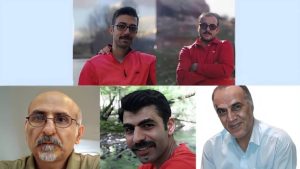
More than a week after the violent transfer of five political prisoners on death row—Vahid Bani-Amrian, Pouya Ghobadi, Akbar (Shahrokh) Daneshvarkar, Babak Alipour, and Mohammad Taghavi—there is a total blackout about their whereabouts or condition. On Friday, 8 August 2025, during a mass transfer from Greater Tehran (Fashafouyeh) Penitentiary to Evin, the five were separated from the others and taken to an undisclosed location.
While officers initially named Qezel Hesar Prison as the destination, officials there later denied any knowledge of their presence. This denial—combined with a total cut-off of communication and the authorities’ failure to respond to families—amounts to enforced disappearance. This case exemplifies total blackout, five death-row prisoners, Qezel Hesar secure ward, secret execution and stands as one of the most serious instances of enforced disappearance in recent years.
Iran Admits to 21,000 Arrests During 12-Day War

Following the 12-day conflict between Israel and Iran, conflicting figures have emerged regarding the number of people detained. The spokesperson for Iran’s Law Enforcement Command announced the arrest of 21,000 individuals, a figure that significantly differs from previous statistics and statements by judicial officials. This discrepancy has raised questions about the legal status and fate of those detained.
Saeed Montazerolmahdi, spokesperson for Iran’s Law Enforcement Command, stated that around 21,000 people were arrested during the 12-day war as suspects. This is the highest number reported for detentions in this conflict, which ended eight weeks ago. Previously, the highest official figure had been approximately 2,000 arrests.
MEK Supporters in Stuttgart Urge Iranians to Join Brussels Free Iran Rally Sept. 6, 2025

Stuttgart – August 2025: Supporters of the People’s Mojahedin Organization of Iran (PMOI/MEK) in Stuttgart held a rally condemning executions in Iran and urging action to stop executions and free political prisoners. They also invited all freedom-loving Iranians to join the Free Iran rally in Brussels on September 6, 2025. The Brussels rally aims to unite voices from across Europe to demand justice, human rights, and a democratic Iran.
Iranians in Brussels Rally for ‘Free Iran’ Demonstration on September 6, 2025, Urging Regime Change in Iran

Brussels – August 2025: Freedom-loving Iranians and supporters of the People’s Mojahedin Organization of Iran (PMOI/MEK) gathered in Brussels for a rally, calling on all freedom-loving Iranians to join the “Free Iran” demonstration in Brussels on September 6, 2025. The event aims to unite voices from across Europe in demanding justice, human rights, and a democratic Iran.