


THIS PAGE WILL BE UPDATED WITH THE LATEST NEWS
UPDATE: 8:30 PM CEST
Iran’s Regime Braces for Fresh Protests as Europe Moves to Reimpose Sanctions

IRAN’S regime is bracing itself for fresh protests as Britain, France and Germany moved to reimpose international sanctions over Tehran’s failure to meet nuclear obligations. The so-called “E3” has written to the United Nations Security Council, initiating proceedings to trigger the snapback clause of the 2015 Joint Comprehensive Plan of Action (JCPOA).
If implemented, it would restore UN sanctions lifted under the deal and further isolate Tehran from global markets. Megan Sutcliffe, a senior analyst with the Sibylline strategic risk group, said the impact would be immediate. “In the coming days, this will likely trigger significant currency valuation fluctuations in Iran due to the risks of UN sanctions being reapplied,” she said.
UPDATE: 2:00 PM CEST
Ireland’s Top Organised Crime Investigator Links Irish Criminals to Iranian-Backed Drugs Gangs

IRELAND’S MOST SENIOR organised crime investigator has said the main driving force behind large-scale cocaine smuggling around our shores are Irish criminals but that in the background they have aligned with Iranian-backed organised crime gangs. Speaking to The Journal recently, Detective Chief Superintendent Seamus Boland – who leads the Garda National Drugs and Organised Crime Bureau (GNDOCB) – said Ireland’s own criminal networks are pitching for business with cartels in South America and in the Middle East.
It’s currently understood that the Kinahans are already heavily engaged with Italian mafia, particularly centred around Naples, and with cartels in Peru and in Colombia.
But Boland believes that Kinahan-aligned, Dutch-based criminals are also working with Iranian crime groups linked to assassinations ordered by the Tehran regime of dissidents.
UPDATE: 8:00 AM CEST
While Iran’s Regime Erases Graves, PMOI Resistance Units Vow to Hold Criminals Accountable
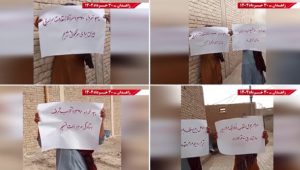
While the clerical regime in Tehran deploys bulldozers in a desperate attempt to erase the evidence of its past massacres, the flame of resistance is burning brighter than ever across the country.
In the southeastern city of Zahedan, the recent activities of the PMOI Resistance Units serve as a powerful testament to this reality. Their actions are a direct and defiant response to the regime’s campaign of fear and historical erasure, demonstrating that the Iranian people and their organized Resistance will neither forget the regime’s crimes nor abandon their struggle for a free and democratic Iran.
The recent wave of defiance in Zahedan comes as the regime accelerates its efforts to destroy a crucial crime scene. On August 22, 2025, an official from Tehran’s Behesht-e Zahra cemetery admitted that Section 41, the resting place of thousands of PMOI members executed in the 1980s, was “flattened… and turned into a parking lot.”
Political Prisoner Elaheh Fouladi, 47, Faces Forced Transfer to Psychiatric Hospital

Prison authorities recently transferred Elaheh Fouladi in handcuffs and shackles to a hospital, where an order was issued for her compulsory admission to a psychiatric facility, an act that constitutes clear psychological torture and an attempt to crush the spirit of political prisoners.
The transfer, carried out with violence by Qarchak prison guards, has sharply heightened concerns over Fouladi’s fate. In Iran, the forced transfer of political prisoners to psychiatric institutions often entails the administration of unidentified medications and coercive treatments, leaving irreversible damage to their physical and mental health.
Bern, Switzerland: Iranians Honor 60th Anniversary of PMOI and Promote ‘Brussels Free Iran Rally’ on Sept 6, 2025

Bern, Switzerland – August 29, 2025: Freedom-loving Iranians and supporters of the People’s Mojahedin Organization of Iran (PMOI/MEK) held an exhibition in Bern, urging freedom-loving Iranians to take part in the upcoming “Free Iran” demonstration in Brussels on September 6, 2025. The event emphasized the importance of uniting voices across Europe to demand justice, human rights, and a democratic future for Iran.
Qarchak Prison – The Slaughterhouse of Human Dignity and Forgotten Justice – Part 5

Qarchak Prison in Varamin is not merely a site of incarceration for women; it has become a tool for exerting double pressure on their families as well. The regime ruling Iran employs restrictions, threats, and ongoing humiliation to ensure that not only prisoners but also their families are trapped in a cycle of fear and repression. This dual policy – torturing prisoners inside while persecuting their families outside – represents one of the less visible but devastating dimensions of human rights violations in Iran.
Visits in Qarchak rarely take place in a humane manner:
• Families frequently face sudden cancellations of visits. After traveling long distances to the prison, they are denied access without explanation.
• When visits occur, families – particularly women and girls – are subjected to degrading body searches.
• Prison authorities often prevent the delivery of essential items such as medicine, warm clothing, or basic necessities.
Iran: Khamenei Orders Nationwide Military Alert

According to state-run newspapers over the past few days, the Iranian regime has placed all its forces on full alert. Amir Mahmoudi, Deputy Executive Officer of the Army, stated:
“Today, the Armed Forces of the Islamic Republic of Iran, particularly the Army, are more prepared, more cohesive, and fully obedient to the Supreme Leader. If a threat emerges on land, sea, or air, it will be neutralized with greater strength and a more decisive response than before.” Reports indicate that this state of alert began in mid-August 2025 in Iran, following assessments made after the 12-day Israel Iran war. As part of these measures, military leave was canceled for the IRGC, the Army, and police forces. Tens of thousands of personnel were deployed across Tehran, and consecutive urban drills were conducted. Journalists and eyewitnesses reported that such a scale of mobilization had not been seen before in the streets.
Widespread Blackouts in Iran Paralyze Half of Production and Industries

Abdolvahab Sahlabadi, head of Iran’s Chamber of Industry, Mining, and Trade, told the state-run Mehr news agency about the state of production and industries: “The biggest crisis today for production units, in addition to economic pressures, is repeated power outages which have practically taken half of the country’s production capacity out of service… nearly 50% of factories in the country have gone out of service due to blackouts, and the constant switching on and off of electricity imposes enormous financial damages on industries.” According to the state-run Mehr news agency on August 20, Sahlabadi said: “About 50% of the country’s factories have been taken out of productive operation due to repeated blackouts.
Tehran-Backed Hackers Carried Out a Cyber Intrusion Against Mediators in the Gaza Ceasefire Negotiations

The cybersecurity company “Dream” announced that it had uncovered a sophisticated cyberattack originating from Iran. According to the company, the attack was “designed to undermine mediation processes and trust between countries” and even infiltrated the Cairo negotiations over a ceasefire in Gaza. According to this report, published on Friday, August 29 in Israeli media, Iranian hackers managed to infiltrate the real email account of an employee at the Omani embassy in Paris. Through this, they gained the ability to send messages that appeared identical to official diplomatic correspondence.
Housing Costs Push Iranian Workers into a Deepening Crisis

The housing crisis in Iran has reached an alarming level, with new reports showing that the majority of working-class households are unable to afford adequate shelter. According to Hamidreza Emam Gholitabar, inspector of the Supreme Assembly of Workers’ Representatives, between 70 and 85 percent of workers’ income is spent on housing-related expenses. “For workers living in substandard housing conditions, the housing share is at least 70 percent, and for those seeking non-slum housing, this figure reaches about 85 percent,” Emam Gholitabar warned. Globally, housing costs are expected to account for only 18 to 20 percent of household expenses. In Iran, the figure is three to four times higher for workers, exposing a massive gap between wages and basic living costs.