

In the final days of August 2025, a new and powerful wave of protests swept across Iran, uniting a remarkably diverse cross-section of society—from industrial workers and farmers to university students and medical professionals.
The demonstrations, stretching from the capital, Tehran, to Kurdistan and the industrial hubs of Ilam and Isfahan, are not isolated incidents of discontent. They are the undeniable symptoms of a collapsing regime under Supreme Leader Ali Khamenei, whose regime has proven incapable of providing basic security, services, or economic stability. The unified outcry reveals a nation pushed to its limit, demanding fundamental change.
Labor Uprisings Paralyze Key Industries
The regime’s economic mismanagement has pushed Iran’s industrial heartland into open revolt. On Saturday, August 30, workers at the SAIPA Press factory in Tehran, a major automotive parts manufacturer, launched a full-scale strike. Halting the entire production line, they sent a clear message to the authorities over months of unpaid wages and benefits, declaring, “The production line won’t run until you pay our rights!”
August 30—Tehran, Iran
Strike by workers at the Saipa Press factory, protesting unpaid wages and benefits. The workers have made it clear that the factory will not resume operations until their demands are met.#IranProtestspic.twitter.com/VjDpAfzA1C— People's Mojahedin Organization of Iran (PMOI/MEK) (@Mojahedineng) August 30, 2025
This act of defiance was mirrored in Ilam province, where laid-off workers from the Arghavan Gostar petrochemical plant gathered outside the provincial governor’s office. Their protest stems from a deeply fraudulent process; for over 14 months, they have been left in limbo after a so-called “recruitment exam” in which the results were never announced. This protest highlights not just a lack of jobs, but the regime’s systemic cronyism and utter disregard for workers’ rights.
Protests Over Failing Basic Services
The crisis extends far beyond the factory floor into the daily lives of all citizens, with the state now failing to provide the most essential services. On Thursday, August 28, university students in Shiraz held their second major rally to protest chronic, unannounced water and electricity cuts, chanting, “Student, cry out, shout for your rights!” That same day, farmers in Qahderijan, Isfahan, held a sit-in to protest the denial of their water rights, which has devastated their crops.
The power crisis is strangling small businesses, a fact made visceral by protesting bakers. One baker, demonstrating how he is forced to mix dough by hand during daily four-hour power outages, angrily addressed the regime’s Minister of Energy: “How dare you send me a bill for 3,160,000 tomans when you cut my power for four hours a day?” In Chabahar, another baker displayed a tray of ruined dough, stating, “This is the masterpiece of the Chabahar electricity department. This dough has to be thrown away. This is our situation because of the power cuts.”
August 28—Isfahan, central Iran
Protest by farmers of Qahderijan, Isfahan province, demanding their water rights amidst severe shortages that have led to the destruction of ancient trees and agricultural lands.
A week earlier, farmers of western Isfahan held similar rallies in… pic.twitter.com/x4FksZoSGF— People's Mojahedin Organization of Iran (PMOI/MEK) (@Mojahedineng) August 28, 2025
The protest wave extended far beyond expectations, highlighting the widening social and geographic reach of Iran’s uprising. On August 30, residents of Jamalabad Loushan in Gilan Province blocked a major road and set fires to protest the severe shortage of drinking water, accusing the regime of gross mismanagement of local water resources.
In Paband, Zanjan Province, villagers staged a demonstration demanding infrastructure improvements and relief from worsening living conditions. Meanwhile, in Hamedan, employees of the Refah retail chain gathered to protest delayed wages and precarious work conditions, underscoring the broader collapse of workers’ rights.
On the same day, hundreds of teacher recruitment applicants rallied in Tehran and Mashhad, condemning a corrupt hiring process riddled with nepotism and secrecy. Together, these actions reflect a deepening crisis in which neglected rural communities, urban laborers, and aspiring educators all confront the same entrenched corruption and systemic failure.
More footage of the protest rally in Sanandaj in support of dismissed and jailed teachers' rights activists.#IranProtests pic.twitter.com/tYu2AvVfLv
— People's Mojahedin Organization of Iran (PMOI/MEK) (@Mojahedineng) August 29, 2025
Regime’s Repression Targets All Professions, But Resistance Grows
Facing a legitimacy crisis, the regime has intensified its repression, which now targets all segments of society, including its most educated professionals. In Kurdistan, a region long defiant of the regime, hundreds of citizens organized a protest hike on Friday, August 29, in support of teachers who had been systematically fired for their activism.
Their chants of “Worker, teacher, student, unite, unite!” and “Imprisoned teachers must be freed!” echoed through the mountains near Sanandaj. The regime’s response was swift and predictable: the very next day, security forces summoned and interrogated four members of the Sanandaj teachers’ union.
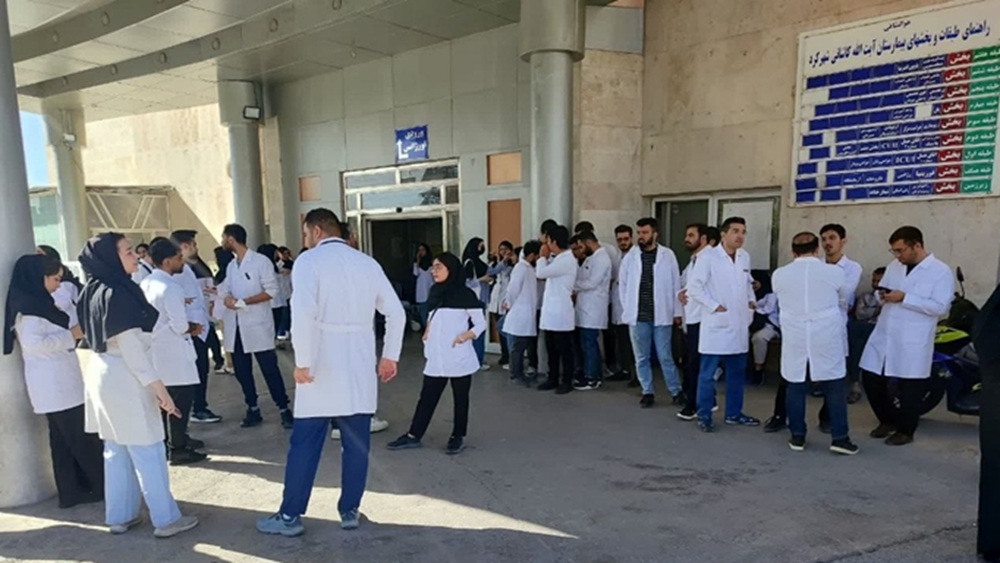
The breakdown of order has become so severe that even doctors and nurses are no longer safe. In Shahrekord, medical interns at Kashani Hospital held a rally on August 30 to protest the third violent assault on one of their colleagues. Their demonstration was a stark indictment of a system that cannot even guarantee the physical safety of its essential healthcare workers.
A Unified Cry for Freedom from a Failing Theocracy
From the assembly lines of Tehran to the university campuses of Shiraz, from the farmlands of Isfahan to the hospitals of Shahrekord, the protests of late August 2025 carry a clear and unified message: the Iranian people have had enough. The regime’s inability to provide electricity, water, housing, or wages is not a temporary setback but a profound and irreversible failure of governance. The widespread and diverse nature of these demonstrations signals that the people’s patience has finally run out, and their movement for a free and democratic Iran is gaining unstoppable momentum.