

THIS PAGE WILL BE UPDATED WITH THE LATEST NEWS
UPDATE: 09:30 AM CET
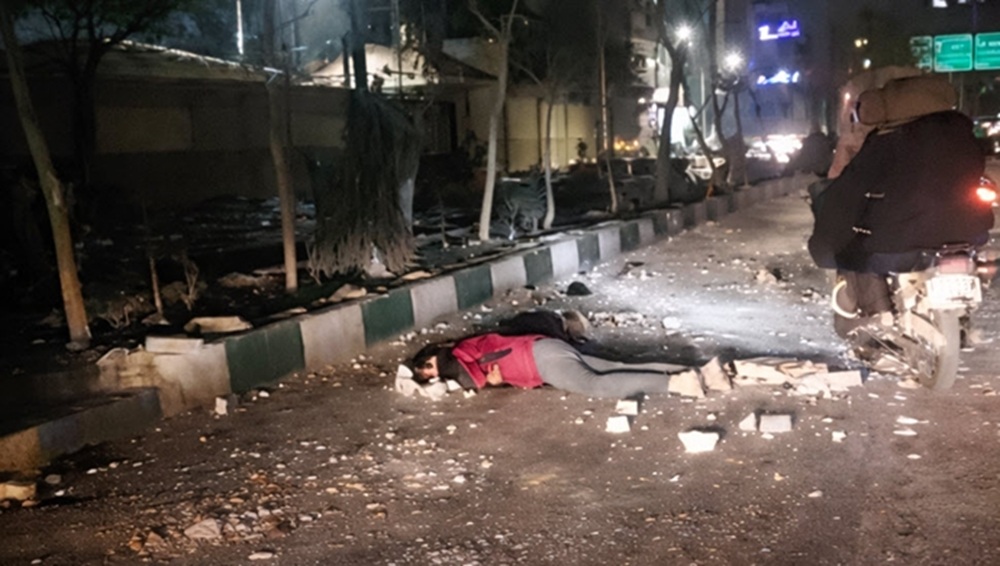
Iran Confirms at Least 5,000 Dead in Protest Crackdown

An unnamed Iranian official told Reuters on Sunday that at least 5,000 people were killed during the regime crackdown on protests last week. The Iranian resistance claimed that at least 127 prisoners were executed between January 5 and January 15, including three women. The Iranian official who spoke to Reuters claimed 500 of the deaths were security personnel killed by the protesters, who had supposedly been provided with weapons by “Israel and armed groups abroad.”
The regime official further claimed that many of the civilian casualties were “innocent Iranians” killed by “terrorists and armed rioters.”
The National Council of Resistance of Iran (NCRI), an opposition group headquartered outside the country, said on Saturday it has received reports of 127 prisoners executed by the regime. The NCRI press release proceeded to name all of the executed prisoners.
UPDATE: 08:00 AM CET
Day 23 of Iran Uprising: Regime Parliament Speaker Admits to ‘Urban War’ and Thousands of Deaths

The nationwide uprising against the religious dictatorship in Iran has reached its twenty-third day on Monday, January 19, 2026. The regime’s own officials admitted to losing control. In the regime’s parliament, the speaker explicitly acknowledged that an “urban war” is underway. Simultaneously, the regime faced a humiliating diplomatic blow as the World Economic Forum in Davos rescinded its invitation to the regime’s Foreign Minister due to the ongoing crackdown. Despite the brutality and a twelve-day internet blackout, the Iranian people remain defiant in the streets.
On Monday, January 19, 2026, the twenty-third day of the uprising marked a significant shift in the regime’s narrative, moving from denial to an admission of a full-scale crisis.
Massacre of Protesters in Iran: A Crime Against Humanity with Organized Impunity
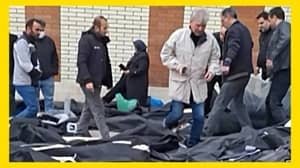
When the regime’s Supreme Leader is forced to confess, it means the scale of the crime has exceeded all attempts at concealment. In a speech on January 17, 2026, Ali Khamenei admitted to the massacre of “several thousand people. Although he immediately tried to distort reality by blaming this “massacre” on the United States, the very admission itself stands as an unintended seal of confirmation on what the people of Iran have written in blood on the streets: the commission of a crime against humanity on a massive scale. Just two days later, on January 19, 2026, Gholamhossein Mohseni-Ejei, the regime’s Judiciary Chief, completed another link in the chain of this crime. He ordered judges to expedite verdicts against protesters—an instruction that means nothing less than the elimination of due process and the paving of the way for executions and heavy sentences. In this way, the street massacre became inseparably linked to a judicial massacre.
Paris: Iranians Rally for Freedom, Reject All Forms of Dictatorship in Support of Iran’s Uprising

Paris, France — January 18, 2026 — Freedom-loving Iranians and supporters of the People’s Mojahedin Organization of Iran (PMOI/MEK), along with French citizens, gathered at Place Saint-Michel in Paris to express solidarity with the nationwide protests in Iran that began on December 28, 2025. The demonstration honored the fallen heroes and victims of the Iranian people’s uprising.
MEK Supporters Rally in Cologne in Support of Iran Uprising, Calling for a Democratic Republic

Cologne, Germany — January 17, 2026 — Freedom-loving Iranians and supporters of the People’s Mojahedin Organization of Iran (PMOI/MEK) held a rally in Cologne to express solidarity with the nationwide protests in Iran that began on December 28, 2025. Braving the freezing weather, participants echoed the call of their compatriots inside Iran for a free and democratic republic.
Iranians in Toronto Support the Iran Uprising, Honor Its Martyrs, and Call for a Free, Democratic Iran

Toronto, Canada — January 17, 2026 — Once again, despite the snowy and subzero temperatures, freedom-loving Iranians and supporters of the People’s Mojahedin Organization of Iran (PMOI/MEK) in Toronto held a rally in solidarity with the nationwide uprising in Iran and its brave protesters. Participants held pictures of the martyrs of the ongoing nationwide protests and chanted anti-regime slogans to express their support for compatriots who have risen up inside Iran.
Iran Protests: Khamenei Blames Outsiders as Deaths Mount

The number of deaths during Iran’s recent protests has become a key focus of international attention, following new statements from Iranian officials alongside reports indicating rising fatality figures and judicial measures related to the unrest. Iran’s nationwide protests have entered a new stage in recent days. Developments over the past week have included public remarks by the Supreme Leader, additional international reporting, and judicial statements addressing responses to the protests. Ali Khamenei publicly addressed the unrest in a televised speech on January 17, 2026, offering the clearest acknowledgment yet of the human cost. He said “several thousand” people had been killed, while placing responsibility squarely on what he described as foreign-instigated unrest.
Davos Meeting Criticized for Inviting Iranian Regime FM Abbas Araghchi

Lindsey Graham, a prominent Republican senator from the United States, published a message on the social media platform X criticizing the invitation of Abbas Araghchi, the foreign minister of Iran’s regime, to the World Economic Forum meeting in the Swiss city of Davos and addressed the organizers of the meeting, writing: “What the hell are you thinking? I cannot think of a worse message to send to the protestors.” This year’s Davos meeting is being held from Monday to Friday, January 19 to January 23. Fox News, a major U.S. cable news network, had previously reported that despite the horrific killing of protesters by Iran’s regime, officials of the World Economic Forum had invited Abbas Araghchi to attend the meeting.
A Nation Past the Point of Return: Iran’s January 2026 Uprising and the Collapse of Fear

Why the uprising of January 2026 marks a decisive break between Iranian society and the ruling clerical regime. A profound transformation is unfolding in Iran. The country before and after 8 January 2026 is no longer the same. What erupted in the January 2026 uprising was not merely another wave of protests, but the most extensive and socially inclusive mobilization Iran has witnessed in more than four decades. For the first time since the establishment of the Mullahs regime, a massive reservoir of social energy has been released toward a final confrontation with clerical dictatorship. The regime’s visible and pervasive fear is itself the clearest evidence that Iran is experiencing a nationwide revolutionary moment. The speed and depth of this social shift were so significant that even state-aligned media and many external observers failed to grasp how decisively public attitudes had changed. What emerged was not spontaneous unrest, but a collective determination centered on one goal: ending the rule of the ruling clerical establishment.