

THIS PAGE WILL BE UPDATED WITH THE LATEST NEWS
UPDATE: 4:00 PM CEST
Iran Threat to UK Is Significant and Rising, Lawmakers Say
LONDON, July 10 (Reuters) – Iran poses a significant and wide-ranging threat to Britain and, while not in the same league as Russia or China, it is one that is rising and for which the UK government is not fully prepared, British lawmakers said in a report released on Thursday.
Parliament’s Intelligence and Security Committee said the Iranian threat varied from physical attacks on and potential assassinations of dissidents and Jewish targets, to espionage, offensive cyber capabilities and its attempt to develop nuclear weapons.
“Iran is there across the full spectrum of all the kinds of threats we have to be concerned with,” the committee chair, Kevan Jones, said in a statement.
“We remain concerned that the government’s policy on Iran has been focused on crisis management and has been primarily driven by concerns over Iran’s nuclear programme – to the exclusion of other issues.”
UPDATE: 2:30 PM CEST

Fourteenth Meeting of the Law Enforcement Coordination Group Focused on Countering Hizballah’s Terrorist and Illicit Activities

The United States Department of State, United States Department of Justice, and Europol convened the fourteenth meeting of the Law Enforcement Coordination Group (LECG) on countering Hizballah’s terrorist and illicit activities on July 9-10. Law enforcement, prosecutors, and financial practitioners from approximately 30 governments from across the Middle East, South America, Europe, Africa, Asia, and North America participated in this session.
The LECG took stock of Hizballah’s global terrorist and lethal plotting capabilities, in light of the significant blows the organization has taken over the past year. LECG participants assessed that Hizballah remains a dangerous organization, determined to maintain its overseas footprint, with the ability to strike with little to no warning against targets around the world. LECG members also discussed Hizballah’s shaky financial state and agreed that Hizballah may seek to increase its fundraising and procurement activities in the Western Hemisphere, Africa, and other locales. Participants highlighted recent actions that governments have taken to counter Hizballah’s financial mechanisms and criminal schemes, as well as its international terrorist operations.
UN Experts Urge Iran to Choose Protection Over Repression after Ceasefire

GENEVA – UN experts* today expressed alarm over the crackdown in the Islamic Republic of Iran since hostilities began on 13 June 2025 and the subsequent ceasefire.
“Post-conflict situations must not be used as an opportunity to suppress dissent and increase repression,” the experts said. Acknowledging the impact of unlawful military attacks by Israel and the United States of America, the experts nevertheless expressed concern over reports of executions, enforced disappearaces, and mass arrests.
Since 13 June 2025, at least six individuals have reportedly been executed on charges of “espionage for Israel”, including three Kurdish men. Hundreds of individuals, including social media users, journalists, human rights defenders, foreign nationals—particularly Afghans—and members of ethnic and religious minorities such as Baha’is, Kurds, Balouchis and Ahwazi Arabs, have been detained on accusations of “collaboration” or “espionage”.
UPDATE: 9:00 AM CEST
Macron Warns of Iranian Nuclear Threat, Rejects Regime Change by Force

Speaking before both chambers of the UK Parliament at Westminster on July 8, 2025, French President Emmanuel Macron delivered a sharp warning about the Iranian regime’s nuclear ambitions, labeling Iran a threat to regional and global stability. In his remarks, Macron stated that “the threat posed by an Iran that possesses nuclear weapons” is intolerable and must be addressed firmly. He emphasized that France, along with the UK and Germany, remains committed to a coordinated and strict negotiation process aimed at reining in the Iranian regime’s nuclear program.
Macron ruled out military solutions or externally imposed regime change, calling instead for “stringent negotiation” and “international monitoring” to preserve the non-proliferation framework. His remarks underscore a broader European consensus that sees the clerical dictatorship’s nuclear ambitions as a destabilizing force.
Referring to Tehran’s role in the broader Middle East, Macron’s comments reflect growing frustration in Europe over the regime’s defiance of international norms. While he did not directly address Iran’s domestic repression, his focus on nuclear containment places the regime’s ambitions under continued international scrutiny.
UPDATE: 8:00 AM CEST
Maryam Rajavi in an Interview with An-Nahar: Neither War, Nor Appeasement with the Iranian Regime
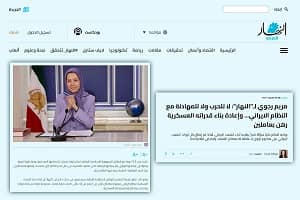
The Iranian regime is now confronted with a fundamental question from its own people: Why was the nation’s wealth poured into a nuclear project that had nothing to do with the people’s interests—and then vanished into thin air overnight?
During the 12-day war with Israel, the Islamic Republic of Iran suffered heavy losses—from the elimination of high-ranking military commanders and severe damage to its air defense systems to blows to its nuclear program, which is considered a symbol of the regime’s authority. Perhaps for the first time since the Iran-Iraq War, the regime finds itself in a truly perilous position.
Brussels Rally Calls for Support of Maryam Rajavi’s Third Option and a Democratic Republic in Iran

Brussels, Belgium – July 9, 2025 – Supporters of the Iranian Resistance including the National Council of Resistance of Iran (NCRI) and the People’s Mojahedin Organization of Iran (PMOI/MEK) gathered outside the European Parliament in Brussels to voice their opposition to the clerical regime in Tehran and advocate for a democratic alternative.
The demonstrators rallied in support of the “Third Option” proposed by Maryam Rajavi, President-elect of the NCRI, which calls for democratic change led by the Iranian people and the organized resistance movement. Rejecting both foreign military intervention and appeasement of the regime, they promoted this path as the only viable solution for a free and stable Iran.
Fariba Hosseini on Hunger Strike in Adelabad Prison, Shiraz

More than two weeks after her arrest, Fariba Hosseini, a 36-year-old dentist based in Shiraz, remains in complete legal uncertainty.
She was arrested on June 21, 2025, while writing protest slogans and is currently being held in pretrial detention at Adelabad Prison on charges of “propaganda against the state.”
In the early days of her detention, the presiding judge approved her release on 400 million tomans bail. However, despite her family having fully posted the bail amount, security officials blocked her release. In a further punitive move, the bail was arbitrarily raised to over 2 billion tomans—a sum beyond Ms. Hosseini’s financial means.
How The IRGC Steals Electricity for a Sanctions-Busting Crypto Empire
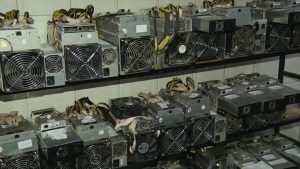
As a sweltering summer grips Iran, the regime has once again imposed rolling blackouts and power outages on millions of citizens. On July 1, the state-run power company, Tavanir, announced the return of the crippling cuts, a measure President Masoud Pezeshkian’s administration has consistently blamed on the public for “high electricity consumption.” This narrative, however, is a deliberate deception designed to mask a vast, criminal enterprise run by the Islamic Revolutionary Guard Corps (IRGC) to plunder the nation’s electricity for its own enrichment and to fund its illicit activities.
The regime’s official lie was inadvertently exposed by one of its own officials. Following a recent multi-day internet shutdown across the country, the deputy for transmission at Tavanir, made a startling admission. He revealed that during the blackout, national power consumption dropped by a massive 2,400 megawatts. More damningly, he cited reports showing that the brief internet outage in Iran caused a 5% to 12% drop in global cryptocurrency mining production.
The Iranian People’s Verdict: No to the Mullahs’ Theocracy, No to the Shah’s Monarchy

As Ali Khamenei’s cornered regime unleashes a new wave of terror following its recent humiliation, the Iranian people’s cry for a democratic future grows louder. But while the world watches the theocracy’s violent death throes, some misguided voices in the West are attempting to promote a ghost from Iran’s dictatorial past: the Pahlavi monarchy. This is a dangerous and insulting distraction. The Iranian people have unequivocally rejected this false dichotomy. Their uprising is not a negotiation between two forms of dictatorship but a resolute demand for a free and democratic republic.
On July 4, 2025, an article in the British newspaper the Express delivered a powerful analysis of Iran’s political landscape, concluding that the Iranian people refuse to “trade a turban for a crown.” The report, titled “Iran must not trade a turban for a crown – why ‘Baby Shah’ is not the answer,” affirms the long-standing position of the Iranian Resistance: the future of Iran lies not with the current theocracy or the ghosts of the past, but in a truly democratic republic.
Iran HRM Monthly Report: June 2025
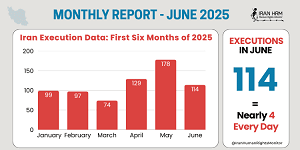
The month of June 2025 witnessed a sharp escalation in executions, mass arrests, inhumane prison conditions, and repressive measures targeting political prisoners and minorities in Iran. A total of 114 executions were carried out across the country, 95 of which were unannounced by the authorities. Six individuals were executed on espionage charges, and several acts of violence, torture, and forced disappearances of political prisoners occurred. The Islamic Republic continues its systematic use of the death penalty and arbitrary detention to suppress dissent and instill fear in the population. The Islamic Republic of Iran carried out a surge in executions during the month of June 2025, further solidifying its position as one of the world’s top executioners. A total of 114 people were executed, marking one of the bloodiest months of the year.
Execution of Lashing Sentence for Arman Shadivand
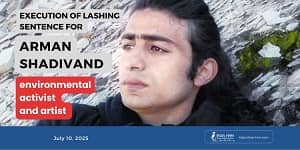
On the morning of Tuesday, July 8, 2025, the sentence of 30 lashes against Arman Shadivand, a well-known environmental activist and artist from Darreh Shahr, was carried out in the enforcement branch of the city’s prosecutor’s office. This punishment was imposed for the charge of “insulting the then-president, Ebrahim Raisi.” The action has drawn strong reactions from human rights organizations, once again highlighting the systematic repression of free expression in Iran.
Arman Shadivand had previously been subjected to multiple heavy judicial sentences. In February 2025, he was sentenced by Branch Two of the Ilam Revolutionary Court to two years of discretionary imprisonment on charges such as “propaganda against the regime” and “insulting officials,” a verdict that was upheld in the Ilam Court of Appeals in May 2025. Prior to that, in January 2025, the Ilam Revolutionary Court had sentenced him to an additional one year and four months in prison.
Tehran Choked by Dust and Pollution as Authorities Offer Little More Than Warnings

Tehran’s skies were once again shrouded in thick dust and polluted air on Wednesday, July 9, marking yet another day in a worsening environmental crisis that has transformed air pollution from a seasonal nuisance into a year-round threat. According to air quality indicators, the capital’s atmosphere reached the “unhealthy” orange level for sensitive groups—an increasingly common designation not just in Tehran, but in cities across Iran including Ahvaz, Mashhad, Karaj, Zahedan, Kashan, and Kerman.
Despite the widespread scope of the crisis, the Iranian regime’s response has largely been limited to vague advisories, such as encouraging people to remain indoors and wear masks. Some officials have even suggested that these conditions could persist through the fall, underlining a stark reality: air pollution in Iran is no longer confined to colder months but has become a persistent and dangerous feature of daily life.
Massive Losses and Ongoing Corruption: Melal Credit Institution’s Financial Collapse Raises Alarm in Iran

The Melal Financial and Credit Institution, a controversial relic of Iran’s Ahmadinejad-era banking experiment, has reported staggering losses totaling 24 trillion tomans for the fiscal year 2024. As the only surviving institution of its kind—once part of a wider network of quasi-banks that flourished under the regime’s president Mahmoud Ahmadinejad—Melal’s ongoing financial turmoil is reigniting concerns over systemic corruption and instability in Iran’s banking sector.
The latest financial statements released for the year ending 2024 show that Melal’s accumulated losses have now surpassed 24 trillion tomans (approximately $480 million USD), marking a steep and troubling trajectory. In 2022, the institution reported losses of under 8 trillion tomans. That figure more than doubled in 2023 to around 17 trillion, and now, just one year later, it has reached new highs.
Drones for the Dictatorship: How Swiss Research Fueled Iran’s Drone Program
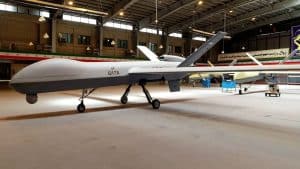
In December 2024, Italian authorities arrested 38-year-old Iranian engineer Mohammad Abedini Najafabadi in Rome. Abedini is the CEO of SDRA, a company that develops navigation systems for Iranian drones and missiles. Its main client: the Islamic Revolutionary Guard Corps (IRGC), the elite military force of the Iranian regime. Iranian drones have become a powerful export product. Russia uses them in Ukraine; Iran and its allies deploy them in attacks on Israel. These drones are cheap, effective—and powered by Western high technology. That includes components from the United States, whose origin has led investigators directly to Switzerland, and specifically, the Swiss Federal Institute of Technology in Lausanne (EPFL).