

THIS PAGE WILL BE UPDATED WITH THE LATEST NEWS
UPDATE: 9:00 PM CEST
Alleged Spy Charged with Helping Iran’s Secret Service

Counter-terrorism police have charged an alleged Iranian spy with assisting a foreign intelligence service. Vahid Aberi was charged after being arrested in the Birmingham area under the National Security Act. The 39-year-old was taken to a police station in the West Midlands. Officers carried out searches at addresses in the Birmingham and Liverpool areas before the Crown Prosecution Service authorised the charges. Mr Aberi will appear at Westminster magistrates’ court on Friday.
Commander Helen Flanagan said: “We have seen a significant and sustained increase in the tempo of our work in national security investigations in recent years.
“This case is yet another example of where we’ve intervened to disrupt suspected activity linked to foreign intelligence services.
UPDATE: 1:30 PM CEST
Dissident Group Claims Massive Cyberattack on Iranian Universities Amid Regional Tensions

A dissident student organization operating inside Iran has claimed responsibility for a large-scale cyber operation that disrupted web portals and online infrastructure at more than a dozen major universities across the country.
The group, identifying itself as Sarbedaran (“Those Bound for the Gallows”), said it targeted over 900 web portals belonging to 12 prominent higher education institutions. In statements emailed to Western news outlets and posted on its social media channels, the group explicitly aligned itself with the Mujahedin-e Khalq (MEK), also known as the People’s Mojahedin Organization of Iran (PMOI).
The operation was timed to coincide with the anniversary of the July 9–10, 1999, nationwide student uprisings, during which many students were killed by security forces under the clerical regime. It also fell on the final day of state-mandated funeral processions for former Supreme Leader Ali Khamenei, who was killed in an airstrike earlier this year.
UPDATE: 7:00 AM CEST
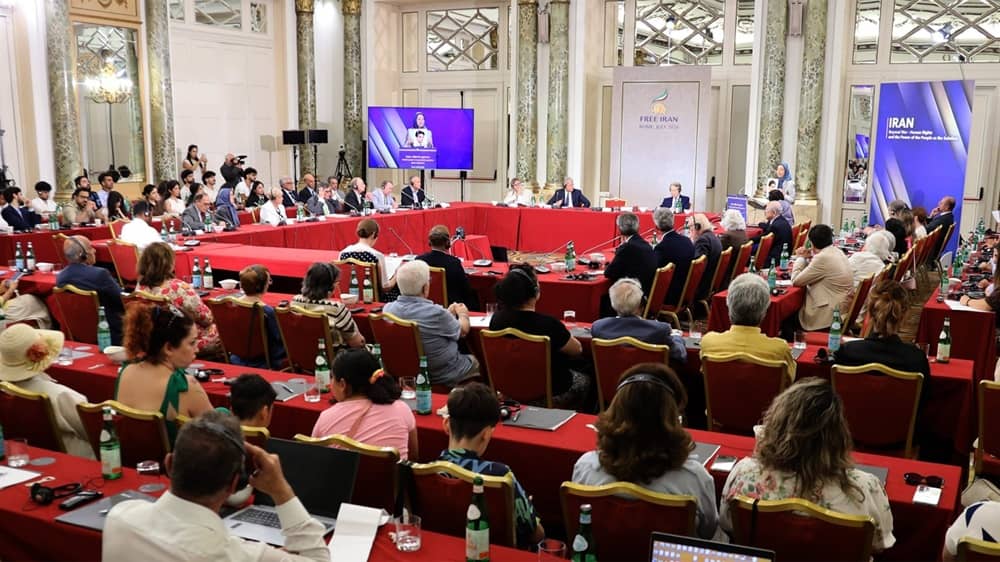
Address to the Conference: “Iran Beyond War, the Power of the People as the Solution”
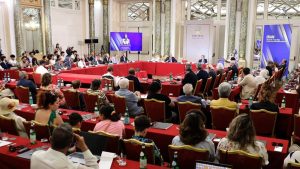
Maryam Rajavi’s speech: “Since the 1979 revolution overthrew the Shah through a genuine popular uprising, only to have its leadership hijacked by Khomeini, the developments surrounding Iran over the past 48 years have consistently had profound and far-reaching impacts on both regional and global affairs.
“Among these defining events, we have witnessed:
• The hostage-taking at the U.S. Embassy;
• The eight-year war with Iraq;
• The rise of a nationwide resistance and its relentless confrontation with clerical despotism;
• The horrific massacres and systematic executions of political prisoners;
• The regime’s relentless pursuit of nuclear weapons;
• Its destructive interventions across the Middle East;
• And its campaigns of transnational terrorism, reaching even into the heart of Europe, including the brutal assassination of Mohammad Hossein Naqdi, the representative of the National Council of Resistance, right on the streets of Rome. We honor and cherish his enduring memory.”
They Buried Khamenei. They Couldn’t Bury the Body Count

With the burial of Ayatollah Ali Khamenei, contemporary political discourse will inevitably focus on his geopolitical maneuvering, Iran’s nuclear trajectory, and prolonged confrontation with Western powers. However, an analysis restricted to statecraft overlooks the defining characteristic of his tenure: the systematic institutionalization of state-sanctioned violence.
Khamenei’s legacy is fundamentally defined by the creation of an authoritarian apparatus designed to subordinate the rule of law to regime survival. Yet, paradoxically, his relentless drive to tighten the state’s grip has exposed its deep-seated fragilities, leaving the post-Khamenei establishment weaker and more vulnerable than ever before.
Unlike autocrats who merely inherit established mechanisms of control, Khamenei was a foundational architect of the Iranian regime’s repressive apparatus. His trajectory spans the entirety of the regime’s history, serving sequentially on the Revolutionary Council, as deputy defense minister, a founding member of the Islamic Republican Party, president (1981–1989), and ultimately as supreme leader for nearly four decades. Consequently, no structural separation exists between the state’s human rights violations and Khamenei’s executive authority.
Iran: Terzi (Brothers of Italy): Rajavi Is Fighting Against a Terrorist State

“Madam Rajavi, President-elect of the National Council of Resistance of Iran, is an extraordinary beacon of freedom, democracy, equality, and pluralism.
Today, in Iran, the regime targets men, women, and young people with horrific instruments such as the death penalty in order to terrorize the entire population. It kills hundreds of thousands of its own citizens without due process. Through its vast criminal network commanded by the IRGC, it not only oppresses its own people but also destabilizes the entire region and the international community.
And yet, despite everything, the regime’s many tentacles are beginning to collapse. We have seen what is happening in Lebanon. A meeting was recently held in Rome between the principal representatives of the Lebanese and Israeli governments, and discussions are underway about substantially revising UN Security Council Resolution 1701 so that it can be effectively implemented.
The developments in Lebanon are evident, just as the developments in Syria are equally clear. The dismantling of the Alawite regime—the criminal Assad regime—has taken place. Syria no longer serves as the direct corridor linking Iran and Iraq, as it once did, when it functioned as the communication route for all the militias.”
Rudy Giuliani: “The War? It Has an Impact, but the Economy Matters More. Don’t Underestimate Donald.”

Rudy Giuliani appeared at the Sala della Regina in Italy’s Chamber of Deputies. The former mayor of New York and former attorney to Donald Trump was in Rome for a conference on Iran organized by Brothers of Italy (Fratelli d’Italia), featuring Maryam Rajavi, President-elect of the National Council of Resistance of Iran (NCRI) and the leading figure of the People’s Mojahedin Organization of Iran (PMOI/MEK), the principal opponent of the regime of the ayatollahs.
Between rounds of applause, Giuliani praised Italian Prime Minister Giorgia Meloni and dismissed recent tensions with Trump as “passing clouds.”
Why did you take part in the conference?
“I have supported a new government for Iran ever since the current regime came to power. I became acquainted with the MEK and the NCRI 14 years ago, and I have actively supported them ever since.
The NCRI and Maryam Rajavi are ready to lead the transition from a regime that has been a nightmare for the Iranian people to a democratic republic—without a king, without a dictator, and without a theocracy. They also have a Ten-Point Plan that, among other things, guarantees the elimination of the long-standing discrimination against women.”
Iran: 7th Day of Hunger Strike by Nirvana Torbati Nejad in Gorgan Prison

Nirvana Torbati Nejad, a resident of Gorgan, began her hunger strike on July 11 which has now reached its seventh consecutive day. She launched the protest to challenge her ongoing detention, the uncertainty surrounding her legal proceedings, and the prison authorities’ refusal to provide the medication she needs.
She has been charged with “propaganda against the state” and has so far been denied temporary release on bail. Torbati Nejad was arrested at her home by police officers on June 27 and was initially transferred to a detention facility operated by the State Security Force Intelligence Organization in Gorgan. She was later moved to Amirabad Prison in Gorgan.
In March 2026, Branch 1 of the Golestan Province Court of Appeals sentenced Nirvana Torbati Nejad to pay a fine of 300 million rials. In the same case, she had previously been sentenced by Branch 1 of the Gorgan Revolutionary Court to six months’ imprisonment.
Iran: Parvin Chardoli, Mother of Several Children, Executed
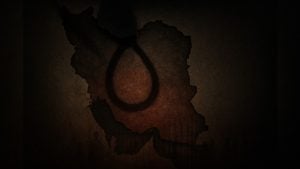
Parvin Chardoli had been arrested on December 15, 2019, for the alleged murder of her stepson.
According to an informed source, the court knew that Parvin had not committed the murder, but since she refused to name the perpetrator, she was sentenced to death. With the hanging of Parvin Chardoli at Ghezel Hesar Prison, the number of women executed in the 2026 calendar year has risen to seventeen. According to data recorded by the Women’s Committee of the National Council of Resistance of Iran, at least 345 women have been executed in Iran since 2007.
Many of the women executed by the Iranian regime are themselves victims of domestic violence and discriminatory family laws. A significant number have acted in self-defense.
Since Masoud Pezeshkian took office, the clerical regime has executed more than 3,900 prisoners, including 105 women.
Widows in Iran: An Analysis of Legal Challenges and the Structure of Discrimination
Introduction: In the political and legal structure governing Iran, misogyny and gender discrimination have been institutionalized as a fundamental principle, heavily impacting the fabric of family and society. In the midst of this crisis, widows in Iran and female-headed households remain among the most vulnerable segments of society. Following the loss of a spouse, they are suddenly abandoned within a government support vacuum and subjected to a barrage of the regime’s medieval laws. This article examines the legal dimensions and contradictory statistics surrounding the crisis of widows in Iran.
In the Iranian legal system, where gender-based discrimination is deeply entrenched, women are not recognized as heads of household. As a result, when a woman becomes a widow, she is not only burdened with the emotional weight of her loss, but is also thrust into a web of economic, social, and legal challenges. In this context, widowhood becomes more than a personal tragedy—it is treated as a social stigma.
Iran’s Power Crisis Costs Industry Billions as Blackouts Deepen Economic Decline

Iran’s worsening electricity crisis is inflicting unprecedented damage on the country’s industrial sector, with new government figures showing that production losses have reached staggering levels. As rolling blackouts continue across the country, manufacturers are warning of declining output, rising unemployment, and growing pressure on an economy already burdened by inflation and chronic mismanagement. The latest estimates underscore how years of poor planning, underinvestment, and distorted energy policies have transformed electricity shortages from a seasonal inconvenience into one of the regime’s most serious economic failures.
Ezzatollah Zarei, spokesperson for the Ministry of Industry, Mine and Trade, announced that industrial revenue lost because of power outages increased from approximately 300 trillion tomans in 2024 to nearly 400 trillion tomans in 2025.
According to remarks reported by ILNA, the energy crisis has affected manufacturing sectors unevenly, with industries that rely on continuous production suffering the greatest losses. Facilities such as steel, petrochemical, cement, and other heavy industries cannot simply restart production after unexpected power interruptions without incurring significant operational and financial costs.
Kolang Gaz La: Billions Spent on a Secret Nuclear Fortress While Iranians Sink into Poverty
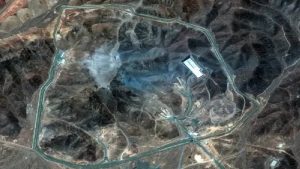
As the Iranian regime pours vast resources into one of its deepest underground nuclear complexes, ordinary citizens continue to bear the cost through deepening poverty, economic collapse, and international isolation.
The Iranian regime’s massive underground nuclear complex beneath Kolang Gaz La Mountain has once again become the focus of international attention. Recent reports indicate that the site—one of the deepest and most heavily fortified facilities associated with the regime’s nuclear program—has emerged as a potential military target as Washington reassesses Tehran’s nuclear ambitions.
Yet beyond its strategic and military significance lies another pressing question: How much has this secret project cost the Iranian people? While the regime allocates billions of dollars to constructing fortified underground facilities, millions of Iranians continue to struggle with inflation, unemployment, collapsing public services, and growing poverty.
CENTCOM Announces End of Sixth Round of Strikes on Military Targets in Iran
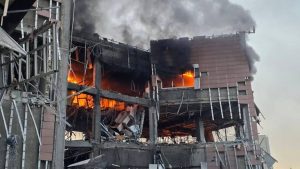
U.S. Central Command (CENTCOM) announced that its large-scale overnight operation against military targets in Iran, which began at 9:30 p.m. Iran time on Thursday, concluded at 5:10 a.m. on Friday. According to CENTCOM’s statement, dozens of military targets, including air defense systems, military logistics infrastructure, and coastal radar facilities, were struck and destroyed.
At the same time, the state-run Fars News Agency reported that several transportation bridges in Hormozgan Province were damaged in the U.S. strikes. According to the report, the Gariveh Bridge on the Bandar Abbas–Khamir–Lar route, the bridge on the return route from Bandar Abbas–Khamir–Lar after Latidan village, two bridges on the Kahourestan–Lar route, an unfinished bridge on the Bandar Khamir–Keshar–Bandar Abbas road, and the Marou village bridge in Khamir County sustained either partial or complete damage. Iranian domestic media also reported that at least seven people were killed and several others were wounded in the attacks.
How Sanctions Made Tehran a Hidden Playground for Billionaires

While global sanctions and hyper-inflation crushed Iran’s middle class, they served as a massive wealth multiplier for the elite. Behind towering concrete walls and private security checkpoints, a protected plutocracy has engineered a sanctions-proof paradise of extreme luxury, social autonomy, and deep political influence.
If you drive north from the dusty, smog-choked highways of southern Tehran toward the foothills of the Alborz Mountains, the shift in atmosphere is far more than a change in altitude. You are crossing a border between two completely different worlds. To the outside observer whose view of Iran is shaped entirely by international news, Tehran is a city trapped in the chokehold of endless sanctions, crushing inflation, and a collapsing national currency. But this is only part of the story. Behind towering concrete walls, heavily guarded security gates, and countless surveillance cameras lies a Tehran that looks less like a sanctioned capital and more like the sun-drenched hilltops of Malibu or the exclusive cliffs of Monaco.