

THIS PAGE WILL BE UPDATED WITH THE LATEST NEWS
UPDATE: 10:00 PM CEST
The Prince Without a Country: Why Reza Pahlavi Has Failed Iran’s Democratic Cause

Every crisis inside the Islamic Republic, every uprising, every confrontation with the West has produced another round of media appearances proclaiming that his moment has finally arrived. Each prediction has dissolved into disappointment.
The latest Reuters investigation has merely confirmed what many Iranians have argued for years. Beneath the multi-million dollar polished public relations campaign lies a political project built on contradiction, personality and inherited privilege, rather than democratic legitimacy.
Iran’s future demands leadership forged through sacrifice. Reza Pahlavi offers inherited status. That distinction could hardly matter more.
For 48 years he has lived comfortably in Western exile while generations of courageous Iranians have endured imprisonment, torture, execution and persecution. Young women have faced bullets for demanding basic freedoms.
UPDATE: 7:30 AM CEST
Iran’s Regime Intensifies Persecution of Political Prisoners in Fear of Uprisings

In tandem with a rising wave of executions targeting supporters of the People’s Mojahedin Organization of Iran (PMOI/MEK) and rebellious youths, the ruling religious fascism in Iran has dramatically intensified its pressure on political prisoners. The regime is now using forced transfers, inhumane deprivations, and internal exile to systematically torment detainees and their families.
On August 3, 2026, authorities transferred 100 prisoners, mostly ordinary criminals, from Fashafouyeh (Greater Tehran Prison) into the political prisoners’ wards at Evin Prison. This deliberate measure was designed specifically to harass and endanger political inmates. A day prior, on August 2, Afshin Rangriz Heirati, a political prisoner supporting the PMOI, was forcibly moved from Evin’s Ward 2 into a ward housing ordinary criminals.
The psychological and physical torment extends far beyond the capital. In Rasht’s Ziabar Prison, Sattar Babaei, another PMOI supporter, has been held in legal limbo for five months. At the time of his arrest in March 2026, regime agents plundered his personal belongings, looting his mobile phone, laptop, and even his house deeds. Furthermore, the regime has escalated the use of forced exile. On August 3, political prisoner Hojjat Alizadegan was banished from Yazd Prison to Saravan Prison, while Abdolsalam Shahmiri was exiled from Zahedan Prison to Iranshahr Prison.
How Runaway Inflation and Structural Decay Are Impoverishing Iran’s Working Class
Unbridled price expansion, the relentless erosion of real wages, and deep-seated systemic imbalances have combined to push nearly half of Iran’s populace to the brink of financial insolvency. The traditional buffer between employment and destitution has largely collapsed; full-time compensation no longer covers baseline household expenditures. What was once a condition confined to the frictionally unemployed or disenfranchised strata has now absorbed millions of breadwinners, forcing families to balance multiple jobs simply to maintain a basic standard of living.
The proliferation of secondary and tertiary employment serves as a primary barometer of this economic strain. Ride-hailing platforms demonstrate the scale of workforce overextension: combined registration data from Iran’s ride-hailing apps Snapp (exceeding 8.5 million drivers by early July 2026) and Tapsi (roughly 1.4 million) indicates that nearly 10 million individuals are enrolled across both services. Surveys reveal that over 86 percent of these drivers operate on the platforms as a supplementary or tertiary revenue stream, highlighting a systemic necessity where formal employment fails to meet minimum subsistence requirements.
Sexual Apartheid in the Laws of Iran’s Clerical Regime – Part 1

At a time when the world is moving toward the abolition of the death penalty, and when the number of women executed in other countries remains in the single digits, the religious dictatorship ruling Iran set a new record of brutality in 2025 by executing 65 women.
The fundamental question is why the fate of these women ends at the gallows.
The answer cannot be found solely in the solitary confinement cells of Qarchak or Evin prisons, nor in the psychological condition of the victims themselves. Rather, it must be sought in legal texts that define “woman” not as a free human being, but as the property of men and a matter of so-called religious expediency. Every knot tightened on the noose of an Iranian woman was first woven into the most foundational laws of this regime.
In this booklet, prepared for CSW70, the NCRI Women’s Committee demonstrates, through a meticulous examination of the clerical regime’s laws, how the mullahs have systematically sealed off access to justice for Iranian women through layers upon layers of misogynistic legislation.
Iran Regime’s Internal Power Struggle Deepens Five Months After Khamenei’s Death

Five months after the death of Ali Khamenei, Iran’s ruling establishment is experiencing one of its most severe internal crises in decades. Public disputes among senior officials, competing political factions, state media, and clerical institutions have intensified, revealing a leadership struggling to maintain cohesion under mounting political and social pressure.
What had long been managed behind closed doors has increasingly spilled into the public arena. Rival factions now openly accuse one another of betrayal, weakness, and even attempts to seize power, illustrating the growing instability surrounding the country’s hereditary leadership.
The widening divisions have become so pronounced that even routine policy issues have turned into battlegrounds for political infighting. Statements by senior officials are quickly met with denunciations from rival factions, leaving the regime unable to project a unified position on key national issues.
The latest dispute centers on the regime’s reported memorandum of understanding with the United States. President Masoud Pezeshkian described the agreement as the product of “collective wisdom” and consensus within the Supreme National Security Council, portraying it as a decision reached through institutional coordination.
Poverty in Iran Deepens as Millions of Working Families Struggle to Survive

Poverty in Iran is no longer confined to the unemployed or marginalized. Increasingly, it has become the reality of millions of working families who find that even holding multiple jobs is not enough to cover basic living expenses. As inflation continues to erode purchasing power and the economy remains mired in structural crisis, a growing share of the population is being pushed below the poverty line.
From ride-hailing drivers working late into the night after their regular jobs to rural households struggling with drought and collapsing agricultural incomes, the country’s economic deterioration has become a nationwide crisis affecting both urban and rural communities.
One of the clearest signs of Iran’s worsening economic conditions is the explosion of second and third jobs among employed workers.
According to official figures from Iran’s largest ride-hailing platforms, Snapp had more than 8.5 million registered drivers by early July 2026, while Tapsi reported around 1.4 million drivers. Combined, nearly 10 million people are registered on the two platforms.
Iran Faces Another Winter Energy Crisis as Billions of Dollars in Natural Gas Go Up in Flames
Even before summer has ended and Iranians have recovered from months of rolling electricity blackouts, officials are already warning of another severe natural gas shortage this winter. The prospect of renewed energy rationing underscores a long-running contradiction: despite holding the world’s second-largest proven natural gas reserves, Iran continues to struggle to meet domestic demand while wasting enormous quantities of valuable gas through flaring.
Experts say years of underinvestment, deteriorating infrastructure, and policy failures have left the country increasingly vulnerable to recurring energy crises, while billions of dollars in national wealth are literally burned into the atmosphere each year.
Mohammad Jafar Ghaem-Panah, executive deputy to President Masoud Pezeshkian, recently acknowledged that Iran is expected to face a daily natural gas deficit of approximately 100 million cubic meters during the coming winter.
“Even if the coming winter is not particularly cold, the country will still face an energy deficit that must be managed.”
Ghaem-Panah linked part of the expected shortage to damage sustained by refineries during recent military conflict. However, Iran has experienced recurring winter gas shortages for years, long before those events.
Iranian State-Affiliated Media Alleges Powerful Network Seeking Control Over Oil and Currency Markets
A report published by the Iranian website Bulletin News (Bolten News) has alleged the existence of a powerful economic-political network that has steadily expanded its influence across Iran’s oil industry, financial institutions, regulatory bodies, and overseas commercial operations.
The report, published inside Iran, describes a far-reaching network that allegedly seeks not only to accumulate wealth but also to consolidate political power by influencing key state institutions. While the publication does not identify the individuals leading the network, it portrays the organization as deeply embedded within strategic sectors of the regime.
According to Bulletin News, the network initially accumulated wealth through privileged access to major industries, including automobile manufacturing, urban development projects, municipal institutions, real estate, refineries, and petrochemical companies.
“The objective of this network is not merely economic gain, but also the acquisition of political power through influence over key institutions.”
Construction Material Prices in Iran Increase by 100%

Iraj Rahbar, head of the Tehran Mass Builders Association, said that following the U.S. and Israeli attacks on Iran, the price of construction materials in the country has increased by 100%.
Rahbar added that under the current conditions, developers are unable to launch new projects and are only trying to complete projects that are already under construction.
According to him, since March 2026, the prices of construction materials, production inputs, and labor wages have risen at an unprecedented pace, sharply increasing construction costs.
The head of the Tehran Mass Builders Association emphasized that for some petrochemical-related products, the increase has exceeded 100%.
He said the construction cost per square meter in Tehran is approximately 550 million rials (about $293) under the best conditions, while in some projects it ranges between 600 million and 700 million rials (about $320 to $373).
US Claims Strait of Hormuz Deal Is Imminent, But Gulf Officials Call Odds “50-50”

MUSCAT / TEHRAN / WASHINGTON — Following days of intense behind-the-scenes diplomatic consultations, Iran and Oman have reached an initial agreement to define the geographical coordinates of a new shipping route in the Strait of Hormuz—a step that could serve as the first opening in a paralyzing global energy and maritime crisis. However, contrary to claims by US President Donald Trump that a deal to reopen the waterway would be reached within 24 to 48 hours, diplomatic officials in Tehran and Muscat clarify that finalization of this temporary plan requires the lifting of the blockade on Iranian ports and the non-interference of third parties.
According to official statements and briefings by Esmaeil Baghaei, spokesperson for the Iranian Ministry of Foreign Affairs, on August 5, 2026, the two countries have prepared a draft joint statement that completely redefines how vessels navigate the passage. Under this plan, a new transit corridor in the Strait of Hormuz has been designated whereby all inbound vessels entering the Persian Gulf will pass through a northern route under the control and supervision of the Iranian Navy. Conversely, all outbound vessels heading toward the Sea of Oman will travel along a southern route managed and supervised by Oman.
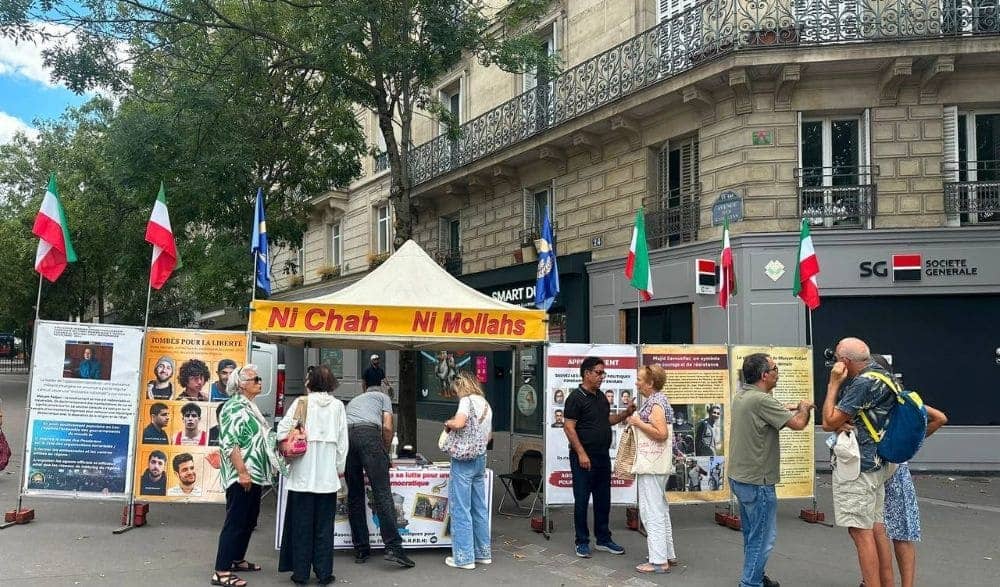
In Paris, PMOI Supporters Hold Exhibition Condemning Executions and Calling for a Free Iran
Paris, France – August 5, 2026 – Supporters of the People’s Mojahedin Organization of Iran (PMOI/MEK) set up a book table and photo exhibition condemning the execution of political prisoners, as well as protesters arrested during the January 2026 uprising. The event highlighted the Iranian people’s call for a democratic republic under the leadership of the Iranian Resistance as a path to peace, freedom, and justice.

Organizers called on the French public and the international community to recognize the suffering of the Iranian people and their firm rejection of all forms of dictatorship, whether monarchical or theocratic. Through powerful images and personal testimonies, the exhibition showcased the courage and sacrifices of participants in the January 2026 uprising while denouncing the regime’s ongoing human rights violations, including the execution of political prisoners.