

THIS PAGE WILL BE UPDATED WITH THE LATEST NEWS
UPDATE: 11:00 PM CEST
Spanish Court Says Attempt on Former Politician’s Life Linked to Opposition to Iran Leadership
MADRID, July 9 (Reuters) – Spain’s High Court charged eight individuals on Wednesday with the attempted assassination of former right-wing politician Alejo Vidal-Quadras over his ties to an Iranian opposition group and support for dissident groups.
Vidal-Quadras, 80, a founder of Spain’s far-right Vox party, was shot in the face by a motorbike pillion passenger as he walked through Madrid’s upscale Salamanca neighbourhood on November 9, 2023. The bullet passed through his jaw.
Investigating judge Santiago Pedraz said the assault was ordered by unidentified individuals seeking revenge for Vidal-Quadras’ advocacy for resistance to Iran’s clerical government.
“Unidentified individuals instructed members of the criminal organisation…to carry out ‘a mission’ consisting of ending the life of Alejo Vidal-Quadras,” the judge said in a court document seen by Reuters.
UPDATE: 3:30 PM CEST
Iran Shuts Out Nuclear Monitors in Tactics Echoing Cold War

Iran is said to be cutting off communication with key United Nations watchdog officials, deepening uncertainty over the status of its nuclear program and introducing additional ambiguity to the diplomatic showdown with Washington.
After formally ending inspections by the International Atomic Energy Agency last week, Iranian nuclear-safety regulators have stopped taking calls from the Vienna-based agency, according to two officials who asked not to be identified discussing sensitive information. The IAEA’s Incident and Emergency Centre was activated after Israel’s June 13 attack and had been in continuous contact with counterparts in Iran, but that information sharing has tailed off, they said.
Iran Leans on Hacktivist Proxies in Wake of Israeli, U.S. Strikes

Iranian state-backed hackers are borrowing from the Russian cyber playbook and sharing tools with ideologically aligned hacktivist groups in the wake of a series of military strikes, experts tell Axios.
Why it matters: Leaning on these hackers allows Iran to amplify its reach while maintaining plausible deniability and staying below the threshold of what’s considered war.
Driving the news: Iran-linked hackers threatened last night to publish emails purportedly stolen from Trump allies, including White House chief of staff Susie Wiles, lawyer Lindsey Halligan and adviser Roger Stone.
- CISA and the FBI released an advisory yesterday warning U.S. critical infrastructure, and particularly defense contractors, are at increased risk for potential Iran-linked cyberattacks.
The intrigue: Experts at cybersecurity firm Armis say they’ve observed Iranian nation-state actors providing tools and resources to pro-Iran hacktivist groups since Israel launched military strikes on June 13.
Iran Says It Can Strike the US And Israel for Two Years. Does It Really Have That Power?

Even amid a fragile ceasefire, Iran continues to warn the United States and Israel that it retains the ability to inflict serious damage if provoked. Iranian officials have declared the country can sustain daily missile strikes for two years — a claim drawing increasing scrutiny from military experts and Western intelligence analysts.
“Our armed forces are at the height of their readiness,” said Major General Ebrahim Jabbari of the Islamic Revolutionary Guard Corps (IRGC), speaking to the semi-official Mehr News Agency. “The warehouses, underground missile bases, and facilities we have are so enormous that we have yet to demonstrate the majority of our defense capabilities and effective missiles.”
But intelligence analysis suggests Iran’s claims mask serious losses.
Tehran began the conflict with an arsenal of about 3,000 missiles and 500 missile launchers to 600 missile launchers, according to open-source intelligence. By the end of the so-called “12-Day War” — a series of attacks by Israel on its military storage warehouses and production facilities followed by U.S. attacks on nuclear sites and Iran’s counterattacks — it was down to between 1,000 missiles and 1,500 missiles and only 150 launchers to 200 launchers.
UPDATE: 8:00 AM CEST
The Regime’s Real War Is on the Iranian People’s Dinner Table

As the clerical regime in Tehran increasingly beats the drums of war, a far more dangerous conflict is already raging within Iran’s borders. The administration of Masoud Pezeshkian, installed to project a facade of moderation, is utterly incapable of addressing the real crisis: a catastrophic economic collapse born from decades of corruption and plunder. The regime’s desperate attempts to use the specter of an external enemy as a distraction are failing, as the social pressures from within build toward an inevitable explosion.
The regime’s policies have gone far beyond mere economic mismanagement; they constitute a psychological war on the Iranian people. A recent report in the state-run Arman Melli newspaper on July 7, 2025, titled “The Shrinking of the Middle Class,” details the profound social damage. It describes a population gripped by “widespread anxiety, depression, and hidden anger” stemming from a complete loss of financial security and hope for the future. The paper soberly concludes that the true war being waged against the Iranian people is not fought with bullets and bombs, but with “continuous economic pressure, the erosion of hope, psychological attrition, and social isolation.” This systemic assault is hollowing out Iranian society, leaving a desperate and angry populace in its wake.
Maryam Delbari Detained under Pressure in Adelabad Prison without Access to Medical Care

Nearly two months after her arrest, Maryam Delbari — a writer and former head of the Abadan Art Bureau — remains arbitrarily detained in Shiraz’s Adelabad Prison, with no transparent legal process in sight.
A cultural figure and outspoken political critic, Maryam Delbari was arrested on May 7, 2025, by security forces and interrogated at a Ministry of Intelligence facility under charges of “propaganda against the state.” She was later transferred to prison.
Her detention sparked a protest by a group of her students outside the Ministry of Intelligence’s detention center in Shiraz. However, not only were these protests ignored, but Delbari’s interrogation and transfer to prison reportedly involved intimidation and pressure.
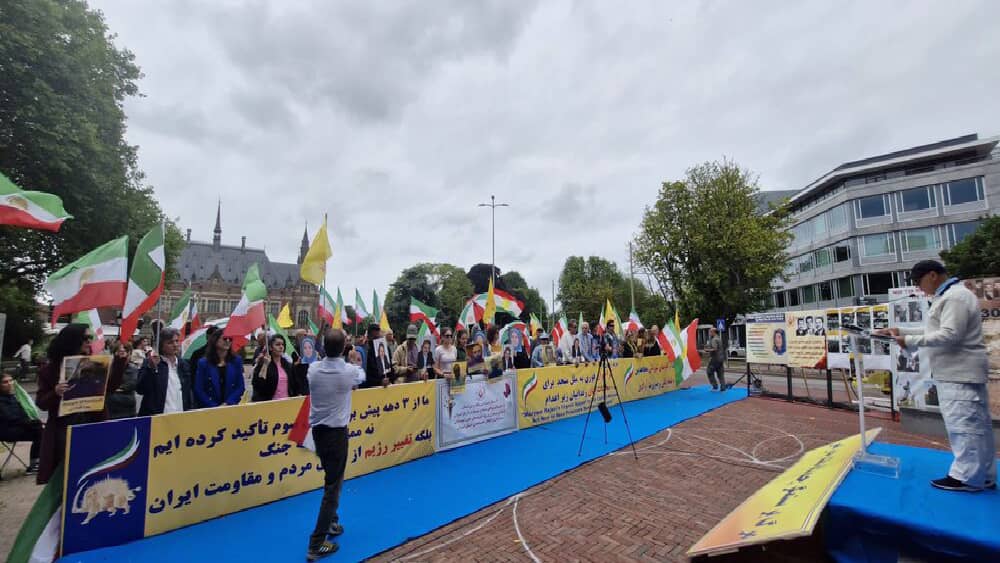
MEK Supporters Rally in The Hague to Demand Justice and Endorse Maryam Rajavi’s Third Option for Iran
The Hague, Netherlands – July 5, 2025: Supporters of the People’s Mojahedin Organization of Iran (PMOI/MEK) held a powerful rally to protest the Iranian regime’s escalating human rights abuses, focusing especially on the recent death sentences handed down to political prisoners. Participants expressed their unity against appeasement, firmly rejecting war and reaffirming their commitment to freedom.
MEK Supporters Rally in The Hague to Demand Justice and Endorse @Maryam_Rajavi’s Third Option for #Iran#NCRIAlternative #IranThirdOption #StopExecutionsInIran #FreePoliticalPrisoners #FreeIran2025https://t.co/w14Nlrh7lq
— Iran Freedom (@4FreedominIran) July 8, 2025
They called for a regime change led by the people through organized Resistance Units and the National Council of Resistance of Iran (NCRI) as a credible alternative. Highlighting Maryam Rajavi’s “Third Option“, they rejected both the Shah and the mullahs and voiced their determination to establish a free and democratic republic based on Mrs. Rajavi‘s ten-point plan.
Heidelberg Exhibition Protests Iran Regime’s Human Rights Violations, Urges Global Action
On July 5, 2025, in Heidelberg, Germany, supporters of the People’s Mojahedin Organization of Iran (PMOI/MEK) organized an exhibition to denounce the escalating human rights abuses by the Iranian regime, particularly the rising number of death sentences imposed on political prisoners.
#Heidelberg Exhibition Protests #Iran Regime’s #HumanRightsViolations, Urges Global Action#StopExecutionsInIran #FreePoliticalPrisoners #FreeIran2025https://t.co/8BDG7udU2p
— Iran Freedom (@4FreedominIran) July 8, 2025
The event strongly condemned the regime’s systemic repression and called for the immediate release of all political detainees. Attendees honored the martyrs of the Iranian Revolution—those who were executed or lost their lives during uprisings for freedom and justice.
Participants—freedom-loving Iranians residing in Germany—reaffirmed their commitment to establishing a democratic republic in Iran. They rejected all forms of dictatorship, including both theocratic rule and the possibility of restoring a monarchy.
Iranian Resistance Rally in Geneva Urges End to Executions, Supports NCRI as Democratic Alternative

Geneva, Switzerland – July 5, 2025 – Supporters of the People’s Mojahedin Organization of Iran (PMOI/MEK) held a rally and exhibition at Place des Nations, in front of the United Nations Office in Geneva, to protest the Iranian regime’s escalating use of the death penalty—particularly against political prisoners.
Participants called for the immediate and total abolition of capital punishment in Iran and the unconditional release of all political detainees, especially those facing imminent execution. They also demanded that the regime’s leaders be prosecuted in an international tribunal for crimes against humanity.
Judiciary Under the Microscope of Justice – Part 1

For over four decades, the judicial system of Iran’s religious–authoritarian regime has functioned not as a guardian of justice, but as a ruthless instrument for repression, executions, torture, and the systematic elimination of critics, political dissidents, ethnic and religious minorities, as well as intellectuals and artists. From the Revolutionary Courts to the security branches within prisons, from Khalkhali and Gilani to Ejei, Raisi, and Salavati, “justice” in this system has never aimed to uphold the rule of law, but rather to sustain the dominance of the Supreme Leader and consolidate absolute religious power.
This investigative and documented report, presented in several chapters, examines the formation, legal structure, and political function of the judiciary within Iran’s apparatus of repression. It also includes separate sections introducing key figures among the repressive judges, including members of the “Death Commissions” responsible for the 1988 massacre, the 2022 uprising trials, and ongoing judicial crackdowns.
IRGC Spy’s Secret Trip to Iran After Spying on Jewish Targets in Germany Exposed

Germany’s Bild newspaper has reported that Ali S., an Afghan-Danish citizen recently arrested in Denmark on charges of spying for the Islamic Revolutionary Guard Corps (IRGC), had previously traveled to Iran and handed over intelligence on Jewish targets in Berlin to Iranian regime agents.
On Sunday, July 6, Bild published a report detailing Ali S.’s activities and how he was identified and arrested in Aarhus, Denmark.
According to the report, in June 2025, this Afghan-Danish national entered Iran under the cover of a family trip to Turkey. After delivering the gathered intelligence on Jewish targets in Berlin to regime officers, he left Iran using falsified documents, avoiding any official passport stamp.
Italian Media Reveals Scope of Iranian Regime’s Espionage and Propaganda Network in Italy

The Italian news website Linkiesta has reported that the Iranian regime has established a shadowy and complex network in Italy, using cultural diplomacy, religious centers, academic partnerships, ideological propaganda, and digital operations to monitor dissidents and expand its influence.
In an investigative report published on Monday, July 7, Linkiesta wrote that multiple accounts have surfaced of threats, surveillance, and pursuit of Iranian regime opponents in Rome, Milan, and other Italian cities.
The report quotes an Iranian woman opposed to the regime saying: “After the protests, I was followed, my phone stopped working, and my family in Iran was threatened.”
Mass Death Sentences in Iran: Five Kurdish Men Face 12 Executions and 75 Years in Prison After Unfair Trial

The Revolutionary Court of Urmia, under the supervision of Judge Reza Najafzadeh, has sentenced five Kurdish Iranian citizens from the city of Bukan to a total of 12 death sentences and 75 years in prison. The verdict, one of the most severe issued in recent years, was formally communicated to the defense lawyers on July 7, 2025. The convicted individuals—Soran Ghasemi (Ali), Pejman Soltani, Kaveh Salehi, Rezgar Beigzadeh Babamiri, and Tayfour Salimi Babamiri—were all arrested during the nationwide protests of 2022. According to their families and legal representatives, they were subjected to prolonged solitary confinement, intense interrogations, physical and psychological torture, and months of enforced disappearance in detention centers run by Iran’s Ministry of Intelligence and the Islamic Revolutionary Guard Corps (IRGC).
Iran’s Economic Collapse: Regime Monopoly, War Fallout, and the Institutionalization of Poverty

Iran’s economy, long burdened by state monopolization and misguided policies, has veered off the path of sustainable development and descended into a crisis marked by structural imbalances and pervasive poverty.
While these challenges predate the recent Iran-Israel war, the devastating 12-day conflict has deepened the economic wounds, accelerating the nation’s decline into a state of near collapse.
At the core of this economic decay is the regime’s monopolistic control over the country’s wealth and resources. By dominating underground assets such as oil and gas, and aboveground industries including petrochemicals, steel, and automotive, the regime has systematically excluded the private sector from meaningful participation.
Iran’s Class-Based Internet: How the Regime Is Institutionalizing Digital Discrimination

The complete shutdown of the international internet in Iran during the recent 12-day Iran-Israel war has once again thrust the regime’s “class-based internet” policies into the national and international spotlight.
While access to the global internet was abruptly cut off for most citizens, evidence suggests that select individuals and institutions remained fully connected—a revelation that has sparked widespread backlash and renewed fears over the regime’s growing control of cyberspace.
In the midst of the blackout, many internet-based businesses and IT leaders called for alternatives to blanket restrictions. They proposed a more “targeted” approach to managing access—essentially advocating for segmented, tiered internet availability based on profession or purpose.