

THIS PAGE WILL BE UPDATED WITH THE LATEST NEWS
UPDATE: 9:00 PM CEST
Iran Allegedly Used Soccer Clubs to Spy on Citizens, Opposition Group Urges FIFA Ban Regime Before World Cup

EXCLUSIVE: Iran’s Islamic Revolutionary Guard Corps (IRGC) has allegedly used the country’s soccer system to spy on citizens, potentially violating FIFA bylaws, according to a new report from a major opposition party.
The National Council of Resistance of Iran (NCRI)’s U.S. office provided the report to Fox News Digital. It outlines an alleged plot for Iran’s soccer federation and top clubs to be drawn into a broader state security apparatus, and that at least 15 IRGC commanders have been formally documented and identified in soccer club management.
The NCRI, citing alleged official IRGC documents, accuses the IRGC of using clubs, stadium infrastructure and security-linked management posts to monitor fans, suppress dissenting athletes and violate FIFA rules on political interference.
The report alleges facial-recognition technology and other devices and tracking systems were used to monitor spectators. The report cites alleged internal Iranian security documents, including Tehran Province Security Council material from 2025 and a Sarallah Headquarters security plan from 2024.
UPDATE: 6:00 PM CEST
Iran’s Execution Machine Is Running at Full Speed

As diplomats debate ceasefires, nuclear agreements and regional security, another crisis is unfolding inside Iran with alarming speed. While global attention remains fixed on war and negotiations, the clerical regime has launched one of its most extensive campaigns of political executions and repression in recent memory. Young protesters, political activists, students and opposition supporters are being sent to the gallows while much of the democratic world remains distracted.
The surge in executions should be a matter of grave concern for every civilized nation. Instead, silence prevails as governments hold their breath, waiting for the latest twist in Donald Trump’s on-again, off-again peace initiative and hopes of an end to conflict involving Iran. Meanwhile, Tehran’s rulers are using the cover of international distraction to intensify their campaign of terror against their own people.
UPDATE: 8:30 AM CEST
Facing The Gallows, Boxing Champion Mohammad Javad Vafaei Sani Sends a Message of Unyielding Resistance

The life of political prisoner and national boxing champion Mohammad Javad Vafaei Sani is in grave danger in Mashhad’s Vakilabad Prison, yet his resolve remains unbreakable. The 30-year-old athlete and coach was arrested in January 2020 following nationwide protests and was subjected to 65 days of intense physical and psychological torture aimed at extracting forced confessions regarding his support for the People’s Mojahedin Organization of Iran (PMOI/MEK).
In a blatant travesty of justice driven by the Ministry of Intelligence, Vafaei’s death sentence has been upheld for a third time. The legal proceedings have been so deeply flawed that even the regime’s own Supreme Court was forced to overturn the death sentence twice—first in late 2022 and again in mid-2024. However, yielding to the unlawful interference of security services who are determined to secure a political execution, the regime’s judiciary has once again confirmed his death sentence and rejected his request for a retrial.
Despite sitting on death row and facing imminent execution, Vafaei Sani has fearlessly insisted that his voice be heard, regardless of the consequences. In a newly published letter sent from prison, he issued an urgent and moving plea: “You didn’t broadcast my previous messages. I beg you, in the most sensitive moments of my life, let this one be broadcast.”
Parisa Kamali: “Executions Cannot Silence the Cry for Freedom”
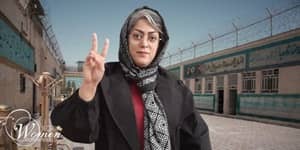
Parisa Kamali, a political prisoner currently serving an eight-and-a-half-year sentence in the Central Prison of Yazd, has released a powerful audio message from behind bars to condemn the recent surge of executions carried out by the clerical regime. In her message, she described the state’s execution machinery as an obsolete tool for regime survival, asserting that it will ultimately fail against the collective will of “the countless.”
Kamali, who is enduring harsh conditions in internal exile at Yazd Prison for her commitment to pro-freedom ideals, reaffirmed her unbreakable bond with those who have lost their lives fighting for freedom. Paying tribute to these fallen individuals, she characterized the death penalty as a desperate authoritarian response to the public’s demands for justice.
“Severed be the hands that sign away human breath with their pens,” Kamali said, describing the perpetrators as entities whose survival depends entirely on shedding blood.
Iran Child Abuse Crisis: Brutal Abuse of Girls Triggers Outrage
A shocking new case has once again intensified the Iran child abuse crisis, following horrific reports of violence against two girls, aged 15 and 7, in Sanandaj that left the public in shock and outrage. What Narin and Aylin endured is not merely a family tragedy; this case has once again drawn attention to the broader system failures and the inefficiency of child protection mechanisms.
The Sanandaj tragedy demonstrates how the lack of effective social and legal protection, particularly for girls, can leave repeated warnings about violence unanswered for years.
The story of Narin and Aylin, two sisters from Sanandaj, the capital of western province of Kurdistan, entered a bitter phase following their parents’ divorce and the assignment of their custody to the father. According to reports, during the years spent living with their father and stepmother, these two children were repeatedly subjected to physical violence and abuse.
Neighbors had repeatedly reported the matter to the responsible authorities, but the follow-ups yielded no results. They state that the father, while denying the reports, prevented officials from entering the house, which disrupted the process of investigating the children’s living conditions.
Iran’s Economic Crisis Deepens as Experts Warn of Inflation, Poverty, and Structural Failure
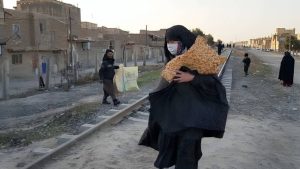
Iran is facing one of the most severe economic crises in its modern history. While the country possesses vast natural resources, a strategic geographic location, and a large, educated workforce, economists and policy experts increasingly warn that these advantages are being overshadowed by deep structural weaknesses, policy failures, and mounting political uncertainty.
Recent discussions among economists inside Iran suggest that the country’s economic difficulties are no longer viewed as temporary disruptions or the product of a single crisis. Rather, they are seen as the result of decades of accumulated problems that have steadily undermined economic growth, investment, and public welfare.
These concerns were prominently featured during the “Iran Economic Outlook 1405” conference, organized by the economic newspaper Donya-e-Eqtesad. Economists, researchers, and business experts gathered to assess the country’s prospects and discuss challenges ranging from inflation and currency instability to investment, employment, trade, and the future of Iran’s digital economy.
For ordinary Iranians, perhaps the most visible consequence of the current crisis is the relentless rise in prices.
In the weeks following the recent ceasefire, inflation and the declining purchasing power of households have become major public concerns. Participants at the conference repeatedly identified government fiscal policies as a central factor behind inflationary pressures.
The Myth of Power: Why Tehran’s Claims of Strength Mask a Deepening Crisis
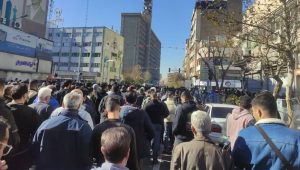
For authoritarian systems facing existential crises, projecting strength often becomes a substitute for possessing it. When political legitimacy erodes, economic failures accumulate, and social unrest expands, governments frequently turn to grandiose rhetoric in an attempt to compensate for declining authority.
The current situation of Iran’s regime reflects precisely this dynamic. Despite mounting domestic and regional challenges, regime officials continue to portray their system as a victorious and rising power. State-controlled media and government figures repeatedly speak of strategic success, national resilience, and regional influence. Some have even gone so far as to describe Iran as one of the world’s leading powers.
Yet the growing gap between official rhetoric and political reality has become increasingly difficult to ignore.
The regime’s narrative rests on a simple proposition: because it has survived repeated crises and has not been overthrown, it must therefore be winning.
This argument confuses survival with strength.
Inside Iran’s Ruling Crisis: When Power Turns Against Itself

Escalating tension, factional conflict, and institutional deadlock have become defining features of Iran’s regime under the doctrine of Velayat-e Faqih. What is unfolding today is no longer a routine political disagreement between competing elites. It is a deeper and more dangerous process: the gradual erosion of the regime’s ability to govern coherently.
The fractures are visible everywhere — in state media, parliament, government institutions, and the broader power structure. Competing centers of authority increasingly operate as rival camps rather than parts of a unified system. The result is a government that appears unable to impose discipline even within its own ranks.
One of the clearest signs of this crisis is that the regime’s own newspapers have begun openly warning about the consequences of continued infighting. These are not opposition outlets; they are media tied to the establishment itself. Their language reflects growing anxiety about a situation that seems to have no clear mechanism for resolution.
In its June 6, 2026 issue, the state-affiliated newspaper Tose’e Irani offered a striking description of the current condition: “It is not acceptable for one government to exist in the country while another government, in the form of the state broadcaster, operates against it.”
Iran’s Future Belongs Neither to the Turban nor the Crown

As Iran faces a historic turning point, the path forward is neither religious dictatorship nor hereditary rule, but a democratic transition led by the Iranian people themselves.
Iran stands at one of the most consequential crossroads in its modern history. The struggle unfolding across the country is not merely a political dispute between competing factions. It is a fundamental confrontation between two opposing visions of Iran’s future: on one side, a repressive system that relies on monopolized power and coercion to survive; on the other, a society that continues to demand freedom, democracy, and the right to determine its own destiny.
This confrontation has been building for decades, but it has now reached a critical stage. The traditional mechanisms used to preserve authoritarian rule are increasingly losing their effectiveness as the gap between the ruling establishment and society continues to widen.
Today, Iran’s ruling system finds itself in perhaps its most isolated and vulnerable position since its establishment. The causes that fueled nationwide protests and uprisings throughout the past decade have neither disappeared nor been resolved. Economic collapse, systemic corruption, political repression, and deepening social discrimination continue to intensify. Rather than addressing these crises, the authorities have allowed them to evolve into structural threats to the country’s stability.
Rationing and Sharp Increases in Bread Prices Across Iran
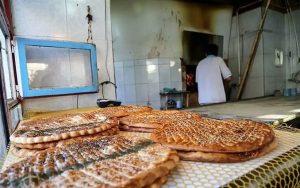
The livelihood crisis and intensifying economic pressures in Iran have now affected one of the most basic daily necessities for people: bread. Reports and messages received on Tuesday, June 9, from Tehran, Karaj, Isfahan, Khorasan Razavi, Mazandaran, and several other provinces indicate that, in addition to official and unofficial increases in bread prices in many cities, some bakeries receiving government-subsidized flour have begun rationing bread sales and are selling only a limited number of loaves to each customer.
These reports come as public disputes have intensified in recent days among the government, state-run media outlets, and officials of Iran’s regime over responsibility for the economic crisis.
In some areas of Tehran, bakeries receiving government-subsidized flour have informed customers that it is not possible to sell more than three barbari loaves or two sangak loaves (a traditional Iranian bread) to each person. At the same time, some residents have reported restrictions on purchasing bread using bank cards.
According to a directive communicated to some bakeries, purchasing more than three loaves of bread with a single bank card is not permitted, and customers must use another bank card if they wish to buy more. This has caused confusion and protests among many people.
Internet Shutdowns Have Devastated the Livelihoods of Millions of Iranians

Following widespread and repeated internet shutdowns in Iran ordered by regime officials, reports by trade and professional organizations show that the economic consequences of these decisions have pushed the livelihoods of millions of Iranians to the brink of collapse. Those affected range from Instagram sellers and content creators to knowledge-based companies, home-based businesses, local enterprises, students, researchers, physicians, and anyone whose work, customers, or audiences depend on stable and unrestricted internet access for even the most basic academic, professional, or commercial activities.
As runaway inflation continues and the value of the Iranian rial declines further amid a wartime atmosphere, on Tuesday, June 9, the U.S. dollar reached a new record high of 1.8 million rials in Iran’s market.
Under such circumstances, internet shutdowns mean the loss of the last remaining source of income for millions of people, the closure of businesses, and complete exclusion from the labor market. Messages received from various cities across Iran confirm this reality.
Aarhus Rally Strongly Condemns Executions in Iran, Endorses NCRI as Democratic Alternative
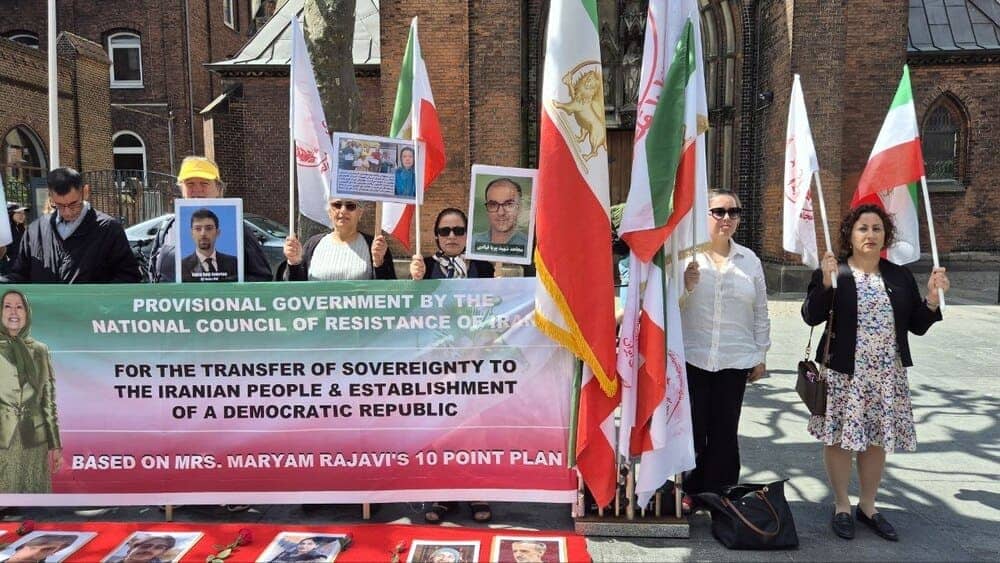
Denmark – June 6, 2026: Supporters of the People’s Mojahedin Organization of Iran (PMOI/MEK) gathered in Aarhus for a rally to strongly condemn the executions of political prisoners, including MEK members and protesters arrested during the January 2026 uprising in Iran. The demonstrators demanded the immediate and unconditional release of all political prisoners in Iran.

Participants strongly denounced the actions of Iran’s ruling clerical regime, calling the executions a clear violation of fundamental human rights. Demonstrators honored the victims by displaying their photographs and reaffirmed their determination to continue the struggle against the regime until its overthrow and the establishment of a democratic republic founded on peace, freedom, and justice.
MEK Supporters in Essen Urge Participation in June 20 Paris Free Iran Rally
Essen, Germany – June 6, 2026 – Supporters of the People’s Mojahedin Organization of Iran (PMOI/MEK) in Essen carried out outreach activities including putting up posters and distributing brochures to promote and call for participation in the major Free Iran rally to be held on June 20 in Vauban, Paris. They sent a clear call to action, urging freedom-loving Iranians and international supporters to join the major rally scheduled for June 20 in Paris under the slogan “A Democratic Republic for Iran.”

MEK supporters reject both monarchical and theocratic dictatorships, emphasizing a third alternative rooted in democracy and popular sovereignty.