

THIS PAGE WILL BE UPDATED WITH THE LATEST NEWS
UPDATE: 10:00 AM CEST
Is Regime Change in Iran Possible?

The open war launched by the United States and Israel against the Islamic Republic of Iran has reached a stalemate. Periods of ceasefire for negotiations alternate with renewed hostilities, yet neither side has gained a decisive advantage capable of tipping the balance. Meanwhile, the blockade of the Strait of Hormuz is seriously disrupting global trade in hydrocarbons and other commodities, while attacks on the Gulf monarchies are undermining their ambitions to establish themselves not only as major energy suppliers but also as financial hubs and leading tourist destinations.
The Iranian regime’s capacity to inflict damage remains considerable. It has become increasingly clear that an air campaign alone is insufficient to bring down the terrorist and criminal theocracy that has ruled the former Persia since the rise to power of Ruhollah Khomeini in 1979. Neither the decapitation of the regime’s leadership through the elimination of key figures nor the significant damage inflicted on its military infrastructure—greatly weakened by coalition American-Israeli operations targeting its naval, air, and ground forces—has thus far caused the totalitarian theocracy to collapse or produced the political change that the vast majority of Iranians desire.
UPDATE: 9:00 AM CEST
Resistance Units in Zahedan Reject Both Shah and Mullahs on the Path to a Democratic Republic
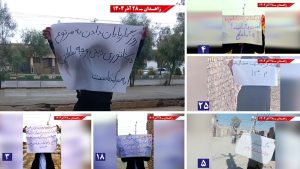
On June 12, PMOI/MEK Resistance Units in the southeastern city of Zahedan continued their weekly anti-regime activities across the city. They reiterated their unwavering commitment to overthrowing the ruling clerical regime and establishing a democratic republic.
Undeterred by the regime’s pervasive security presence, activists boldly displayed placards in public spaces declaring, “Iranian society is moving toward a democratic republic.” They emphasized that the current ruling establishment “neither intends to change its behavior and policy, nor does it have the capacity and nature to do it,” pointing out that “All the heavy burdens and problems of the people are, above all, the direct consequence of the clerical regime’s rule.”
The central theme of the Zahedan activities was the definitive rejection of both monarchical and religious fascism. Protesters held signs with slogans such as “Dictatorship is a dictatorship, be it with a turban or a crown,” “100 years of crimes by the monarchy and the clergy,” and “From Zahedan to Tehran, death to the oppressor, be it the Shah or the Leader.” Placards warned that the “principle of ‘Neither the Shah nor the mullahs’ establishes an absolute red line against all forms of dictatorship and foreign dependence.”
Iran: Crackdown on Protesters Continues in Bid to Fend Off Another Uprising

Mass and arbitrary detentions continue across various Iranian cities following the recent nationwide protests in January. The escalating crackdown on protesters, imposition of harsh sentences, and prolonged detentions of women and young girls left in legal limbo expose the clerical regime’s security strategy—a desperate attempt driven by deep-seated panic over the reignition of public fury and the outbreak of another nationwide revolt.
Amid this crackdown, denying prisoners the right to a fair trial, withholding adequate medical care, and cutting off access to family visits and phone calls have become systemic tools to exert maximum pressure on protesters and civil rights activists.
The following report details the latest wave of detentions and the status of prisoners currently sentenced to prison terms.
The judiciary has continued to hand down heavy prison sentences to those captured during the crackdown. Among them are sisters Samira and Mina Kouchaki, detainees from the 2026 nationwide uprising, who are currently serving their sentences in Evin Prison. The Revolutionary Court sentenced the sisters to a combined total of 10 years in prison. Samira is a mother of one, and Mina is a mother of two; both had previously been arrested during the 2022 protests. Similarly, Parnian (Fatemeh) Hashempour, another detainee from the 2026 uprising, is serving a five-year sentence in Evin Prison following a prior arrest in 2022 where she was held in Qarchak Prison.
Iran Human Rights Report: Executions, Political Repression, and Arbitrary Killings Escalated in May 2026

The human rights situation in Iran continued to deteriorate sharply during May 2026, with a significant increase in executions, political arrests, and reports of arbitrary killings by security forces. The developments unfolded against the backdrop of the January 2026 uprising, one of the largest anti-government protest movements in recent years, and the consequences of a regional war that further deepened instability across the country. Human rights advocates argue that the events of recent months have exposed the extent of state repression in Iran. Images and reports emerging after the January uprising documented large numbers of casualties and widespread allegations of violence against protesters. While the country has since been consumed by regional conflict and heightened security tensions, rights organizations say the regime has once again shifted its focus toward suppressing domestic dissent through executions, arrests, and intimidation.
The rapid execution of political prisoners and protesters, according to observers, reflects what many describe as the regime’s continuing struggle against a population demanding fundamental political and social change.
According to reports collected during May 2026, at least 78 prisoners were executed in Iranian prisons.
Among those executed were 11 Baluch prisoners, 17 Kurdish prisoners, and two Afghan nationals. The figures highlight the continued disproportionate impact of capital punishment on ethnic minorities and marginalized communities.
Resistance Units Launch Nationwide Campaign Ahead of June 20 Anniversary of Iran’s Historic Resistance
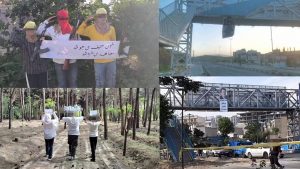
As Iran approaches the anniversary of June 20, 1981—a date regarded by the Iranian Resistance as a turning point in the struggle against dictatorship—Resistance Units and rebellious youth carried out a broad and coordinated campaign of political activities across Tehran and at least sixteen other cities throughout the country.
The nationwide initiative, conducted on June 12, included extensive wall-writing operations, poster campaigns, public displays of banners and placards, distribution of leaflets, and installations featuring the images and messages of Massoud Rajavi and Maryam Rajavi. The activities took place in public squares, parks, major streets, highways, and other urban locations, emphasizing themes of resistance, democratic change, and the rejection of both religious and monarchical dictatorship.
One of the largest actions was reported in Shiraz, where Resistance Units carried out nine separate wall-writing operations across major streets and public areas.
When Inflation Becomes Hunger: Iran’s Economic Crisis and the Erosion of Food Security

History has repeatedly shown that famine does not always begin when warehouses are empty. Often, it starts much earlier—when ordinary people can no longer afford the food that remains abundantly available in the marketplace. The shelves may still be stocked, but when family tables are left bare, society enters a far more dangerous stage of economic decline.
This reality has become increasingly relevant in Iran today. The country is not facing an absolute shortage of food supplies, yet a growing share of the population is losing the economic ability to purchase basic necessities. Dairy products, meat, poultry, fruits, and other essential food items have gradually disappeared from the consumption baskets of many low-income households. What was once considered a temporary hardship has evolved into a structural threat to national food security.
The consequences of inflation and recession in Iran are now visible in the daily lives of millions. Labor organizations and economic observers report a dramatic decline in per capita dairy consumption, which has fallen to a fraction of the global average. This is not a matter of changing dietary preferences. Rather, it reflects the inability of families to meet even their most basic nutritional needs.
Ali Khamenei’s Corpse and the Spectacle of a Dictator’s Burial
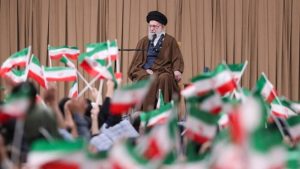
The project of burying Ali Khamenei has long been a subject of discussion among the leaders of Iran’s regime. Regime officials are allegedly seeking to stage a lavish spectacle around the burial of a bloodstained ruler in order to gain political advantage and conceal what they view as the regime’s loss of power and balance. In recent days, a series of analyses and claims have circulated on social media centered on a topic referred to as the “Khamenei Burial Project.” These narratives attempt to present a political and media-oriented picture of how ceremonies following Khamenei’s death might be managed. Within this framework, Khamenei’s burial is described not merely as a religious ritual but as an organized propaganda campaign. According to these claims, the objective of delaying the burial of Khamenei’s corpse for 100 days and synchronizing it with religious mourning ceremonies would be to counter a popular uprising. Through such a display, the regime would seek to show both the Iranian people and the international community that it still retains a social base and possesses the “resilience” to withstand both domestic unrest and foreign conflict.
Agreement Between Iran’s Regime and the United States Highlights a New Rift Within the Ruling Establishment
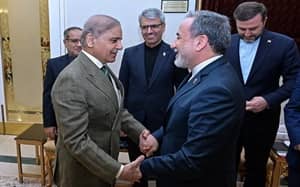
Disagreements over the course of negotiations between Tehran and Washington have once again become public. While some media outlets and figures close to the government speak of progress in the talks and the possibility of reducing tensions, other factions within the ruling establishment present a different narrative. The latest example of these disputes is the remarks of Mahmoud Nabavian, a member of the National Security Commission of the Iranian regime’s Majlis (parliament), who has sharply questioned claims regarding the achievements of the negotiations.
On June 12, Nabavian commented on the course of talks between Iran’s regime and the United States. He rejected claims that the United States had retreated from its previous demands and said that such narratives are highly inaccurate and even completely false. The member of parliament emphasized that, contrary to the publicity surrounding the talks, the text of the potential agreement has not only failed to address past shortcomings but also includes additional restrictions.
The Solar Lie: 5x Capacity Announced, $1 Billion Looted, Yet Iran’s Blackouts Continue
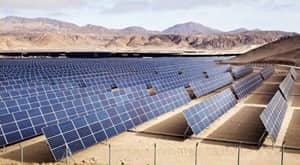
As Iran’s power crisis worsens, growing criticism is emerging over the government’s renewable energy policies. A new report questions official claims about solar expansion and raises concerns over waste, rent-seeking, and corruption.
Iran’s electricity crisis has taken on a different character these days. It is no longer just about recurring blackouts and the unbearable summer heat; now, divisions within the ruling establishment itself are becoming more visible than ever.
Amid this backdrop, the newspaper Tose’e Irani has published a sharp and direct report titled “200 Trillion Tomans Wasted on Imports of Low-Quality Chinese Panels,” shedding light on what it describes as the darker aspects of government policy in the renewable energy sector. The debate has also intensified around allegations of Iran solar energy corruption and the effectiveness of costly solar projects.
MEK Supporters in Paris Call for Mass Participation in June 20 Free Iran Rally
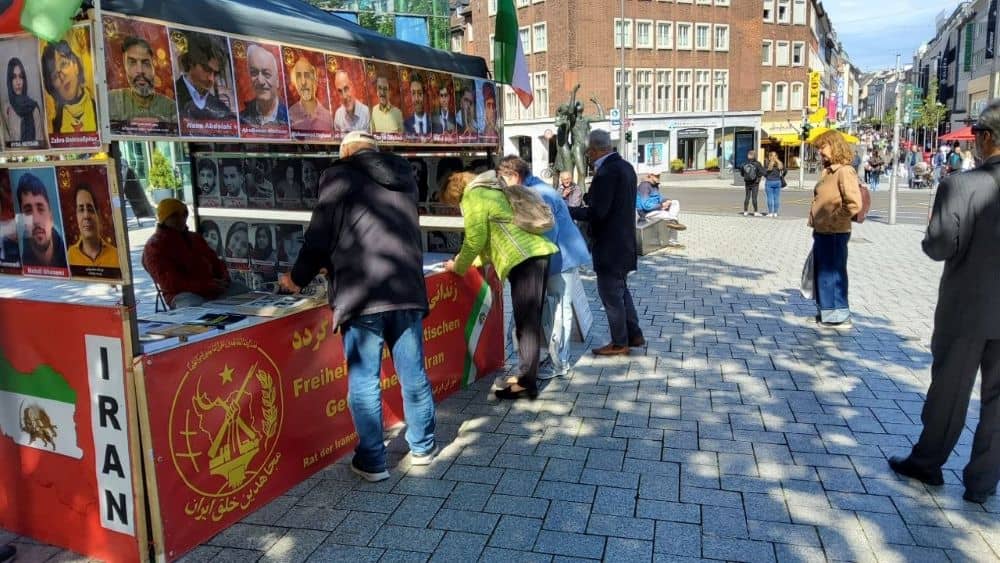
Paris, France – June 12, 2026 – Supporters of the People’s Mojahedin Organization of Iran (PMOI/MEK) held a bookstall and exhibition protesting the execution of political prisoners and demonstrators in the aftermath of the January 2026 uprising. The event highlighted growing calls for freedom, justice, and the protection of human rights in Iran.

Organizers used the occasion to issue a broader call to action, urging freedom-loving Iranians and international supporters to participate in the Paris Free Iran Rally on June 20, which is expected to attract more than 100,000 participants. Held under the slogan “A Democratic Republic for Iran.”
MEK Supporters in Aachen Call on Iranians to Join the Paris Free Iran Rally on June 20
Aachen, Germany – June 10, 2026 – Supporters of the People’s Mojahedin Organization of Iran (PMOI/MEK) held a book table in Aachen to send a clear call to action, urging freedom-loving Iranians and international supporters to join the major rally scheduled for June 20 in Paris under the slogan “A Democratic Republic for Iran.”

The rally rejects both monarchical and theocratic dictatorships, emphasizing a third alternative rooted in democracy and popular sovereignty.
The protesters reaffirm their opposition to executions, war, and the policy of appeasement toward the clerical regime, emphasizing that the only viable solution is the establishment of a democratic republic based on Mrs. Maryam Rajavi’s Ten-Point Plan.