

THIS PAGE WILL BE UPDATED WITH THE LATEST NEWS
UPDATE: 7:30 AM CEST
A Meeting and Dialogue with Mr. Charles Michel, Former President of the European Council, General James Jones, Former National Security Advisor to U.S. President and General Keith Kellogg, Special Presidential Envoy for Ukraine (2025)
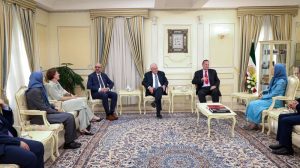
On Saturday, June 20, Ms. Maryam Rajavi met and held discussions with Mr. Charles Michel, President of the European Council (2019-2024); General James Jones, National Security Advisor to U.S. President Barack Obama and former NATO Commander; and General Keith Kellogg, former Acting National Security Advisor to U.S. President Donald Trump and Vice President Mike Pence, and U.S. Special Presidential Envoy for Ukraine (2025).
Expressing her appreciation for the support shown by Mr. Charles Michel, General James Jones, and General Keith Kellogg for the Iranian people and resistance, Ms. Rajavi emphasized that today, the Iranian regime is weaker than ever, while the organized resistance of the Iranian people and the Resistance Units are more prepared than ever. However, she added, let us remember that this regime will neither relinquish power, nor abandon suppression, nor stop its interventions in regional countries. She stressed that recent events have demonstrated that changing this regime is only possible at the hands of the people and the resistance, and that to be rid of the evil of a religious dictatorship that has brought the world to the brink of a comprehensive war, the world must stand alongside the Iranian people.
A Meeting and Discussion with Former UK Prime Minister Boris Johnson
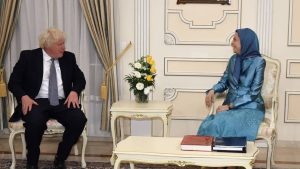
On Saturday, June 20, Maryam Rajavi met with the Rt Hon Boris Johnson, Prime Minister of the United Kingdom (2019–2022), to discuss the latest developments in Iran and the wider region, the expansion of the nationwide resistance movement, and international policy regarding Iran.
During the meeting, Maryam Rajavi detailed the volatile, explosive state of Iranian society and the growing activities of Resistance Units across the country. She emphasized that the recent surge in political executions reflects the regime’s profound fear of an escalating popular uprising merging with an organized resistance movement.
She emphasized that the Iranian Resistance welcomes an end to war and the suffering of the Iranian people, noting that within Iran, none but the remnants of the Shah and the clerical regimes have ever desired war. She added that as long as the current regime remains in power, domestic suppression, foreign warmongering, and the pursuit of nuclear weapons will persist. These crises, she stressed, will only cease with the overthrow of the regime, a task that can only be accomplished by the Iranian people and their organized resistance.
The Third Option: Why Neither Appeasement nor Foreign Intervention Will Free Iran
Iran currently stands at one of the most critical junctures in its history. As the ruling religious dictatorship grapples with profound political, economic, and social crises, the international community is once again confronted with a defining question: What is the solution to the crisis in Iran?
For decades, Western policymakers have been trapped in a false dichotomy, operating under the assumption that the only available options are endless appeasement or devastating foreign military intervention. However, the Free Iran 2026 Summit clearly articulated that both of these paths are fundamentally flawed. The true answer lies in the “third option”: democratic regime change brought about exclusively by the Iranian people and their organized Resistance.
As Mrs. Maryam Rajavi, the president-elect of the National Council of Resistance of Iran (NCRI), emphasized, the only viable path forward is relying on the power of the Iranian people. “The only solution to Iran’s present crisis is regime change. And that change can only be achieved through the uprising of the Iranian people and their organized Resistance,” she stated.
The Iranian People and Resistance Units Are Driving the Struggle for Change
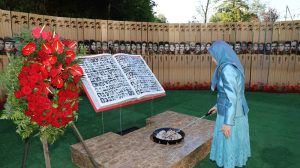
Speakers at Free Iran 2026 argued that Iran’s democratic transformation must come from within, led by protesters, Resistance Units, and supporters of the organized opposition.
One of the clearest messages emerging from the Free Iran 2026 conference in Paris was that the future of Iran will not be determined by foreign military intervention or diplomatic bargaining, but by the Iranian people themselves.
Across speeches delivered by lawmakers, former ministers, and political figures from Europe and North America, participants repeatedly emphasized that the driving force behind democratic change is the network of protesters, Resistance Units, political activists, and supporters of the organized opposition operating inside and outside Iran.
Rather than portraying Iranians as passive victims of repression, speakers described them as active participants in a sustained struggle that has continued despite executions, arrests, torture, and decades of state violence.
Iran’s Economic Growth Nears Stagnation as War, Protests, and Structural Crisis Weigh on Economy

New figures released by the Statistical Center of Iran on Monday, June 22, reveal that the country’s economy effectively stagnated during the Iranian year 1404 (March 2025–March 2026), highlighting the severe impact of war, domestic unrest, sanctions, and structural economic problems.
According to the report, Iran’s economic growth reached only 0.2 percent when oil revenues are included, while the economy contracted by 0.3 percent excluding oil, indicating that non-oil sectors continued to weaken despite government claims of economic resilience.
The Statistical Center reported that Iran’s gross domestic product (GDP) exceeded 100 trillion rials when calculated with oil revenues and stood at approximately 75 trillion rials without oil.
The disappointing growth figures come after a turbulent year for Iran. During 1404, the country experienced a 12-day war with Israel in the summer, followed by the nationwide January protests and a subsequent 40-day conflict involving the United States and Israel during the winter.
Iran’s Economic Growth Decline Accelerates

The Statistical Center of Iran, a government agency of Iran’s regime, announced in its latest report that the country’s economic growth in the past year, including oil revenues, was only 0.2%, a figure that shows a significant decline compared to the 3.1% growth recorded in 2024.
According to the report, if oil revenues are excluded from the calculations, economic growth falls to negative 0.3%, meaning that Iran’s economy effectively contracted during the past year. The data show that key sectors of the economy experienced declines. Agriculture contracted by 2.9%, industry by 1.5%, and the water and electricity sector by 6.5%—areas that directly affect employment, people’s livelihoods, and the energy crisis. In contrast, oil and gas extraction grew by 1.8%, making it the only factor preventing overall economic growth from turning negative.
In the services sector, although overall growth was reported at 0.3%, the real picture of the economy is different. While financial activities expanded by 8.4%, sectors tied to people’s daily lives, such as wholesale trade, retail trade, hotels, and restaurants, shrank by 1.8%.
New Wave of Protests Across Various Iranian Cities
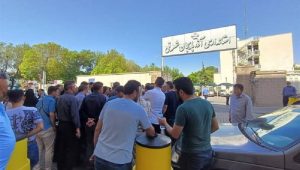
On June 21 and 22, a new wave of protest gatherings emerged across various cities in Iran. Students, university students, retirees, and employees from different government and service sectors took to the streets and gathered in front of administrative offices to protest educational, livelihood, and employment-related problems and to demand that their grievances be addressed.
Students in the cities of Ilam, Khorramabad, Shahrekord, Urmia, Kerman, Tehran, Yazd, Shiraz, and several other cities held protest gatherings to express their opposition to the decision to postpone final examinations until after Arbaeen and to increase the intervals between exams.
The protesters described the decision as a cause of confusion, increased psychological pressure, and educational difficulties for students, and called for its cancellation.
On June 22, a group of university students gathered outside the Shahrekord Governorate building, calling on officials to address their educational and student-related demands.
The students participating in the gathering emphasized the need for accountability from officials and practical action to address student concerns.