


THIS PAGE WILL BE UPDATED WITH THE LATEST NEWS
UPDATE: 8:00 PM CET
US Vows to Keep Hitting Houthis Until Shipping Attacks Stop
WASHINGTON/ADEN, Yemen, March 16 (Reuters) – The United States will keep attacking Yemen’s Houthis until they end attacks on shipping, the U.S. defense secretary said on Sunday, as the Iran-aligned group signaled it could escalate in response to deadly U.S. strikes the day before.
The airstrikes, which the Houthi-run health ministry said killed at least 31 people, are the biggest U.S. military operation in the Middle East since President Donald Trump took office in January. One U.S. official told Reuters the campaign might continue for weeks.
Hegseth Declares ‘Peace Through Strength Is Back’ While Vowing ‘Unrelenting’ Campaign Against Houthi Targets

The U.S.’s large-scale strike campaign against Houthi targets in Yemen will be “unrelenting” until the Iran-backed proxies pledge to back off U.S. assets, Defense Secretary Pete Hegseth said Sunday.
“The minute the Houthis say ‘we’ll stop shooting at your ships, we’ll stop shooting at your drones,’ this campaign will end, but until then, it will be unrelenting,” he told “Sunday Morning Futures” host Maria Bartiromo.
U.S. Central Command said Saturday it had “initiated a series of operations consisting of precision strikes against Iran-backed Houthi targets across Yemen to defend American interests, deter enemies, and restore freedom of navigation.”
UPDATE: 4:00 PM CET
US Strikes ‘Took Out’ Multiple Houthi Leaders: National Security Adviser Mike Waltz

The U.S. airstrikes that bombarded Yemen on Saturday targeted and “took out” multiple leaders of the Iranian-backed Houthis, White House national security adviser Mike Waltz said Sunday. Speaking on ABC’s “This Week,” Waltz argued to co-anchor Martha Raddatz that these latest strikes differ from the countless strikes the Biden administration launched against the rebel group, which the Trump administration has designated a foreign terrorist organization.
“These were not kind of pinprick, back and forth- what ultimately proved to be feckless attacks,” Waltz said. “This was an overwhelming response that actually targeted multiple Houthi leaders and took them out. And the difference here is, one, going after the Houthi leadership, and two, holding Iran responsible.”
UPDATE: 9:30 AM CET
Facing Deportation, Alleged Senior Iranian Regime Member Leaves Canada

An alleged senior member of the Iranian regime has “voluntarily departed Canada” days before she was to face deportation proceedings, Global News has learned.
Elham Zandi left the country after the Canada Border Services Agency signaled its intention to expel her by asking the Immigration and Refugee Board to hold a hearing.
She is the third suspected high-ranking member of the Iranian government to depart Canada after being targeted under sanctions adopted just over two years ago.
Global News reported last week that the CBSA had withdrawn its case against Zandi. At the time, officials did not explain why.
UPDATE: 8:30 AM CET
PMOI Resistance Units In Zahedan Reject The Shah And Mullahs’ Dictatorships

On March 14, the city of Zahedan, one of the main centers of resistance against the Iranian regime, witnessed a new escalation in the activities of PMOI Resistant Units. Despite tight security measures, the PMOI Resistance Units carried out a series of operations, continuing their previous actions. The slogans they inscribed on walls sent a clear message rejecting all forms of dictatorship, whether from the Shah’s monarchy or the mullahs’ religious fascism, emphasizing that the ongoing revolution in Iran aimed to establish a democratic and pluralistic republic based on freedom and equality.
The Resistant Units made strong statements against the regime and mobilized the Iranian people through bold revolutionary slogans painted across various parts of the city. Some of the most prominent slogans and their meanings include:
PMOI Resistance Units Challenge Pezeshkian in Varamin: “Resign and Leave, Varamin is Not Your Place”
Coinciding with the visit of Iranian regime president Masoud Pezeshkian to the city of Varamin in Tehran Province, PMOI Resistance Units carried out extensive protest activities, including distributing leaflets and writing slogans on walls. These activities rejected his presence and emphasized his direct responsibility for human rights abuses and executions against the Iranian people.
In clear defiance of the Iranian regime, leaflets and graffiti appeared throughout various parts of Varamin, demanding Pezeshkian’s immediate departure and resignation. His presence was seen as provocative by the local residents who have endured considerable repression and systematic violence. Among the prominent slogans were:
Iran’s Regime Expands Surveillance to Enforce Mandatory Hijab Laws

A recent report by the United Nations has revealed that Iran’s regime is increasingly relying on advanced technology, including drones, facial recognition systems, and a citizen-reporting application, to enforce its mandatory hijab laws. The report highlights the government’s systematic use of digital tools to monitor and penalize women for non-compliance.
At the heart of this crackdown is the state-backed Nazer app, which allows both police and selected members of the public to report alleged hijab violations. The app enables users to submit vehicle license plate numbers, location details, and timestamps of supposed infractions. Upon receiving such reports, authorities send real-time text messages to the registered owners of the vehicles, warning them of the violation. The messages also inform them that repeated offenses could lead to the impoundment of their vehicles.
Fact-Finding Mission on Iran Highlights Systematic Persecution of Women and Girls
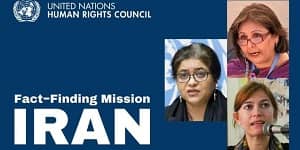
The United Nations Independent International Fact-Finding Mission, in its latest report, once again highlights the ongoing systematic and targeted repression by the Iranian regime against dissidents, particularly women and human rights activists. The findings of the Fact-Finding Mission indicate that Iranian women and girls remain the primary targets of repressive policies, with the enforcement of strict laws, including mandatory hijab, becoming even more severe.
The report also underscores the responsibility of state institutions, including the Revolutionary Guard Corps (IRGC), the Basij, the Morality Police, and the judiciary, in human rights violations.
Families Commemorate Political Prisoners Executed in the 1980s Amid Iranian regime’s Restrictions

On Friday, March 14—the final Friday of the Iranian calendar year—families of political prisoners executed in the 1980s gathered behind closed doors at Khavaran Cemetery to hold a commemoration ceremony. The event took place under severe restrictions imposed by Iranian regime’s security forces, who have kept the cemetery gates closed for over a year, preventing families from paying tribute to their loved ones.
For years, the families of those executed in the 1980s have faced systematic obstruction by the Iranian regime’s authorities. Most recently, they have protested the burial of deceased members of the Baha’i community in the section of Khavaran Cemetery that contains mass graves of political prisoners executed in the summer of 1988. The Baha’i community has also joined these protests, denouncing the practice as part of a broader effort to erase historical evidence of the mass executions.
Warning About the Possibility of Water Rationing in Iran

With decreasing rainfall in Iran and the absence of a proper system for protecting water resources, media reports indicate that water rationing is imminent in the country.
According to reports, water reserves behind Iran’s dams are in a critical state, and in the coming months, the water supply crisis will add to the country’s existing crises.
The government-affiliated Tejarat News website wrote on Friday, March 14, that due to reduced rainfall, poor management of surface and groundwater, and an increase in both legal and illegal well drilling for groundwater extraction, Iran’s water situation is disastrous.
Threat of Amputation for Three Prisoners in Urmia Prison

Reports from Urmia Central Prison indicate that prison authorities have summoned three inmates and informed them that their amputation sentences will be carried out next month. This decision has sparked widespread concern among human rights organizations and civil society activists. According to available information, on Thursday, March 13, 2025, three prisoners named Hadi Rostami, Mehdi Shahivand, and Mehdi Sharifian, were summoned to the prison’s sentence enforcement office. They were told that if they failed to obtain the plaintiffs’ consent, their amputation sentences would be executed the next month.
Executions of Multiple Prisoners, Including a Woman, in Iranian Prisons

Iranian authorities have carried out the execution of several prisoners in recent days across different prisons, including the execution of a female prisoner in Isfahan.
On Tuesday, March 11, 2025, another prisoner, Hojjat Torkaman, was executed in Neyshabur Prison. He had been arrested four years ago on murder charges and sentenced to death.
Melbourne Exhibition Sheds Light on Iran’s Human Rights Abuses and Demands an End to Executions
Melbourne, Australia – March 14, 2025: Supporters of the People’s Mojahedin Organization of Iran (PMOI/MEK) organized an exhibition to spotlight the escalating human rights violations by the Iranian regime. The event served as a strong demonstration of solidarity with the ongoing Iranian Revolution, with a particular focus on the increasing executions of political prisoners.
#Melbourne Exhibition Sheds Light on #Iran’s #HumanRights Abuses and Demands an End to Executions #StopExecutionsInIran #FreePoliticalPrisoners #FreeIran2025 #MehdiHassani #BehrouzEhsanihttps://t.co/a9C5vS3Kgb
— Iran Freedom (@4FreedominIran) March 15, 2025