

THIS PAGE WILL BE UPDATED WITH THE LATEST NEWS
UPDATE: 7:00 AM CEST
Pezeshkian’s Remarks In New York Cause Turmoil Inside Iran’s Regime
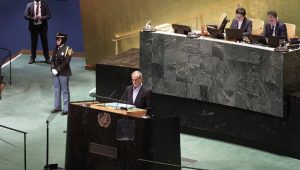
The recent trip of Iranian regime president Massoud Pezeshkian to New York for the UN General Assembly and his remarks during the visit have caused significant turmoil within the regime, sparking a heavy wave of political and media attacks against him, his entourage, and associates. In a piece published under the title “Mr. Pezeshkian, Beware of This Conspiracy!” on September 24, Hossein Shariatmadari, the de facto spokesperson of regime supreme leader Ali Khamenei in Kayhan newspaper, warned Pezeshkian while attacking his entourage and also targeting Pezeshkian himself. He wrote: “During the trip to America, a group with a notorious and dubious past is plotting against Dr. Pezeshkian, inviting him to oppose Iran and Islam and to submit to humiliation in front of America.”
The Reality of Pezeshkian’s Plans for “Economic Surgery” in Iran

“Economic surgery” is one of the terms that has become a favorite phrase of Iranian regime president Massoud Pezeshkian, and he mentions it in every interview. But by looking into his various statements, no one can grasp the substance of this surgery. In his remarks in Mashhad, he said, “Naturally, we need to have surgeries in many areas to be able to get the country out of this situation.”
Now, when we delve deeper into his statements, we realize that one example of this economic surgery was increasing the price of bread, the staple food of the deprived people, which rose by an average of 70%. The second step, or example, is the increase in gasoline prices.
Pezeshkian has slipped the topic of gasoline price hikes into his comments several times. In his remarks on August 28, he said, “I (as the government) don’t have money for wheat, medicine, supplies, or retirees’ salaries, but I’m selling gasoline, worth 500 rials per dollar, for 100 rials. What logic accepts that we are doing this?”
Challenges Facing Iran’s Railway Infrastructure: Mismanagement and Underutilization
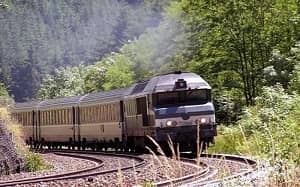
An official from the Trade Union of Iranian Railway Transport Companies recently highlighted one of the critical issues plaguing the industry: the construction of railway lines for which there is little to no demand. The official, Ehsan Salari, pointed out that approximately 5,000 kilometers of railway lines in Iran remain unused. On Wednesday, September 25, Salari emphasized that all new railway lines in the country were constructed as “single-track railways,” a decision he criticized as severely hampering traffic flow and reducing efficiency. According to him, these 5,000 kilometers of unused railway lines serve no practical purpose.
U.S. and GCC Reaffirm Strategic Partnership in Ministerial Meeting
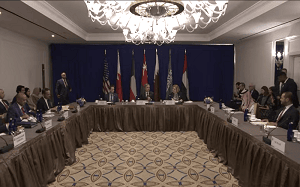
The United States and Gulf Cooperation Council (GCC) member states held a high-level ministerial meeting on September 25, 2024, in New York. The session was co-chaired by U.S. Secretary of State Antony J. Blinken and Qatar’s Prime Minister and Minister of Foreign Affairs, Sheikh Mohammed bin Abdulrahman Al-Thani, who also serves as the current chairman of the GCC Ministerial Council. Senior officials from GCC member countries and GCC Secretary General Jasem Albudaiwi were also in attendance.
The meeting reaffirmed the strong and enduring strategic partnership between the U.S. and the GCC, building on the achievements of previous ministerial meetings, including one held in Riyadh earlier in 2024. The ministers committed to further enhancing consultation, coordination, and cooperation across various fields.
Iran’s Budget for IRGC’s Baqiatollah Base Quadruples in Three Years

The budget for the Baqiatollah Base, a branch of the Islamic Revolutionary Guard Corps (IRGC), has seen a staggering increase over the past three years, according to a report by Iran Open Data on Wednesday, September 25. This military and cultural unit has had its funding increase from 668 billion tomans in 2021 to 888 billion tomans in 2022, reaching nearly 3,000 billion tomans in the 2024 budget. This quadrupling of financial resources underscores the growing support for institutions tied to the regime’s cultural and social agenda.
The Baqiatollah Base primarily uses its funding to support a range of cultural and social institutions, including the Owj and Seraj institutions. These organizations are heavily involved in media, artistic projects, and cyberspace activities that align with the regime’s ideological objectives. These initiatives allow the regime to exert influence across various forms of cultural expression, including film production, social media campaigns, and online content creation.
Iran’s Shared Oil and Gas Fields Are in Dire Condition

With Kuwait and Saudi Arabia completing their studies for developing the “Al-Durra” (Arash) field, Abdolreza Abed, the commander of the IRGC Khatam al-Anbiya Construction Headquarters, has issued a warning and requested that this institution be involved in the field’s development.
Abed also claimed that Khatam al-Anbiya has the capability to develop the Esfandiar and Farzad fields, which are shared with Saudi Arabia. Iran has 28 shared oil and gas fields with neighboring countries, in almost all of which it has fallen behind its neighbors. The main reasons for Iran’s lag in oil and gas extraction from shared fields are a lack of investment and modern technology.
Increase in Executions Across Iran: Execution of Death Sentences in Ten Prisons in Iran
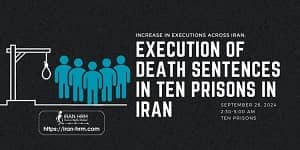
Iranian authorities have carried out a series of executions in recent days, intensifying concerns over the use of capital punishment in the country. These executions reflect a worrying trend of increased death sentences for a range of crimes, including drug-related offenses and murder. On Monday, September 23, 2024, two prisoners were executed in separate prisons. Fardin Ahmadi, a resident of Mamasani, Fars Province, was hanged in Adelabad Prison in Shiraz for a murder conviction. That same day, Yaser Balandeh, convicted of murder, was executed in Jiroft Prison. Both men had been sentenced to death following trials that have raised questions over the fairness of their legal proceedings.
Iranian Academics in Winchester Host Book Exhibition to Condemn Human Rights Violations and Call for Justice in Iran

On September 24, 2024, freedom-loving Iranians and academics in England, who support the People’s Mojahedin Organization of Iran (PMOI/MEK), organized a book exhibition in Winchester. The event aimed to condemn human rights violations in Iran and express solidarity with the Iranian Revolution.
Bern—September 24, 2024: MEK Supporters Exhibition to Condemn the Mullahs’ Regime Crimes in Iran

Bern, Switzerland—September 24, 2024: Freedom-loving Iranians and supporters of the People’s Mojahedin Organization of Iran(PMOI/MEK) organized an exhibition to protest the rising wave of executions carried out by the Iranian regime. They called for the immediate release of all political prisoners held in the prisons of the mullahs’ regime in Iran and expressed their solidarity with the Iranian Revolution. The exhibition’s organizers also condemned the recent execution sentences handed down in Iran for PMOI supporters.
MEK Supporters Rally in Aarhus to Support ‘No to Execution Tuesdays’ Campaign Against Iran’s Regime

Aarhus, Denmark—September 24, 2024: Freedom-loving Iranians and supporters of the People’s Mojahedin Organization of Iran (PMOI/MEK) organized a rally in solidarity with the “No to Execution Tuesdays” campaign in response to the executions taking place in Iran’s regime prisons.
MEK Supporters Rally in Copenhagen to Support ‘No to Execution Tuesdays’ Campaign Against Iran’s Regime

Copenhagen, Denmark—September 24, 2024: Freedom-loving Iranians and supporters of the People’s Mojahedin Organization of Iran (PMOI/MEK) organized a rally in solidarity with the “No to Execution Tuesdays” campaign for the third consecutive week, in response to the executions taking place in Iran’s regime prisons.