

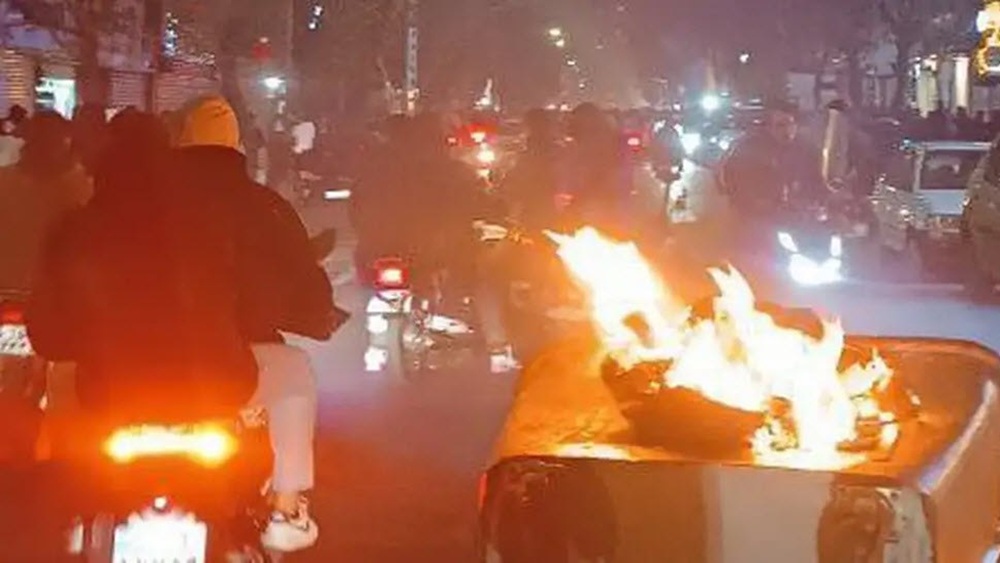
For one week, the Iranian regime has imposed a total internet blackout, attempting to cast a shroud of silence over a nation in revolt. Yet, as the uprising marks its 21st day, the “wall of silence” has failed to contain the realities on the ground. Reports leaking from the country reveal a capital city under de facto military occupation and a populace that remains defiant despite the deployment of heavy weaponry in residential areas.
On January 17, the uprising that began three weeks ago showed no signs of abating. While the regime has resorted to unprecedented domestic suppression to quell the unrest, the international community is simultaneously moving toward a consensus that could sever the regime’s lifeline: the designation of the Islamic Revolutionary Guard Corps (IRGC) as a terrorist organization. From the streets of Tehran to the parliament halls of Europe and South America, the pressure on the theocracy is mounting.
Tehran Under Siege: A Regime in Panic
According to a detailed report by the Social Headquarters of the People’s Mojahedin Organization of Iran (PMOI/MEK) inside the country, the regime has deployed a staggering 52,000 suppressive forces solely to control Tehran. This massive mobilization indicates a security apparatus on high alert, fearing the loss of control over the capital.
The breakdown of these forces reveals a multi-layered strategy of repression. The deployment includes 24,000 members of the IRGC and the paramilitary Basij, 21,000 agents from the State Security Force (SSF), and 2,000 army personnel under Khamenei’s direct command, tasked specifically with protecting power plants, the state broadcasting network (IRIB), and critical infrastructure. Perhaps most telling of the regime’s distrust in its own stability is the deployment of 5,000 proxy forces, notably members of the Iraqi Hashd al-Shaabi, to suppress the Iranian population.
NCRI Statement: Protesters in Zahedan Chant 'Death to Khamenei' and 'Death to Basiji'; Hit-and-Run Clashes in #Tehran and Other Citieshttps://t.co/jV17BPYyoq
— NCRI-FAC (@iran_policy) January 17, 2026
The capital has taken on the appearance of a war zone. In major squares and strategic bottlenecks, the IRGC has stationed machine guns and 12.7mm DShK heavy machine guns—weapons designed for battlefield combat, not urban policing. Snipers have been positioned on rooftops overlooking government buildings and sensitive locations, with reports confirming their presence even on residential buildings in various neighborhoods.
On the ground, armed patrols roam the streets 24 hours a day. Motorized units, operating in groups, are equipped with Kalashnikovs, shotguns, and handheld launchers for tear gas. They also utilize paintball guns to “mark” protesters, homes, and shops for later targeting. In several districts, random checkpoints have been established where forces inspect vehicle trunks, searching for anything that could aid the resistance.
Despite this martial law atmosphere, the resistance continues. On Friday, January 16, rebellious youths in Tehran engaged in hit-and-run clashes with suppressive forces in the districts of Naziabad, Tehranpars, Piroozi, and Ekbatan.
The defiance is nationwide. In Zahedan, defying a heavy siege around the Makki Mosque, protesters marched on Friday chanting “Death to Khamenei” and “Death to the Basiji.” In Izeh, armed clashes erupted between Bakhtiari youths and IRGC members. In Saveh, rebellious youths clashed with mercenaries on Motahari Street, while in Qirokarezin, the local bazaar went on strike in solidarity with the uprising.
The Price of Liberty: New Martyrs Identified
The regime’s response to these protests has been lethal. On January 16, the PMOI announced the names of 31 more martyrs of the uprising, verified despite the severe restrictions on information flow. This brings the number of identified martyrs in this specific wave of protests to 161.
The list of victims underscores the indiscriminate nature of the crackdown, targeting men, women, and children alike. Among the newly identified martyrs are six women. The ages of the victims reveal a war against the country’s youth: 15-year-old Arnika Dabbagh from Gorgan and 17-year-old Abolfazl Yaghmouri from Fardis, Karaj, are among the dead.
Other victims include 20-year-old Ali Janani from Eslamshahr, 23-year-old Pouya Rostami from Ilam, and 23-year-old Parnia Shad Bejarkenari from Rasht. The geographic spread of the killings—from Bijar and Salmas in the west to Mashhad and Sabzevar in the east, and Shiraz in the south—demonstrates the nationwide scale of the lethal force being employed.
International Isolation: The World Turns Against the Regime
While the regime attempts to secure its survival through domestic terror, it is facing an unprecedented diplomatic backlash. The international community is starting to take concrete measures against the regime’s terror apparatus.
In a historic move on Saturday, Argentine President Javier Milei signed a decree officially designating the IRGC’s Quds Force as a terrorist organization. The decree cited the force’s involvement in the 1992 Israeli Embassy bombing and the 1994 AMIA Jewish center bombing in Buenos Aires. The designation comes amidst reports confirming the direct involvement of the Quds Force in the brutal suppression of the current uprising in Iran. According to multiple reports, the Revolutionary Guard’s Quds Force and its allied proxy forces played a central role in the killing of protesters on January 8 and 9.
People in Iran deserve to live free.
The European Parliament will keep pushing to designate the Islamic Revolutionary Guard Corps (IRGC) as a terrorist organisation.
It would mean further degradation of the IRGC's ability to operate with impunity, disrupt their cash flow,… pic.twitter.com/XW2XABoP6i
— Roberta Metsola (@EP_President) January 17, 2026
Across the Atlantic, European leaders are echoing this stance. Roberta Metsola, President of the European Parliament, issued a strong statement declaring, “People in Iran deserve to live free.” She emphasized that the European Parliament will continue to push for the designation of the IRGC as a terrorist organization to “disrupt their cash flow” and ensure they find “no safe haven.”
This sentiment was reinforced by French Foreign Minister Jean-Noel Barrot, who vowed “no impunity” for the perpetrators of the crackdown. Speaking in Belgrade, Barrot confirmed that the European Union is launching a designation process to sanction those responsible for the repression, which he described as the most violent in Iran’s contemporary history. Similarly, Austrian Chancellor Christian Stocker condemned the “unprecedented violence” and called for the immediate release of protesters.
In the United States, Senator Thom Tillis commended the Trump administration for taking “appropriate action” to confront the regime’s human rights violations, signaling a unified transatlantic stance against Tehran.
The images from Iran have been deeply disturbing. I commend @POTUS for taking appropriate action to confront the Iranian regime for its egregious human rights violations. By sanctioning those behind this violent crackdown, America is sending a clear message of support and is…
— Senator Thom Tillis (@SenThomTillis) January 16, 2026
The convergence of a resilient nationwide uprising and a hardening international stance places the Iranian regime in a precarious position. The NCRI President-elect Maryam Rajavi welcomed the renewed calls from Europe for tougher sanctions.
“The IRGC is the principal instrument of repression, criminal violence, and state-sponsored terrorism under Ali Khamenei’s rule,” Mrs. Rajavi stated. She warned that following the crimes against humanity committed during the January uprising, “any further delay in designating the IRGC as a terrorist organization is unacceptable and, in practice, serves only to benefit the ruling religious fascism in Iran.”
The timely and renewed call by Ms. Roberta Metsola, @EP_President for the imposition of tougher sanctions on the Iranian regime, particularly the designation of the Revolutionary Guard Corps (IRGC) as a terrorist organization, comes at a moment marked by the brutal killing of… pic.twitter.com/igKbEcrBTb
— Maryam Rajavi (@Maryam_Rajavi) January 17, 2026
As the regime fortifies Tehran with machine guns and foreign proxies, it acknowledges a reality it tries to hide from the world: it is no longer fighting for legitimacy, but for survival against a nation that has already moved on.