

Three-minute read
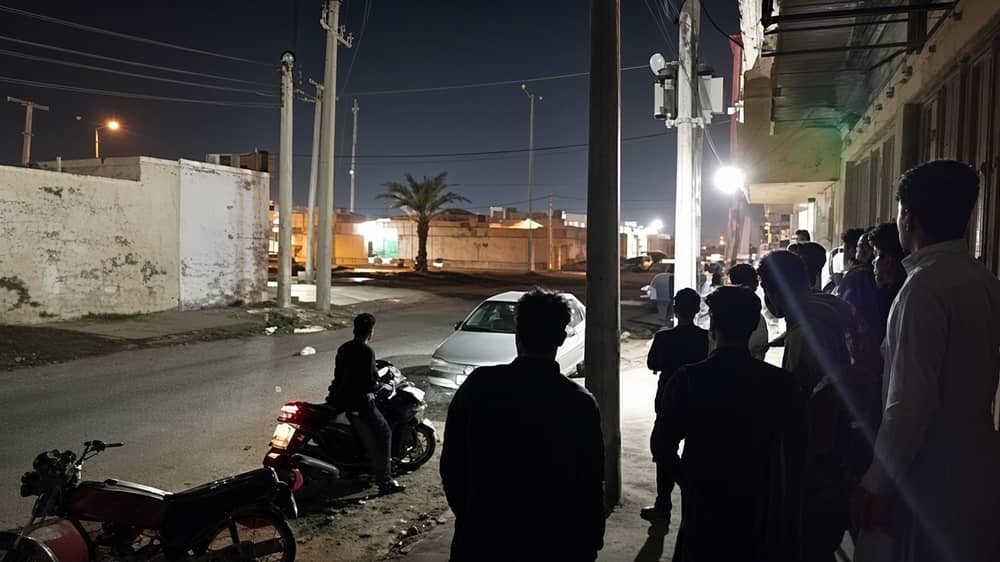
Iran’s southeastern security crisis intensified again on October 1, when a joint IRGC-police operation outside Zahedan left six people dead, followed hours later by an armed attack on a police checkpoint in Rask that killed an officer.
The IRGC’s Quds regional headquarters said security forces raided a house in Manzel-Ab, about 13 kilometers from Zahedan, killing six people during the operation and claiming to have recovered explosive devices. State media said clearance operations continued afterward but did not identify those killed or establish any organizational affiliation.
Local reporting described a much larger confrontation than the terse official statement suggested. A local source said fighting began around 6 a.m. and continued for roughly four hours, with RPGs, mortars and other heavy and semi-heavy weapons heard across the area. Dozens of security personnel reportedly surrounded a residential building, some taking positions on neighboring rooftops. Images published afterward showed extensive damage to the house and a destroyed vehicle in its courtyard. The identities and affiliations of those killed remain independently unverified.
Hours later, gunmen fired from the river side toward the Ahmadabad checkpoint at the entrance to Rask. Provincial security deputy Ali Khalilabadi initially told state media that the attackers had been driven back and that there had been “no damage or particular incident.” State security forces then announced that First Sergeant Alireza Sanchouli had been killed in the attack—a striking contradiction within the authorities’ own reporting.
Three explosions shook #Zahedan on the anniversary of Bloody Friday as Iran’s point-to-point inflation hit 89.8%, the dollar crossed 256,000 tomans, teachers and nurses quit, internet instability spread and the state expanded loyalist mobilization.
The pressures are increasingly…
— NCRI-FAC (@iran_policy) September 30, 2026
A Sequence, Not an Isolated Clash
These incidents follow the armed confrontation in IranShahr, explosions near Zahedan’s Police Station 19 on the anniversary of Bloody Friday, and other recent shootings in the province. The pattern over recent weeks is therefore broader than a single security operation: repeated firefights, attacks on security positions and increasingly heavy deployments are occurring across several points in Sistan and Baluchestan.
Yet the southeast is only one part of the pressure visible inside Iran. In parliament, Shamseddin Hosseini, chairman of the Economic Commission and a former economy minister, offered an unusually bleak assessment of the domestic economy, saying growth was negative 1% last year and was “considerably worse” this year.
More significantly, Hosseini rejected attempts to explain the deterioration simply through war. “The future is worrying,” he said, adding that major economic imbalances “have nothing to do with the war.” He cited machinery investment falling 12% last year, unemployment rising from 7.3% to around 9%, exports reportedly dropping as much as 31% in the first three months of the current year and imports falling 26.5%. He said shortages of intermediate goods, components and machinery were constraining production.
His example from industry was especially revealing: a steel producer he visited had lost 52 production days out of the previous 150 because of energy cuts. The consequence, Hosseini noted, was less production, lower exports, reduced domestic supply and higher prices.
Hours of heavy gunfire shook IranShahr as security forces deployed armored vehicles and drones.
Elsewhere, the dollar broke 250,000 tomans, police arrested currency traders, #medicine supplies strained, teachers quit, and compulsory hijab moved toward the national-security…
— NCRI-FAC (@iran_policy) September 29, 2026
Food Prices Show the Scale of the Squeeze
Fresh official inflation figures demonstrate what that breakdown means for households. The Statistical Center reported September point-to-point inflation of 89.8%, with annual inflation at 73.6%. But food inflation was considerably worse: prices for food and beverages were up roughly 121.7% from a year earlier, edible oils about 257.5%, dairy products and eggs more than 160%, and meat around 128%. Apart from vegetables, every major food category in the data had more than doubled in price.
The currency market is transmitting still more pressure. The dollar moved around 255,000 tomans, while the gap between official and free-market exchange rates had widened from roughly 20% to about 46%, according to Donyaye Eqtesad. The Central Bank responded by announcing up to $2 billion in cash-dollar sales, initially releasing $1 billion through selected banks and exchanges.
But even analysts quoted in domestic economic media cautioned that currency injections can address immediate demand without eliminating fear about future inflation and depreciation—the expectations now driving households and businesses toward foreign currency and gold.
Pezeshkian’s own explanation of higher gasoline prices underscored the fiscal squeeze. He said that if the government did not spend $6 billion on gasoline, those resources could instead be placed into food vouchers, potentially adding three to four million tomans per person, while confirming that the third-tier gasoline price had risen from 5,000 to 10,000 tomans. The argument effectively lays bare the increasingly difficult trade-off between maintaining energy subsidies and preserving household purchasing power.
Tehran’s infighting is testing Mojtaba Khamenei’s authority.
Hardliners are turning on FM Araghchi over his #NewYork contact with the U.S. envoy—despite reports the Leader approved the talks. MPs demand impeachment. Pezeshkian is under fire too.
Loyalty to the Leader is looking…— NCRI-FAC (@iran_policy) September 29, 2026
Crises fuel infighting
The pressure is also sharpening factional conflict inside the ruling establishment. Security Commission member Abolfazl Zohrevand accused the government of disregarding positions emerging from the Supreme National Security Council secretariat and declared that there was no place for “collective wisdom” in opposition to velayat, while fellow commission member Morteza Hayat-Moghadam publicly said Araghchi had been wrong to await intermediaries in New York. The dispute comes as Hamid Rasaee, another hardline MP, begins a 10-month prison sentence stemming from his publication of an allegation that Parliament Speaker Mohammad-Bagher Ghalibaf had manipulated parliamentary documents.
What now matters is not the severity of any single crisis, but the way they are beginning to interact. A collapsing currency worsens living standards; economic pain fuels protest; protest triggers heavier repression; repression deepens public anger; and factional disputes complicate the regime’s ability to respond coherently. In that sense, the clerical establishment is no longer confronting separate fires, but a chain reaction of pressures rooted in problems it has allowed to accumulate for years.