

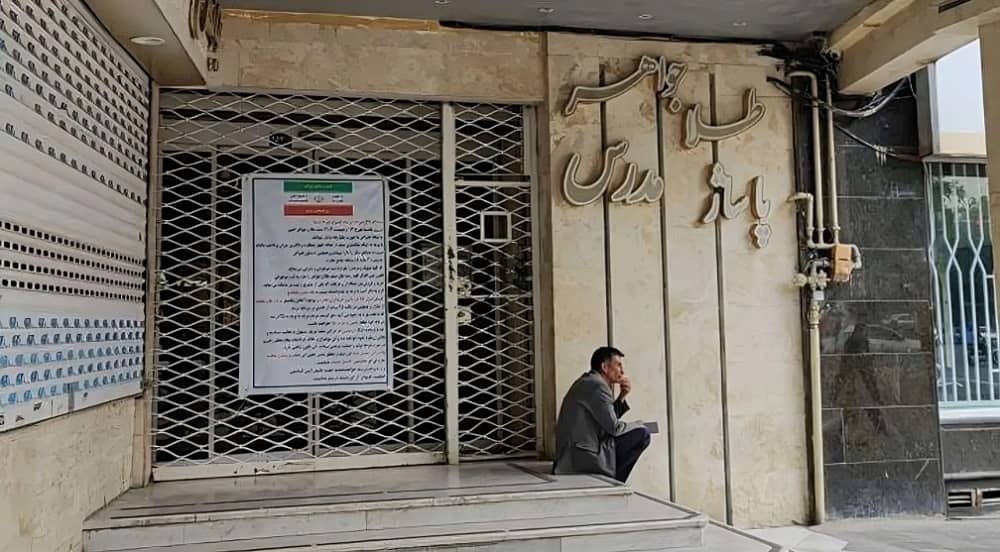
Gold markets across Iran remain shuttered as gold merchants stand firm in a nationwide strike, extending their protest against parliamentary tax legislation and the reactivation of the “Comprehensive Trade System”.
The gold market in Tehran joined the strike on Wednesday, May 9, following suit with closures initiated by gold merchants in other major cities like Shiraz, Yazd, Isfahan, Mashhad, Tabriz, Hamedan, Qom, Ardabil, Urmia, Zanjan, and more since April 28.
Recent reports reveal that provincial authorities in Khorasan Razavi, particularly in Mashhad, responded to the ongoing strike by sealing off several gold shops. Images circulating on social media depict these shops barricaded with concrete blocks, a tangible sign of the authorities’ response to the protests. Despite three days passing, these establishments remain sealed, with reports from the state-run Tajarate News indicating that approximately 70% of gold shops in Mashhad have been affected.
May 8—#Iran
Gold merchants continue strikes in Tehran, Shiraz, Yazd, Isfahan, Mashhad, Tabriz, Hamedan, Qom, Ardebil, Urmia, Zanjan, and other cities.
The strikes are in protest to new regulations that give the government free rein to arbitrarily levy on the assets of gold… pic.twitter.com/rDtzxfPgFp— People's Mojahedin Organization of Iran (PMOI/MEK) (@Mojahedineng) May 8, 2024
Nader Bazrafshan, head of the Gold and Jewelry Union of Tehran, voiced concerns shared by many within the industry regarding the implications of registering their capital in the national trade system. Bazrafshan said, “Many industry activists are concerned about future capital gains tax. Why should they register their capital, which has been accumulated over several generations, in the national trade system? Confusion has arisen in the gold industry. Electronic invoice registration in the Taxpayer System is by the Rial, whereas in the Comprehensive Trade System, it’s measured by weight. Furthermore, while it is not mandatory to register the national ID card in the Taxpayer System, the latter is mandatory in the Comprehensive Trade System.”
State officials, however, have sought to dampen fears among gold merchants merely by making promises. Mehdi Movahedi Beknazar, spokesman for Tax Affairs, assured merchants that registering gold inventory information would exempt them from capital gains tax, particularly since the law primarily applies to non-commercial individuals.
May 8—Tehran, #Iran
Tenth day of strikes by gold merchants, protesting new regulations that overtax their assets.#IranProtests pic.twitter.com/4TU4IYd0Mv— People's Mojahedin Organization of Iran (PMOI/MEK) (@Mojahedineng) May 8, 2024
Ehsan Khandouzi, the regime’s Minister of Economic Affairs and Finance, previously claimed that a significant portion of gold merchants had evaded taxes in recent years. Despite gestures from the Raisi government aimed at boosting tax revenues and combating tax evasion, exemptions for specific entities linked to the Revolutionary Guards and the Supreme Leader’s Office remain, shifting all burdens onto ordinary citizens.
Amidst these tensions, gold merchants fear that the government’s push to register their inventory may pave the way for increased taxation. This apprehension has reignited protests among gold merchants, who previously staged strikes in December, prompting officials to promise a three-month postponement of the registration plan. However, with the expiration of this grace period and renewed governmental pressure, the gold merchants’ strike has resumed, signaling ongoing discontent within the industry and the resurgence of protests.