

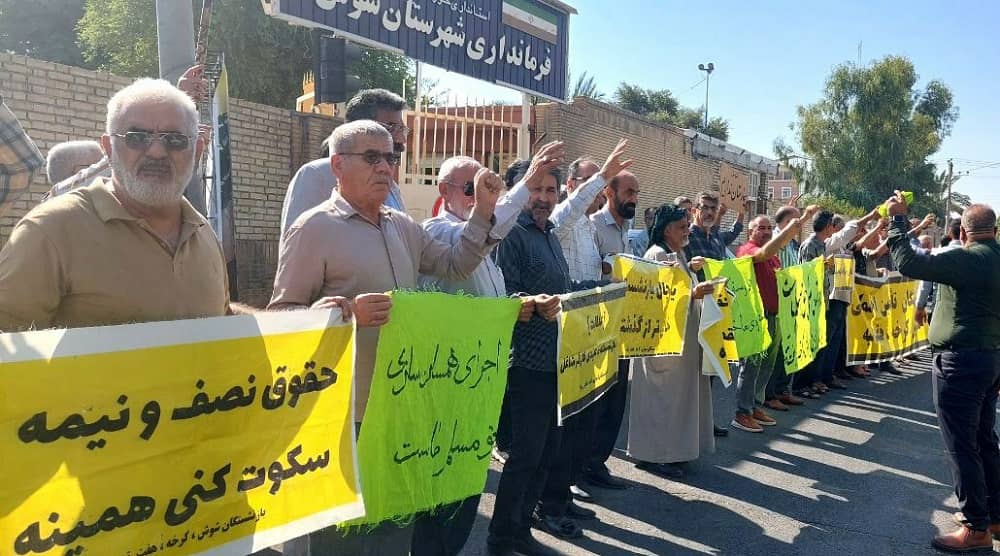
In the first week of October 2024, a new wave of protests erupted across Iran, with various sectors of society, including retirees, workers, and students, taking to the streets. These demonstrations, sparked by the regime’s economic mismanagement, oppressive policies, and neglect of basic rights, continue to spread across multiple provinces. From protests over pensions and fuel rations to strikes by industrial workers, the widespread unrest reflects the deep frustration felt by Iranian citizens under the clerical regime.
October 6
In Tehran, security forces attacked a peaceful protest by steel industry retirees. The demonstrators, demanding higher pensions and better living conditions, were met with violence, leaving several protesters injured and others arrested. The crowd responded by chanting “Both the government and parliament are oppressing people,” a slogan that has become a symbol of the growing discontent with the regime’s handling of economic issues. The steel retirees’ protest reflects the broader national frustration over pensions that fail to meet the rising cost of living in Iran.
In Shush, retirees of the Social Security Organization resumed their protests, calling for higher pensions and the release of imprisoned labor activists. This demonstration was part of a larger movement in Khuzestan Province, where retirees from Karkheh and Haft Tappeh joined the calls for justice. Economic struggles have hit southwest Iran particularly hard, with retirees left unable to cover basic living costs.
October 6—Zabol, southeast Iran
Truck drivers rally in front of the headquarters of the oil company, protesting low fuel rations and the blocking of their fuel cards for four months. #IranProtestspic.twitter.com/meNUrANAXf— People's Mojahedin Organization of Iran (PMOI/MEK) (@Mojahedineng) October 6, 2024
In Ahvaz, retirees of the Social Security Organization rallied, echoing the demands seen in Shush for better pensions and access to basic services. Protesters condemned the government and parliament, chanting slogans like “Both the government and parliament are oppressing people,” underscoring the deepening crisis in Khuzestan.
Truck drivers in Zabol rallied outside the oil company’s headquarters to protest low fuel rations and the blocking of their fuel cards, which had been inactive for four months. This demonstration highlights the dire economic conditions in Sistan and Baluchestan, where fuel shortages are crippling the local economy, leaving drivers unable to work.
Retirees in Mashhad gathered in protest, demanding higher pensions and basic necessities. This ongoing demonstration, part of a larger movement across northeast Iran, reflects the mounting economic challenges facing retirees, whose pensions are no longer enough to cover daily expenses due to soaring inflation.
Retirees in Rasht held a protest demanding better pensions and living conditions. As in other regions, retirees are struggling with an economic system that has left them without enough support, prompting nationwide protests against the regime’s failure to address their needs.
October 5
Students from medical sciences universities across Iran rallied in front of the Health Ministry in Tehran. The protest was sparked by new employment rules that would negatively affect the job security of future medical graduates. This demonstration reflects the growing dissatisfaction among professionals and students, who are increasingly facing uncertain employment prospects in the face of economic instability.
In Zahedan, members of the PMOI Resistance Units marked the anniversary of Bloody Friday, the massacre of protesters in Zahedan in 2022, by renewing their activities against the regime. The PMOI’s continued resistance in Sistan and Baluchestan underscores the region’s ongoing defiance of the regime, particularly in light of the government’s violent crackdown on ethnic minorities.
"The regime will be overthrown by Iran's people and resistance movement" pic.twitter.com/7yTWY9vGKb
— People's Mojahedin Organization of Iran (PMOI/MEK) (@Mojahedineng) October 5, 2024
October 4
Retirees from various sectors held protests in Tehran, calling for an increase in their pensions. The demonstration was marked by chants condemning both the government and parliament for their oppressive policies. These protests have become regular occurrences in Tehran, as pensioners continue to suffer under the weight of economic mismanagement and rising inflation.
In Mahr-e-Sistan, Sistan and Baluchestan Province, another tragic incident unfolded as regime forces fatally shot a Baluchi teenager riding a motorcycle at a checkpoint between Sib and Suran without warning. The passenger on the motorcycle was severely injured. This incident is a continuation of the regime’s brutal crackdown on the Baluch minority, who have long faced systemic violence and repression in southeastern Iran.
October 3
In Bandar Lengeh, residents of Lamzan gathered to protest the regime’s exploitative economic policies. The people of Lamzan have been particularly affected by government corruption and embezzlement, which have drained local resources and left communities struggling to make ends meet.
Workers from the Tazareh Mine in Damghan held a protest over job insecurity and the lack of safety measures in the mines. The miners’ demonstrations reflect the increasing frustration within the industrial workforce, where safety concerns and delayed wages have become persistent issues.
October 2
Workers and their families from the oil industry staged a protest in Bushehr, denouncing the regime’s exploitative economic policies. The workers demanded fair wages and an end to corruption within the industry, which has led to widespread dissatisfaction among the workforce in southern Iran.
More footage of protest rally by steel retirees in Tehran and the attack of by security forces against the peaceful protesters#IranProtestspic.twitter.com/9DaE31uDil
— People's Mojahedin Organization of Iran (PMOI/MEK) (@Mojahedineng) October 6, 2024
In Asaluyeh, Bushehr Province, workers at the Tenth South Pars Gas Refinery went on strike, demanding the removal of salary caps, proper retirement benefits, and an end to government interference in their pension funds. These oil and gas sector workers have been striking for weeks, highlighting the deteriorating working conditions and wage disparities across Iran’s vital energy industry. Their protests are part of a larger labor movement that has been building in southern Iran for the past two years.
In Nowsud, Kermanshah Province, security forces killed a Kurdish kulbar (freight carrier) named Tariq Nazari. A resident of Javanrud and a father of three, Nazari was shot dead while transporting goods across the Iran-Iraq border. His death is part of the regime’s ongoing violence against the Kurdish community, particularly targeting kulbars, who rely on this perilous work due to the region’s poverty and lack of economic opportunity.
October 1
Retirees of the Telecommunications Company of Iran gathered in front of the Majlis (parliament) in Tehran to demand better pensions. The demonstration, which saw retirees from across the country unite, is part of the ongoing national movement of pensioners who are demanding their rightful benefits as inflation continues to skyrocket.
In Ilam, Ilam Province, regime forces violently attacked impoverished street vendors near Enghelab Square, beating them brutally. These vendors, who struggle to make a living in western Iran, have faced repeated harassment from the authorities. The regime’s actions reflect a broader pattern of economic oppression targeting the most vulnerable segments of society.
October 5—Tehran, Iran
Medical sciences university from across the country rally in front of the Health Ministry, protesting new rules that affect their employment status.#IranProtestspic.twitter.com/NEN2x9PeS5— People's Mojahedin Organization of Iran (PMOI/MEK) (@Mojahedineng) October 6, 2024
The protests across Iran reflect the nation’s mounting economic crisis and the regime’s inability to address the needs of its citizens. With demonstrations spreading across multiple sectors, from labor to retirees to students, the unrest signals a growing nationwide call for accountability and justice in the face of increasing state oppression.