

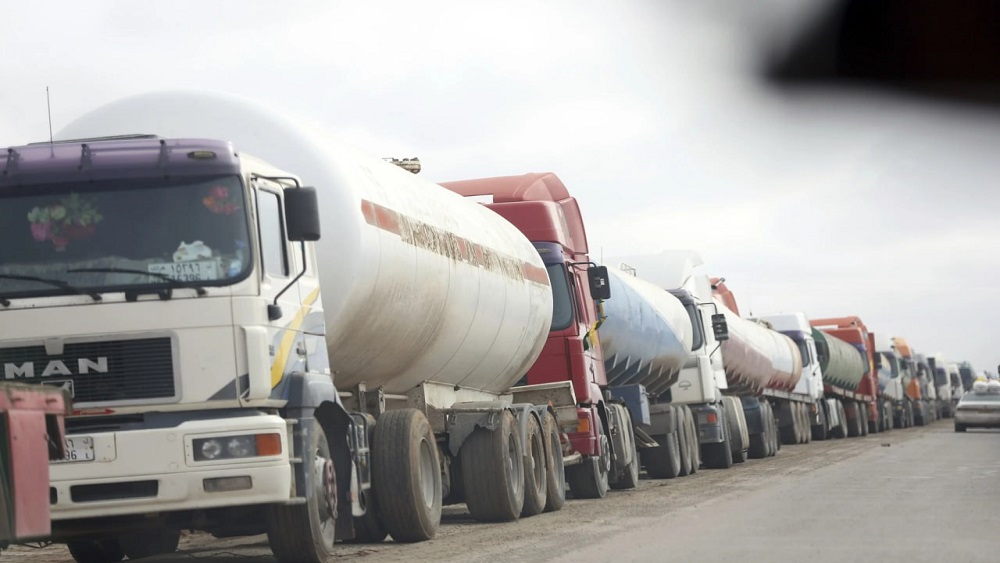
A powerful nationwide strike by tens of thousands of Iranian truck drivers entered its sixth consecutive day on Tuesday, May 27, 2025, crippling supply chains and sending a clear message of defiance to the clerical regime. The strike, now reportedly encompassing over 125 cities, underscores the deepening economic crisis and widespread discontent fueled by the regime’s policies.
Alongside this formidable industrial action, other sectors of Iranian society have also voiced their grievances through protests and rallies, painting a picture of a nation pushed to its limits.
May 27—Iran
Sixth day of strikes and protests by truck drivers across Iran. Videos from Nasim Shahr (Tehran province), Golpayegan (Isfahan province), Bukan (West Azarbaijan province), and Gonabad (Khorasan Razavi province).#IranProtestspic.twitter.com/W0OhB4j4Cd— People's Mojahedin Organization of Iran (PMOI/MEK) (@Mojahedineng) May 27, 2025
The resilience of the truck drivers is evident across the country. In Kermanshah, western Iran, drivers reiterated their commitment to the strike, refusing to load cargo until their demands are met. Similar scenes of parked trucks and determined drivers were reported from Mahidasht (Kermanshah province), Gonabad in the northeast, Golpayegan and Arak in central Iran, and Nasim Shahr in Tehran province. Videos showed deserted highways, such as the road from Zarrin Shahr to Shahrekord in western Iran, normally bustling with freight traffic, now conspicuously empty.
In the capital, Tehran, at the Molavi intersection, striking drivers declared, “No loads are coming, no loads are going,” a stark indication of the strike’s impact. One driver in Tehran stated that truckers at the Siahsang industrial town were refusing to work due to the high price of diesel. At the “Jahan Peymanbar” loading center near Molavi Square in Tehran, another driver confirmed, “Today, May 27, the drivers’ strike continues; no cargo is coming, no trucks are moving.”
May 27—Golpayegan, central Iran
Sixth day of strikes by truck drivers in tandem with similar protests across the country.#IranProtestspic.twitter.com/AJE46ot5Ib— People's Mojahedin Organization of Iran (PMOI/MEK) (@Mojahedineng) May 27, 2025
The drivers’ demands are rooted in the severe economic hardship they face. They are calling for fair commission rates, a significant reduction in the exorbitant prices of spare parts, tires, and crucially, fuel. Truckers are often forced to purchase diesel at 6,000 tomans per liter on the open market, double the official rate of 3,000 tomans, as the National Oil Company allegedly fails to provide adequate supply. Furthermore, they are protesting crippling insurance costs.
Truckers can be charged 4.7 million tomans for insurance from a monthly income of 17.7 million tomans, while the estimated cost of a minimum living basket for a family exceeded 35 million tomans as of March 2025 – a figure that has likely increased with rampant inflation. Delayed payment for their services, sometimes stretching up to four months after delivering goods, further exacerbates their financial precarity.
May 27—Iran
The IRGC is trying to break the nationwide strike of truck drivers by carrying cargo with its own trucks and armed escorts.#IranProtests pic.twitter.com/K6bK5c1Cjh— People's Mojahedin Organization of Iran (PMOI/MEK) (@Mojahedineng) May 27, 2025
In a desperate attempt to undermine the strike, reports indicate the Islamic Revolutionary Guard Corps (IRGC) is trying to move cargo using its own trucks, often accompanied by armed escorts.
Security forces have also been heavily deployed in cities like Qazvin, where one driver noted, “As always, with a security presence, they want to force us to load, but the honorable drivers are standing firm.” Despite these intimidation tactics, including threats and “psychological warfare,” drivers have shown remarkable resolve. In Kermanshah, they actively refuted state media claims that the strike had ended, emphasizing their continued protest.
The truckers’ courageous stand is not an isolated event. On May 27, sanitation workers in Shiraz, southern Iran, rallied outside the Fars Province governor’s building. They protested unpaid insurance and hardship allowances, decrying the lack of response from municipal and other responsible authorities. One worker lamented, “These are all sanitation workers who came at 2 AM. They collected people’s trash until 4 PM. Their work share isn’t paid, their insurance isn’t paid, and there’s no inspection… We went to the municipality, the governorate, the city council, nobody, sir, is addressing our plight.”
May 27—Shiraz, southern Iran
Rally by sanitation workers outside the Fars Province governor's building, protesting unpaid insurance and hardship allowances, and lack of response from municipal and other responsible authorities.#IranProtestspic.twitter.com/V986LAEDZW— People's Mojahedin Organization of Iran (PMOI/MEK) (@Mojahedineng) May 27, 2025
The previous day, May 26, saw school bus drivers in Qarchak protesting, with chants like “The company must be closed down!” and “We won’t pay extortion money!” On the same day, fishermen from the Fisheries Department in Abadan gathered to protest persistent issues with permits, stating, “They keep giving us the runaround every day. They harass us every day.”
Beyond the immediate economic grievances, a growing political dimension is emerging from these protests. From a previous day of the strike, one driver in Kermanshah was heard shouting the powerful slogan, “Neither Shah nor Supreme Leader, damn every oppressor!” Another driver in Kangavar asserted, “Only in a popular republic can we get our rights.”
These sentiments reflect a deeper frustration with the entire ruling system, suggesting that the protests are evolving from purely economic demands to a broader call for fundamental change. The striking truckers are becoming the vanguards of an uprising that is taking a step from economic pressures towards political demands; a step against a religious dictatorship that has enslaved Iran’s workers and laborers for decades.
May 27—Shahrekord, western Iran
The road from Zarrin Shahr to Shahrekord is empty as truck drivers continue their strikes and protests for the sixth consecutive day.#IranProtests pic.twitter.com/PxwT8udxTS— People's Mojahedin Organization of Iran (PMOI/MEK) (@Mojahedineng) May 27, 2025
The NCRI’s Labor Committee has issued a call to the International Labor Organization and trade unions worldwide to condemn the anti-labor policies of the mullahs’ regime and support the minimum demands of the striking truck drivers. The regime, particularly Supreme Leader Ali Khamenei and the IRGC, control major production and distribution conglomerates like “Shasta” (Social Security Investment Company), leading to widespread plunder and corruption that affects all segments of Iranian society.
The escalating strikes and protests across Iran, spearheaded by the determined truck drivers, reveal a populace increasingly unwilling to bear the brunt of the regime’s economic mismanagement, corruption, and repressive policies. The convergence of economic hardship and political aspiration signals a critical juncture. The fight for basic rights and dignified living is inextricably linked to the call for fundamental change, a call that aims to reclaim the usurped popular sovereignty through uprising and resistance. The wheels of protest, set in motion by Iran’s truckers, may well be driving the nation towards a new horizon.