

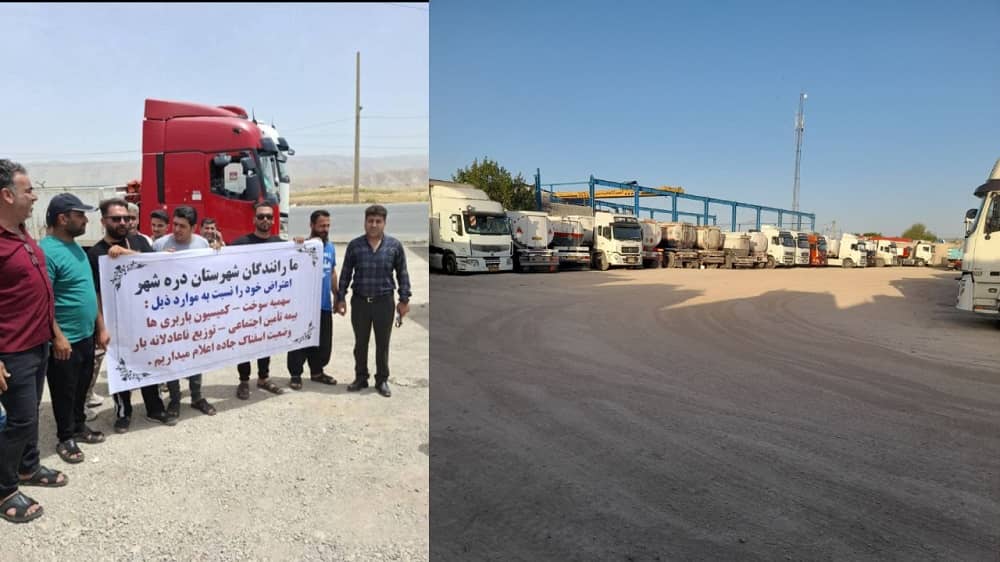
A significant nationwide strike by truck drivers across Iran, entering its second day on May 23, 2025, has cast a harsh spotlight on the severe economic conditions gripping the country.
This coordinated action, protesting high fuel prices, low pay, and a raft of other economic grievances, signals deepening discontent and highlights the regime’s persistent failure to address the fundamental needs of its working population. The strike’s widespread nature and the clear articulation of demands underscore a growing crisis that the authorities can no longer ignore.
On Friday, May 23, 2025, the truckers’ strike continued for a second consecutive day, with significant participation reported in numerous cities. Images and reports indicated that truck drivers in Asadabad (Hamedan province), Eslamabad-e Gharb (Kermanshah province), Isfahan, Baft (Kerman province), Bandar Abbas (Hormozgan province), Divandarreh (Kurdistan province), Fasa and Kazerun (Fars province) joined the work stoppage.
May 23—Fasa, southern Iran
Truck drivers in Fasa join nationwide strikes in protest to high fuel prices, low pay, and other economic grievances.#IranProtestspic.twitter.com/oR0jBDvs5F— People's Mojahedin Organization of Iran (PMOI/MEK) (@Mojahedineng) May 23, 2025
In Fasa, southern Iran, drivers explicitly protested high fuel prices, low pay, and other economic grievances. Similarly, in Ilam, western Iran, drivers continued their strike as their demands, including those related to fuel costs and wages, remained unaddressed by the regime.
This new round of protests began in a coordinated manner on Monday, May 19, 2025, with dozens of truck drivers striking in Bandar Abbas, a critical southern port city. Protesters there stopped at the entry and exit points of the port. The strike gained momentum on Thursday, May 22, 2025, the first official day of the nationwide action, with drivers in Arak (Markazi province), Ilam, Bandar Abbas, Tabriz (East Azerbaijan province), Sirjan (Kerman province), Shiraz (Fars province), and Kermanshah ceasing work.
The “Union of Truckers and Drivers Associations of Iran” had previously issued a statement calling for the strike.
May 23—Ilam, western Iran
Truck drivers continue strikes as the regime continues to ignore their grievances, including high fuel prices and low pay.#IranProtestspic.twitter.com/1BN3l6XWbF— People's Mojahedin Organization of Iran (PMOI/MEK) (@Mojahedineng) May 23, 2025
The striking drivers have articulated clear demands, centered on the economic unsustainability of their profession under current conditions. Key grievances include the reduction of diesel fuel quotas, the high cost of insurance, persistently low freight charges that do not cover operational costs, and other unmet professional demands.
The union’s statement powerfully conveyed their resolve: “We strike because we demand our rights. We stand together because our unity is the only thing that turns this wheel in our favor. Today, from the heart of Lorestan to the soil of Khuzestan, from the southern ports to the northern roads, the trucks are silent, but the voices of the drivers are echoing louder than ever.” The drivers have indicated their intention to continue the strike for a week if their demands are not met.
The truckers’ grievances echo across other essential sectors also struggling under the weight of the regime’s economic mismanagement and neglect. On Thursday, May 22, 2025, bakers in Sanandaj, western Iran, held protest gatherings. They decried the regime’s failure to provide stable utility rates, the rising cost of ingredients, and the unreliability of essential services like water and electricity, which they stated were either unavailable or prohibitively expensive. One striking Sangak baker in Sanandaj highlighted that promised rate adjustments had not materialized while their costs, including for these vital utilities, had soared.
May 22—Kermanshah, western Iran
Tanker drivers on strike, protesting high fuel prices and low income.#IranProtests pic.twitter.com/JDOkHsB6QN— People's Mojahedin Organization of Iran (PMOI/MEK) (@Mojahedineng) May 22, 2025
Further illustrating the dire situation for small businesses providing essential goods, a baker in Jakigour, Sistan and Baluchestan province, also on May 22, directly condemned local and provincial officials for unannounced and unplanned power cuts.
He lamented that these outages were ruining their dough, directly impacting the people’s access to bread, and criticized the poor quality of flour provided. He described the situation as a “theft” and demanded accountability from officials for the financial losses incurred by bakeries due to these disruptions and the lack of prior notification for blackouts. These protests by bakers coincide with wider public discontent in various cities over power cuts and the non-payment of subsidies, reported on May 23.
The impact of the strike has been visibly significant. Videos emerging from Iran show transit routes, typically bustling with freight trucks, unusually empty. Coordinated gatherings of striking drivers have also been reported in various cities, demonstrating a high level of organization. Despite the widespread nature of the protest and its clear economic ramifications, reports indicate that the regime continues to ignore the drivers’ grievances. This lack of response is a recurring theme, further fueling the frustration of a sector vital to the nation’s economy.
May 22—Sanandaj, western Iran
Protest by bakers, highlighting their grievances over escalating costs and lack of government support.#IranProtestpic.twitter.com/U2jcDMf3yP— People's Mojahedin Organization of Iran (PMOI/MEK) (@Mojahedineng) May 22, 2025
This is not the first time Iranian truck drivers have resorted to strike action to protest their dire economic situation. In the spring of 2024, drivers protested the method of allocating diesel quotas and the failure of freight rate increases to keep pace with soaring costs.
In one notable instance, truckers in Tehran brought their vehicles to a standstill on the Babayi Expressway. The recurrence of these strikes, centered on largely unchanged grievances, points to a systemic failure by the regime to address the deep-rooted economic problems plaguing not only the transportation sector but the Iranian economy as a whole.
The ongoing nationwide truckers’ strike is more than just an industrial dispute; it is a potent manifestation of the widespread economic hardship and frustration simmering across Iran. The drivers’ unity and determination in the face of official indifference expose the regime’s inability or unwillingness to manage the economy effectively or respond to the legitimate demands of its citizens. As trucks remain parked and vital supply chains are disrupted, this powerful display of organized dissent serves as a stark reminder of the deep economic rot hollowing out the country and the Iranian people’s increasing resolve to demand accountability and change.