

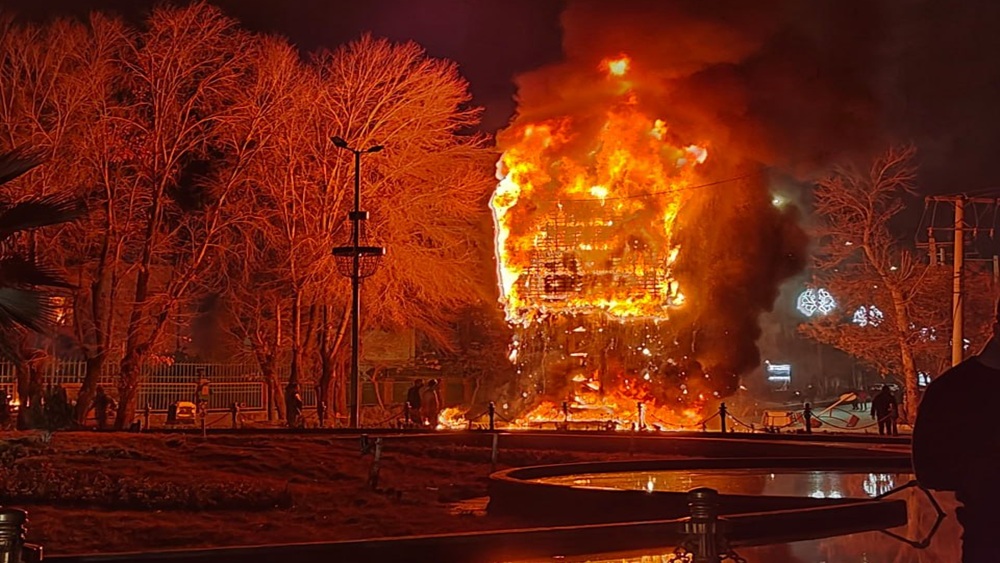
As the nationwide uprising against the clerical regime in Iran marks its 27th day on January 23, 2026, the mullahs’ regime finds itself confronting what its own security apparatus now describes as an “existential threat.” Despite a near-total information blackout, reports leaking from the country depict a volatile landscape where unprecedented state brutality is being met with organized, fearless resistance.
According to NetBlocks, Iran remains engulfed in a severe internet blackout now entering its third week, spanning over 348 hours. While the regime attempts to manufacture false traffic data to feign normalcy, the reality on the ground is a militarized crackdown. On Friday, January 23, video footage from Zahedan showed a massive deployment of security forces surrounding the Makki Mosque and its prayer hall. Security personnel were stationed at short intervals, monitoring citizens’ movements to prevent the weekly post-prayer demonstrations that have become a hallmark of the city’s defiance.
⚠️ Update: #Iran remains in the midst of a national internet blackout in its third week at hour 348 with only a slight rise in overall connectivity and tunneled users. There are indications of an attempt to generate false traffic and manufacture narratives of a wider restoration. pic.twitter.com/nIMSfqCj6e
— NetBlocks (@netblocks) January 23, 2026
Rasht: A City in Revolt
New detailed reports from Rasht, covering the events of January 8 and 9, offer a window into the intensity of the clashes hidden by the internet blockade. Local reports describe a city where protesters effectively wrested control of key districts from state forces during the intense day of protests.
During these two days, symbols of government repression were systematically targeted. The “Shahid Khojasteh” Basij base near Gaz Square was set ablaze by rebellious youth, and the “Imam Sajjad” clinic on Namjoo Street—identified by locals not as a medical facility, but as a detention and torture center for the Revolutionary Guards (IRGC)—was burned down. Protesters reported that in previous uprisings, ambulances were used to transport detainees to this location for interrogation.
January 9—Rasht, northern Iran
Aftermath of protests in Rasht. After the regime's security forces tried to brutally suppress demonstrations, protesters set fire to regime buildings.#IranProtests pic.twitter.com/fpA40Ur0y4— People's Mojahedin Organization of Iran (PMOI/MEK) (@Mojahedineng) January 10, 2026
The conflict in Rasht involved heavy weaponry. Eyewitnesses reported that security forces, including plainclothes agents and high-ranking officers, opened fire with G3 battle rifles, Kalashnikovs, and machine guns. The violence was indiscriminate; in one harrowing account, bodies of the slain were transported by dump trucks to the Bagh-e Razvan cemetery. Families seeking to retrieve their loved ones were reportedly told they must pay 800 million tomans to claim the bodies. Despite this brutality, residents in Rasht were seen distributing sweets and flowers on Friday afternoon, buoyed by rumors that other cities had fallen to the people.
The “New Kahrizak” and the Human Cost
The crackdown has birthed new sites of horror comparable to the infamous Kahrizak Forensic Center. Reports from Kermanshah on January 9 describe a massacre at the Khomeini Stadium on Taq-e Bostan Boulevard. Local sources indicate that IRGC forces, alongside Fatemiyoun and Iraqi Hashd al-Shaabi militias, corralled protesters into the stadium.
January 8—Kermanshah, western Iran
Security forces use lethal force and are directly shooting at demonstrators during nightly rallies.#IranProtests #IranRevolution pic.twitter.com/GWOgmnkqBC— People's Mojahedin Organization of Iran (PMOI/MEK) (@Mojahedineng) January 8, 2026
A local doctor and witnesses at the scene alleged that vital organs were harvested from wounded protesters before they were executed. The volume of casualties was reportedly so high that the stadium grounds could not contain all the bodies.
These atrocities have done little to silence the grieving families. At the funeral of Daniel Dayani, a law student from Kermanshah’s Razi University killed on January 8, his mother was filmed clutching his picture and chanting, “Khamenei the executioner, rule over our children’s blood now.” Her defiance echoes the sentiments of a population that has lost its fear.
Regime Admissions of Weakness
In a significant revelation of the regime’s fragility, the IRGC Intelligence Organization issued “Statement No. 3,” explicitly categorizing the uprising as an “existential threat” to the state. The statement admitted to the detention and summoning of 735 individuals described as “key elements” and the seizure of over 700 weapons.
The IRGC’s rhetoric reveals a deep anxiety regarding the organized nature of the protests, referring to them as a “hybrid operation” designed to create “internal chaos” and “group movements.” By acknowledging the need to “guide” 11,000 people and claiming to have neutralized a “lightning operation,” the security apparatus has inadvertently confirmed the scale and coordination of the uprising they are struggling to suppress.
International Outcry and Demands for Justice
The international community is reacting to the escalating violence with increasing urgency. Maryam Rajavi, President-elect of the National Council of Resistance of Iran (NCRI), welcomed the convening of a UN Human Rights Council session to address the crisis. She highlighted the regime’s use of DShK 50-caliber machine guns against civilians and the killing of children, including a five-year-old shot in his mother’s arms.
We welcome the convening of the @UN_HRC session to address the horrific crimes committed by the Iranian regime during the January uprising.
Once again, on the direct orders of Khamenei, the clerical regime has perpetrated a grave crime against humanity.
The international… pic.twitter.com/Al1yimN3Rx— Maryam Rajavi (@Maryam_Rajavi) January 23, 2026
“Verbal condemnations no longer solve the problem,” Rajavi stated, calling for the UN Security Council to hold Ali Khamenei and other leaders accountable for crimes against humanity.
Simultaneously, the European Parliament adopted a strong resolution condemning the repression. Dr. Alejo Vidal-Quadras noted that the Parliament overwhelmingly rejected a proposal to invite Reza Pahlavi to speak, a move he described as a rejection of “opportunistic non-entities” fabricated by Western media, thereby validating the NCRI as the primary opposition voice.
The European Parliament has adopted a very strong resolution condemning the brutal repression of the Iranian people by the criminal mullahs’ regime. The Chamber has also rejected by an overwhelming majority to invite Reza Pahlevi to speak in plenary. After all, he represents…
— Alejo Vidal-Quadras (@VidalQuadras) January 22, 2026
UN experts and the World Organisation Against Torture (OMCT) have also issued statements confirming credible reports of unlawful lethal force, noting that many victims were shot with metal pellets while fleeing or had their backs turned.