

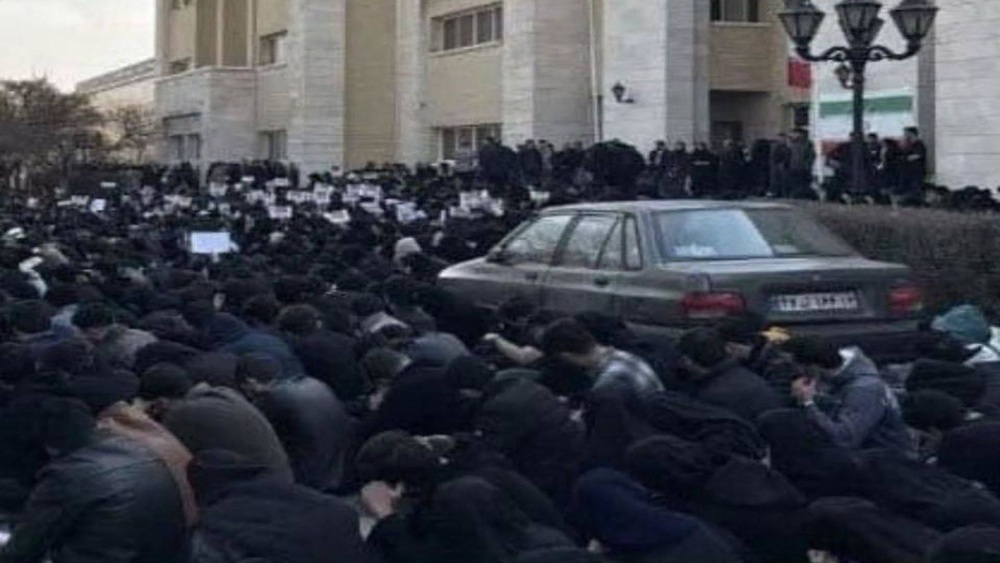
Despite the Iranian regime’s frantic efforts to project control through severe internet blackouts and violent suppression, the nationwide uprising has persisted into February 2026. On Sunday, February 1, defiance flared once again across university campuses as students launched a coordinated boycott of end-of-semester exams. This internal resistance coincides with new revelations regarding the staggering human cost of the crackdown and an intensifying international campaign to hold the regime’s leadership accountable.
“Empty Seats for Martyrs”: Universities Defy Normalcy
On Sunday, February 1, 2026, students in major cities including Tehran, Tabriz, Mashhad, and Ahvaz refused to sit for their scheduled examinations. According to reports from the Amirkabir Newsletter, the boycott was organized to protest the ongoing killing of protesters and the detention of university peers.
At the University of Tehran’s School of Medicine, the protest took on a particularly poignant visual form. In an exam hall where students refused to write their papers, a single chair was left empty. On it sat a photograph of Aida Heidari, a medical student shot and killed by security forces during the uprising, draped in black fabric.
Simultaneously, students at medical science faculties in Tabriz, Mashhad, and Ahvaz held protest rallies on campus grounds instead of attending exams. Their demands were specific: an immediate halt to the state-sanctioned killing of civilians and the unconditional release of abducted students. These actions signal that the university, historically a bastion of political change in Iran, remains paralyzed by dissent despite the administration’s attempts to force a return to normalcy.
🚨 Simay Azadi EXCLUSIVE | Iran Protests — Karaj Mehrshahr, Karaj — January 8, 2026
This exclusive report and video show rebellious youth blocking the advance of regime forces by setting streets on fire, cutting off access routes amid the uprising. pic.twitter.com/k7UJ3yT7MZ
— SIMAY AZADI TV (@en_simayazadi) February 2, 2026
52 Children Among Newly Identified Victims
As students rallied, the sheer scale of the regime’s lethality came into sharper focus. On Monday, February 2, the People’s Mojahedin Organization of Iran (PMOI/MEK) released the names of an additional 810 martyrs of the nationwide uprising following a rigorous verification process.
This latest release brings the total number of verified identities published by the PMOI to 2,257. The demographic breakdown of the new list reveals the indiscriminate nature of the violence: it includes 69 women and 52 children and adolescents between the ages of 10 and 17.
The geographical distribution of the casualties indicates that the crackdown has been most severe in major urban centers. Tehran accounts for 610 of the confirmed deaths, followed by Isfahan with 310, Khorasan Razavi with 201, and Alborz with 170. The PMOI noted that while 152 minors have been confirmed killed so far, the actual number is likely considerably higher as verification continues.
🚨 Iran Protests Update| Babol
At the funeral of Mehdi Ghadimi, a young footballer killed by gunfire during the uprising, mourners honored his sacrifice, chanting:
“Well done, Mehdi!”
“You are our pride, Mehdi!” pic.twitter.com/ubkX1Lu2WM— SIMAY AZADI TV (@en_simayazadi) February 2, 2026
Regime Officials Admit Fragility: “We Wouldn’t Be Here Today”
The persistence of the uprising appears to have rattled the highest echelons of the clerical establishment. In a speech at the grave of the regime’s founder Ruhollah Khomeini on Monday, February 2, Judiciary Chief Gholam-Hossein Mohseni-Eje’i offered a rare admission of the system’s vulnerability.
Eje’i characterized the uprising as a “coup” and acknowledged the severity of the threat it posed to the regime’s survival. “If the hand of God hadn’t come out… and if [the protests] hadn’t been neutralized, we would then understand if it was a coup or not,” Eje’i stated. He concluded with a stark admission: “If what they predicted had happened, we would not have this day today.”
This rhetoric coincides with angry reactions from the Islamic Revolutionary Guard Corps (IRGC) following their recent terrorist designation by the European Union. State-affiliated media outlets described the EU’s move as hindering “constructive cooperation,” while lashing out at European nations for harboring opposition groups.
🚨 Iran Protests | Gorgan — January 2026
At the funeral of Reza Asadi (30), killed by gunfire during the uprising, his father declared at the graveside:
“My son is a sacrifice for the people and the homeland.”
Mourners answered in unison:
“This fallen flower gave his life for our… pic.twitter.com/b51uf117k3— SIMAY AZADI TV (@en_simayazadi) February 1, 2026
International Isolation and Reports of Atrocities
Internationally, the regime faces mounting punitive measures. On February 2, the United Kingdom announced a sweeping package of sanctions targeting ten individuals and the Law Enforcement Forces (FARAJA) for human rights violations.
UK Foreign Secretary Yvette Cooper designated high-profile officials, including Eskandar Momeni, the regime’s Minister of Interior, and various provincial police chiefs. Among those sanctioned are Mohammad Reza Hashemifar, Police Chief of Lorestan, and Yadollah Bouali, an IRGC commander in Fars Province, both cited for their roles in lethal violence against protesters. The package also includes asset freezes for judges in Rasht who issued death sentences to activists.
Simultaneously, international media is documenting the brutality on the ground. A report by The Sun detailed “death squad atrocities,” citing witnesses who described security forces using DShK 50-caliber machine guns—weapons typically used in warfare—against unarmed civilians in city streets. The report highlighted the regime’s attempts to hide bodies in mass graves and the execution of doctors who treated the wounded.
Maryam Rajavi, President-elect of the National Council of Resistance of Iran (NCRI), described the crackdown as a “grave crime against humanity,” noting that the international community faces a “litmus test” on how it addresses a regime engaged in genocide.
As the uprising grinds on, the contrast between the regime’s narrative of control and the reality on the ground deepens. With students refusing to participate in the academic system and the death continuing to rise, the “coup” that Eje’i fears appears to be a persistent, nationwide rejection of the dictatorship itself.