

Three-minute read
The latest designation of the Islamic Revolutionary Guard Corps as a terrorist organization is not simply a move against one armed institution.
It is a belated acknowledgment that, in many of the Iranian state’s most important rooms, the people making decisions are not distant from the Guard. They are products of it, alumni of it, and in some cases senior figures of it.
If policy makers want to understand what is newly actionable here, they should begin with the roster of power, not the rhetoric.
The secretary of the Supreme National Security Council is Ali Larijani, is a former IRGC commander. The same security council leadership role was previously held by Ali Akbar Ahmadian, a senior IRGC officer. The speaker of parliament is Mohammad Bagher Ghalibaf, a former IRGC commander. In the cabinet, the foreign minister Abbas Araghchi enlisted in the IRGC during the Iran–Iraq War. The interior minister Eskandar Momeni is another figure who emerged from the IRGC’s security ecosystem.
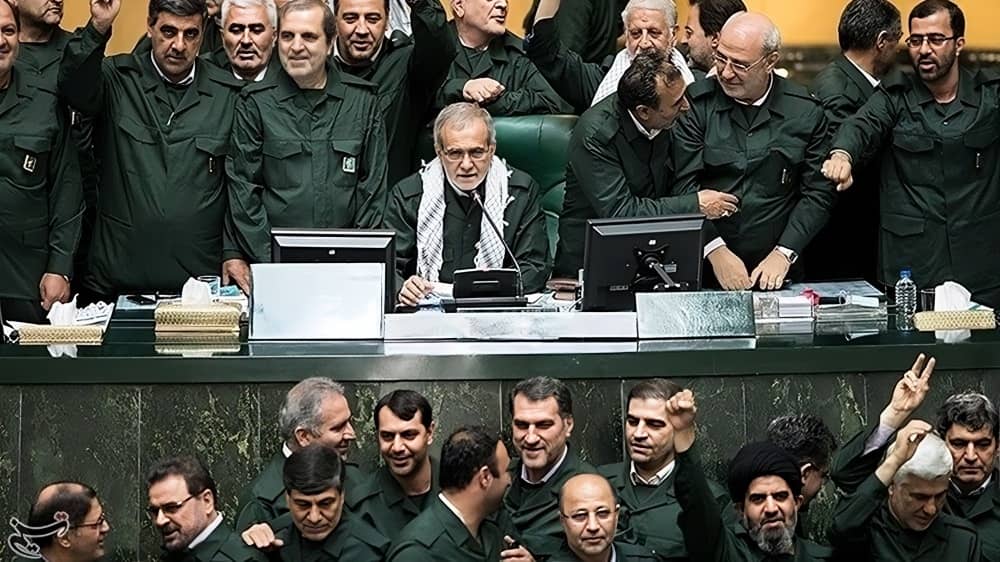
On Sunday, 1 February, 2026, the entire chamber of Iran’s Parliament (Majles) appeared in IRGC uniforms and chanted slogans against Europe and the United States—a display that underscored a basic reality about power in Iran: more than 51% of the parliament’s members are former IRGC commanders, meaning the institution is no longer merely influenced by the Guard, but is structurally staffed by figures shaped inside its command-and-security ecosystem.
Blacklist IRGC as a terrorist group and evict it from the entire region#FreeIran pic.twitter.com/AH4mjd61is
— Maryam Rajavi (@Maryam_Rajavi) July 1, 2017
That is why the designation should change European policy thinking. It is not just “the IRGC is bad.” It is: the state you are engaging is staffed by people whose careers were shaped inside the IRGC system, and whose advancement depends on demonstrated loyalty to that system.
A state that rewards complicity produces officials tied to coercion
In Iran, merit is not neutral competence. The most reliable route upward is loyalty that is tested under pressure: war service, intelligence work, internal security, and crisis management inside the security apparatus. Over time, that produces a governing class in which the line between “civilian” and “security” is political theater.
The cabinet illustrates the point. Public biographies and reporting have tied multiple serving ministers to IRGC service or IRGC units: Esmail Khatib (intelligence), Abbas Aliabadi (energy), and Ahmad Donyamali (sports and youth) are routinely described in that direction in public profiles, alongside Momeni. This is not an argument about whether each minister personally ordered a specific act. It is a structural point: when the system promotes IRGC backgrounds into the state, engagement with “the government” becomes engagement with the Guard’s governing network.
The security command layer makes it even clearer. The IRGC commander-in-chief Mohammad Pakpour was appointed by official decree. The Quds Force is headed by Esmail Ghaani; the IRGC navy is led by Alireza Tangsiri; senior IRGC leadership includes Ahmad Vahidi; the Basij has been publicly linked to senior IRGC command under Gholamreza Soleimani; and national policing has been led by Ahmad-Reza Radan, a figure described as coming from the security forces that overlap with the IRGC power system.
Interview w/ the @FoxNews: The US should designate the #IRGC as a terrorist entity 4 its crimes against humanity in #Iran and the region pic.twitter.com/U13dmDOdU6
— Maryam Rajavi (@Maryam_Rajavi) February 22, 2017
The reality is that the IRGC cannot be treated as merely a “hardline faction” within an otherwise normal state. The IRGC is a central pillar of the state, and the state is increasingly staffed by those shaped by those shaped the IRGC.
Make the designation operational
The value of a terrorist designation is practical leverage: freezing assets, blocking services, and criminal exposure for those who facilitate a listed network. Policy should therefore focus on the IRGC’s real bloodstream—finance, procurement, logistics, and front structures—rather than on speeches or diplomatic theater.
That means sustained, cross-border pressure on intermediaries and cutouts: beneficial ownership enforcement, customs scrutiny, shipping and insurance checks, dual-use export controls, and prosecutions where evidence permits. If the IRGC is the target, the ecosystem that funds and equips it cannot be treated as “ordinary business.”
EU decision to blacklist top Iran Guards, terrorist Qods Force & IRGC’s intelligence org is movement in right direction #iranelection
— Maryam Rajavi (@Maryam_Rajavi) June 26, 2011
No safe haven, and recognize the right of self-defense
States should ban entry for officials credibly linked to the IRGC network, expel operatives using diplomatic cover where security grounds exist, and pursue prosecution for those on credible wanted lists or under warrants. The premise must be simple: listed terrorist structures do not get privileged access to foreign soil.
The next step is also political: acknowledging the Iranian people’s right to self-defense against a tyrannical, terrorist state. This means ending the reflex to treat the regime as the only legitimate actor. In practice it means protecting victims and enabling lawful resistance—safe haven pathways, secure communications, and accountability mechanisms that raise the cost of repression.