

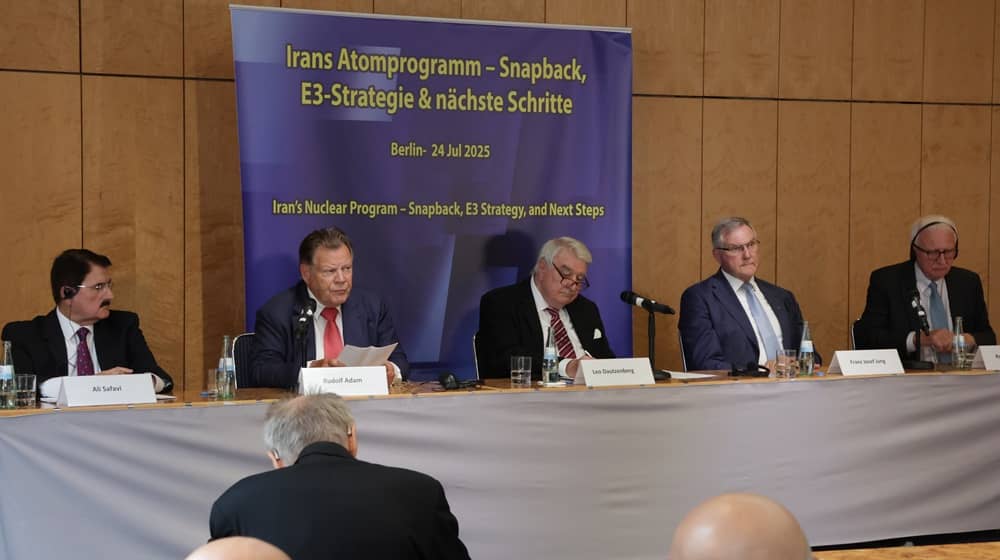
At a conference in Berlin on July 24, 2025, international security experts and former officials from Germany and the United States called for the immediate activation of the snapback sanctions mechanism against the clerical dictatorship in Iran. With the clock ticking toward the October deadline, speakers emphasized that Tehran’s growing nuclear ambitions, regional destabilization through proxies, and open defiance of international commitments present an urgent threat to global peace. The conference also underscored the legitimacy of the Iranian opposition and the need for a democratic alternative to the regime.
Leo Dautsenberg, former German MP and chair of the German Solidarity Committee for a Free Iran, opened the conference by highlighting the pivotal role of the National Council of Resistance of Iran (NCRI) in uncovering Tehran’s secret nuclear facilities. “It was the National Council of Resistance of Iran that, as early as 2002, exposed the secret nuclear facilities in Natanz and Arak, revealing the true military intentions of the Iranian regime,” he said. “Since then, they have published over one hundred revelations about Iran’s clandestine nuclear and missile programs aimed clearly at developing weapons of mass destruction.”
Dautsenberg emphasized that the time for European action was running out: “The time window for activating the snapback mechanism is closing rapidly. This question—whether the European states should act and what is politically at stake—concerns not only the Middle East but the security of Europe and the entire world.” He reaffirmed his support for the democratic opposition and urged European governments to adopt a firm, strategic posture toward the clerical dictatorship’s expanding nuclear threat.
Amb. Robert Joseph, former undersecretary of state for arms control and international at the #Berlin #Iran Conference:
“Negotiations with the Iranian regime will get nowhere. 20—plus years of negotiation have not had positive results. They have only given the regime valuable time… pic.twitter.com/1v1XDmDJ91— Javad Dabiran (@JavadDabiran) July 24, 2025
Dr. Franz Josef Jung, former German Minister of Defense, denounced the clerical dictatorship’s support for terrorist groups such as Hamas and Hezbollah, its supply of drones to Russia in the war on Ukraine, and its ongoing uranium enrichment program. “Iran’s nuclear weapons program, in my view, represents an immediate threat to world peace,” Dr. Jung declared. “With ballistic missiles reaching up to 3,000 kilometers, this is no longer just a danger for the Middle East—it directly targets all of Europe.”
He described the snapback sanctions mechanism as a powerful legal instrument to reimpose international pressure without requiring consensus in the UN Security Council. But he stressed that sanctions alone are not enough. “The real solution for global peace lies in regime change in Iran—not through war, but through the organized resistance and the will of the Iranian people,” he said, pointing to NCRI President Maryam Rajavi’s “Third Option” for non-violent democratic transformation.
Dr. Jung warned that Tehran’s escalating crackdown on dissent reveals its internal weakness: “The regime wants the world to believe there is no democratic alternative. But the growing support for the resistance inside Iran proves the opposite.” He urged European governments to stand with the Iranian people and help secure lasting peace through democratic change.
On the eve of E3 talks with Tehran, former German DM Dr. @jungfj , Amb. Robert Joseph, Dr. Rudolf Adam & NCRI's @amsafavi urged Europe to trigger snapback sanctions & support democratic change in Iran. “Appeasement has failed—support the Iranian people.”#FreeIran2025 #Iran https://t.co/Pf3AByD7hY pic.twitter.com/ir5YaUM4Fc
— SIMAY AZADI TV (@en_simayazadi) July 24, 2025
The conference presented a clear consensus: the clerical dictatorship in Tehran cannot be trusted, time is running out, and only through immediate international pressure and support for Iran’s democratic opposition can long-term security be secured.
"The time for negotiations with Iran's regime is over. The E3 should trigger the Snapback Mechanism, reinstating UN resolutions and sanctions," @amsafavi told Simay Azadi at today's Berlin conference. #Iran pic.twitter.com/CZFsLG7ubh
— SIMAY AZADI TV (@en_simayazadi) July 24, 2025
Ali Safavi of the NCRI’s Foreign Affairs Committee delivered a sharp rebuke of Tehran’s long-standing pattern of nuclear deception, calling it not merely a proliferation risk but a full-blown credibility crisis. Safavi urged policymakers to stop treating the clerical regime as a partner in good faith and instead hold it accountable for decades of calculated dishonesty and strategic manipulation.
He traced Iran’s nuclear duplicity back to the early 2000s, citing the regime’s reliance on denial, deception, and duplicity—not only to build nuclear infrastructure under cover of diplomacy but to systematically violate every agreement from the Tehran Declaration to the JCPOA. Citing former President Rouhani’s own memoirs, Safavi revealed how Iran openly used negotiations to buy time for uranium enrichment, covert facility construction, and weaponization efforts.
He detailed alarming developments since 2015: advanced centrifuge production, uranium enrichment to 60%, obstruction of IAEA inspections, and clandestine work on warhead and delivery systems—all while portraying the nuclear program as peaceful. Safavi described this not as misunderstanding but a deliberate survival strategy, cloaked in false nationalism.
Calling for immediate action, he urged European governments to trigger the UN “snapback” mechanism, reinstate all Security Council resolutions, demand zero enrichment, and support the Iranian people and resistance—“the only force capable of ending this threat at its root.”