

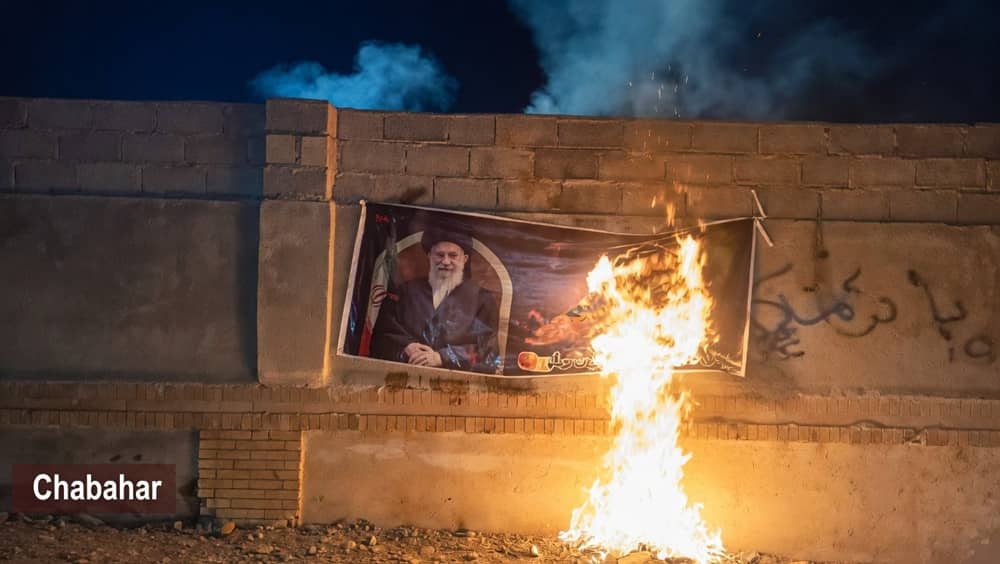
A weekly overview of the activities of MEK Resistance Units across Iran from July 11–18, 2026, reveals a significant escalation in coordinated domestic defiance that challenges the clerical establishment’s grip on power. While the regime attempted to exploit the burial ceremonies of its slain Supreme Leader to project strength, the Iranian Resistance launched an expansive, multi-city campaign of sabotage, public demonstrations, and coordinated prison strikes to exploit the widening power vacuum. The geographic spread of these operations—from the restive southeastern borderlands to the central industrial corridors and the capital—shows that the regime is confronting not isolated protests, but a nationwide, organized resistance. As the regime navigates a turbulent transition to Mojtaba Khamenei, the scale of this grassroots resistance exposes a security apparatus struggling to contain a population that increasingly views the ruling elite as deeply vulnerable.
July 17, 2026
In Zahedan, Resistance Units defied heavy security cordons to launch high-visibility street protests directly challenging the theocracy and firmly rejecting any notion of monarchical restoration. Activists expressed support for the terror blacklisting of the IRGC and highlighted the acute political weakness of Mojtaba Khamenei, whose succession remains contested by nearly half of the Assembly of Experts. Utilizing placards that rejected dictators wearing either a crown or a turban, protesters asserted the public’s unwavering memory of state-sanctioned executions and demanded the establishment of a democratic republic.
On July 10, PMOI Resistance Units launched a nationwide campaign of defiance, carrying out 25 daring operations across Iran. These courageous actions targeted the ruling clerics' apparatus of suppression, espionage, and corruption. pic.twitter.com/VDKqG27CJO
— People's Mojahedin Organization of Iran (PMOI/MEK) (@Mojahedineng) July 17, 2026
July 14, 2026
Defiance deeply penetrated the penal system as political detainees marked the 129th week of the “Tuesdays Against Executions” campaign, mobilizing coordinated hunger strikes across 58 separate correctional facilities. This internal prison resistance was amplified by synchronized underground support actions from MEK Resistance Units across Nain, Tehran, Karaj, Sari, Isfahan, Shiraz, Mashhad, Behbehan, Kermanshah, Babol, Gorgan, and Zabul, demonstrating a sophisticated, nationwide organizational network that the intelligence apparatus has proven utterly incapable of dismantling.
July 10, 2026
Directly countering the state’s heavily militarized funeral ceremonies for Ali Khamenei, Resistance Units executed 40 synchronized anti-regime operations. In Tehran, Isfahan, Babol, Yazd, and Arak, activists torched massive propaganda billboards of Ruhollah Khomeini, Ali Khamenei, Mojtaba Khamenei, and Qasem Soleimani. Kinetic strikes also battered the security infrastructure: incendiary attacks hit an IRGC Basij command center in Karaj, a student-surveillance Basij post in Zahedan, a Ministry of Intelligence billboard in Dorud, an espionage installation in Khorramabad, and a government headquarters in Aligudarz. Concurrently, anti-regime graffiti and pro-National Liberation Army placards proliferated across Mashhad, Shahin Shahr, Sari, Gorgan, Rasht, Hamadan, Kermanshah, Borujerd, and Shiraz.
PMOI Resistance Units send strong message with 25 daring operations across Iran https://t.co/ycinjbG6FT
— People's Mojahedin Organization of Iran (PMOI/MEK) (@Mojahedineng) July 15, 2026
Internal intelligence integration confirms the regime’s funeral ceremonies were merely coercive military theater; over 70 percent of attendees were forced to participate via severe threats of job termination or welfare cuts, with government employees in Kurdistan bused to Tehran and Qom under extreme duress. The regime’s structural panic culminated in the abrupt cancellation of a televised capital procession, forcing authorities to extract the casket via helicopter. This vulnerability was further compounded by deep internal fractures, visibly demonstrated by the deliberate exclusion of prominent former presidents from the official VIP proceedings.
The organized network of MEK Resistance Units is challenging the regime across Iran. In July alone, over 100 coordinated actions struck centers of repression across dozens of cities. At the same time, they are spreading slogans and messages that reject all forms of dictatorship. pic.twitter.com/pz1Lx6P7b0
— People's Mojahedin Organization of Iran (PMOI/MEK) (@Mojahedineng) July 15, 2026
This week’s developments illustrate a regime trapped in a profound existential deadlock, proving unequivocally that Tehran’s strategy of domestic terror and escalating executions has backfired. The aggressive geographic scope and tactical precision of these operations strip away the facade of totalitarian invincibility tإhat the clerical elite desperately projects to the international community. By relying on naked extortion to manufacture funeral crowds while simultaneously battling synchronized sabotage across dozens of cities, Mojtaba Khamenei’s leadership begins in a highly fragile state completely devoid of domestic legitimacy. Ultimately, these expanding underground networks prove that state terror no longer inspires systemic fear, but instead accelerates the inevitable domestic reckoning for a fractured autocracy.