

Thirteen-minute read
In the clerical dictatorship, journalism has never been treated simply as journalism. It is part of the security environment. Newspapers are licensed and closed; reporters are arrested, interrogated and surveilled; communications are restricted; contact with real sources on the ground is monitored; and foreign correspondents operate through an accreditation system in which the intelligence establishment has a formal role. Reporters Without Borders documented that representatives of Iran’s ministries of Culture, Foreign Affairs and Intelligence maintain files on foreign journalists and their outlets, with critical reporting affecting access and visas. A foreign correspondent told RSF that intelligence officials explicitly instructed him on the subjects he could not cross and even suggested language for his reports.
The system applies two pressures simultaneously. It restricts information leaving Iran while seeking to influence the information that reaches audiences abroad. RSF found that foreign agencies maintaining bureaux in Tehran faced close monitoring and the constant possibility of losing accreditation, while journalists of Iranian origin were particularly susceptible to state leverage because Tehran treats dual nationals solely as Iranian citizens. In 2026, Iran remains near the bottom of the World Press Freedom Index, and speaking even anonymously to foreign media can bring arrest or threats. A bill advanced in August 2026 would go further still, potentially criminalizing unauthorized contact with foreign news organizations and requiring notification to the Intelligence Ministry.
This is why Tehran’s struggle over journalism should be understood as a security function rather than a public-relations exercise. Censorship prevents unwanted evidence from leaving the country. Surveillance identifies the people supplying it. State media establish the official account. International broadcasting projects that account outward. Covert online networks create apparently independent messengers. And when credible foreign journalists publish arguments favorable to Tehran, those arguments can be imported back into Iranian media carrying the authority of an outside institution. The purpose is larger than making the government look good. It is to control which accounts of Iran acquire legitimacy, which opponents are regarded as credible, and ultimately whether the Islamic Republic is understood abroad as a system that can be replaced or a reality that must be accommodated.
Saeed Kamali Dehghan and Tehran’s Information War Against Iran’s Resistance https://t.co/8TciBvjgkE
— Ali Safavi (@amsafavi) August 30, 2026
From Iran’s media system to the Guardian
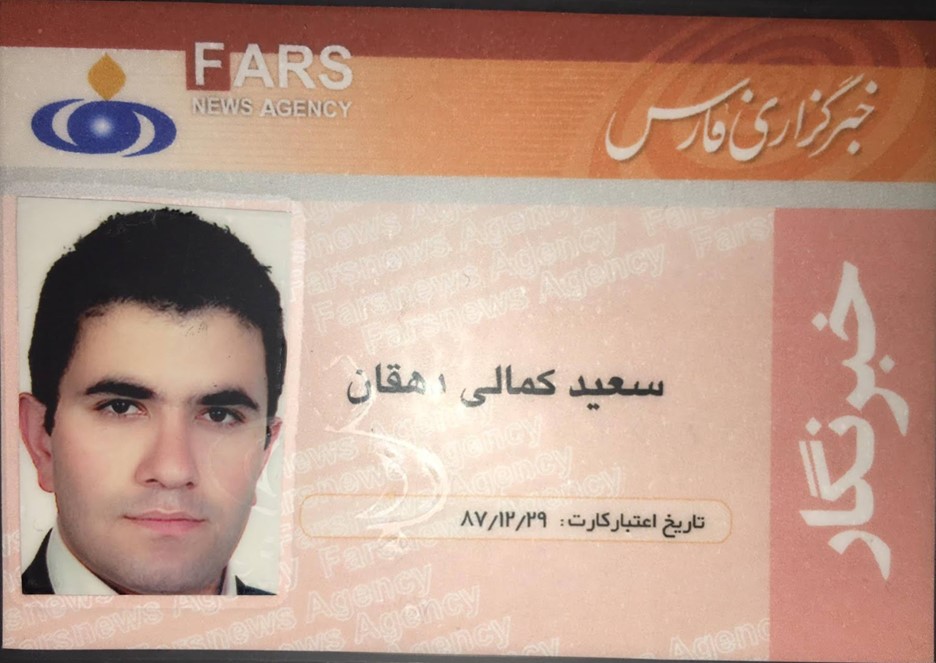
Saeed Kamali Dehghan’s career crossed several layers of that information environment. Before becoming a prominent journalist in Britain, he worked in Iran’s domestic press. Multiple sources reported in February 2020 that he had worked with the so-called reformist publications like Shargh, Etemaad and Shahrvand-e Emrooz, and for a period as a reporter at Fars News Agency. Fars is not an ordinary private news organization. In 2023, the U.S. Treasury designated Fars, Tasnim and Press TV among “IRGC and regime-controlled media outlets,” describing Fars as closely affiliated with the Revolutionary Guards and documenting coordination with the Basij and the production of intelligence reports for the IRGC commander.
His movement between “reformist” publications and Fars matters because those institutions occupied different rhetorical positions within the same restricted political system. The “reformist press” was permitted to criticize policies, officials and hardline factions while operating inside boundaries set by the state. Fars represented a security-aligned information culture. A journalist traversing those environments would become familiar with both registers: criticism from within the permissible political spectrum and the harder language of regime security. That professional background preceded his emergence as an interpreter of Iranian politics for Western readers.
His relationship with the Guardian had already begun in October 2006, while he was still living in Tehran. Index on Censorship identified him in June 2009 as a Guardian contributor from the Iranian capital who also wrote for Le Monde, the Los Angeles Times and Etemaad. This chronology is important. Dehghan did not arrive in Britain and then search for a Western platform. He developed a foreign-media role from inside Iran, at a time when journalists working for international outlets were operating inside one of the world’s most heavily supervised reporting environments.
"For over three decades, the terrorist regime in #Iran has executed a sophisticated agenda to compel the international community to accept the rule of its illegitimate theocracy in Tehran," writes @khansari_m https://t.co/2JCtVzc0Qw
— NCRI-FAC (@iran_policy) September 28, 2023
The moment that made him indispensable
The sham presidential election of June 2009 transformed his professional position. Iranian authorities expelled foreign reporters, restricted those who remained and jammed international broadcasts. Dehghan was already inside the country, spoke the language, understood the political landscape and possessed a functioning relationship with foreign editors. In his later account for the Guardian, he described the election as the moment when “everything” changed professionally: he began filing daily, appeared on front pages and became a regular source of live reporting for international broadcasters. A London agency, Global Radio News, arranged appearances, and he wrote that he gave more than 50 live television interviews during June alone.
This explains how he acquired such a large audience without resorting to mystery. The clerical dictatorship had created an information vacuum by restricting foreign correspondents; Western media urgently needed people who could report from inside that vacuum. Dehghan was unusually well positioned to fill it. His access, Iranian background and existing relationship with the Guardian made him more valuable precisely as the state made conventional foreign reporting more difficult. By 2010, he was no longer merely another contributor on Iran. He was becoming an authoritative and uniquely-positioned Western interpreter of a closed country.
His own story deepened that authority. Dehghan wrote that reporting for foreign media led to what he called a “sinister warning” from the Intelligence Ministry and that he left Iran for London with his male partner. He described their relationship as one they could not live openly in Iran and presented his departure simultaneously as the flight of a threatened journalist and a gay Iranian unable to live freely with his partner. In Britain, both elements carried readily understood markers of persecution.
Ruhollah Mo'men Nasab, parliamentary special advisor on the so-called "internet users projection bill" and former commander of the cyber army reveals how #Tehran has been using @Twitter for #propaganda.
#Iran #InternetFreedom pic.twitter.com/kHzjtlEFvR— NCRI-FAC (@iran_policy) March 29, 2022
A biography built for Western trust
That personal history gave Dehghan an unusually compelling profile in Western journalism: a reporter who had exposed repression, been threatened by Iranian intelligence, belonged to a sexual minority persecuted under Iranian law and had escaped with his partner. The Guardian itself published his account under the headline “The day I fled Iran in terror and left my family behind.” His identity was therefore not separate from his journalistic authority. It helped establish him in the eyes of readers as someone with personal experience of the state whose politics he was interpreting.
His professional credentials rapidly reinforced the story. He somehow managed to return “clandestinely to Iran” in late 2009 to film Neda Agha-Soltan’s family for the HBO documentary For Neda. In November 2010, he and filmmaker Antony Thomas jointly won the Foreign Press Association’s Journalist of the Year award, while the documentary also won the association’s documentary category. It later received a Peabody Award. By 2011–12, he had completed postgraduate journalism studies in London and become a Guardian staff journalist dedicated to Iran. His research dossier records more than 800 Iran-related bylines by August 2015.
This accumulated reputation is central to understanding what came later. Tehran possesses newspapers, television channels, diplomats and spokesmen capable of describing Iranian politics in almost any terms it chooses. What those institutions cannot manufacture easily is independent Western credibility. A Guardian correspondent who had reported government abuses, filmed the family of an iconic protest victim and personally described himself as driven into exile by intelligence pressure possessed an authority that Iranian state media could never confer on one of their own commentators.
Ambassador Mitchell Reiss recounts his experience battling #Iranian regime's misinformation and propaganda to successfully delist the MEK from the US State Department's FTO.#FreeIran2024 pic.twitter.com/gr5j3doyjW
— NCRI-FAC (@iran_policy) June 5, 2024
What he did with that credibility
Dehghan covered the 2009 uprising, political prisoners, censorship, executions, repression of journalists, Kahrizak abuses and restrictions on women. His Guardian archive contains extensive reporting that Iranian authorities had every reason to dislike. His own 2010 account of For Neda accused Tehran of trying to neutralize the impact of Agha-Soltan’s death and described the regime as sophisticated in its efforts to impose its version of events. That history was the foundation of his authority.
But when Dehghan moved from documenting abuses to interpreting what Iranians wanted politically, a different and highly consequential pattern emerged. On 7 January 2010, in “The wrong approach to Iran,” he argued explicitly against increased Western support for the National Council of Resistance of Iran. He said the NCRI did not represent the Iranian opposition, was unpopular inside Iran and that Western support for it would allow Tehran to associate domestic protesters with the organization. The article’s central policy message was that external pressure and support for regime-change opposition would worsen conditions rather than advance change.
The same underlying argument resurfaced repeatedly. In April 2017, his Guardian opinion article carried an even clearer headline: “Iran’s people care about elections. The so-called democratic fringe doesn’t.” He described prominent exile opposition forces as fringe, irrelevant to modern Iran and appealing to “gullible Americans.” More significantly, he argued that Iranian participation in elections demonstrated continued faith in gradual change and concluded that voices like Maryam Rajavi should be dismissed while reform-minded Iranians worked for change from within.
Amb. Mitchell Reiss: Outside #Iran, the regime, its allies, and its proxies continue to spread misinformation. Academics repeat and spread these lies. We need to showcase @Maryam_Rajavi, as we see her. An inspiring, committed, passionate, and democratic leader. pic.twitter.com/UKjpSNO4pW
— NCRI-FAC (@iran_policy) July 19, 2024
The political value of “reform from within”
That argument went beyond criticism of particular opposition organizations. It established a hierarchy of political legitimacy. The Islamic Republic could be repressive, but its elections still mattered. Its reformists and moderates represented authentic Iranian politics. Regime-change movements existed outside that legitimate arena and lacked meaningful domestic constituency. Western pressure empowered hardliners, while engagement gave internal reform a chance. Dehghan returned to this framework again in May 2018, warning that destruction of the nuclear agreement would mean the end of hopes for reform and strengthen Iran’s hardliners.
The principal beneficiary of that framework was the existing state. Tehran did not need Western audiences to embrace the clerical regime. It benefited if they accepted three propositions instead: the system was durable; meaningful politics occurred within it; and its organized alternatives were less credible than gradual change through its own institutions. That turns regime survival from a political preference into the supposedly realistic option. The distinction is important because it shifts the policy debate. Pressure becomes reckless, regime change becomes implausible, opposition becomes suspect, and engagement with actors inside the tyrannical regime becomes the responsible course.
Dehghan’s biography made that argument unusually persuasive. If the same propositions appeared on Press TV, readers could identify them immediately as the position of the Iranian state. When they appeared under the Guardian masthead from a journalist known for documenting executions and repression, they arrived carrying accumulated credibility. That is precisely how influence can work without crude propaganda: the power lies not only in the argument, but in who appears to have reached it independently.
New Report Shows How #Iran Regime Spread 'Fake News' Online
The Iranian regime has been caught once again spreading misinformation and 'fake news' online, according to a report published on May 14, 2019 by a research group at the University of #Toronto.https://t.co/IF7BxPQ61v pic.twitter.com/0TUud5M2gJ— NCRI-FAC (@iran_policy) May 15, 2019
How Tehran recycled his Western authority
Iranian state media understood that distinction. When Dehghan’s words supported narratives useful to Tehran, they repeatedly emphasized the institution that had given him international standing. In February 2020, Press TV did not describe him merely as an Iranian commentator. Its headline called him a Guardian journalist who had been “demoted for relatively fair reporting on Iran.” The story used his dispute with his employer to argue that British media enforced an anti-Iran agenda. His Guardian affiliation was the credential that made the claim useful.
Days later, the Tehran Times published a lengthy interview under the headline “Guardian reporter speaks out on Neda Agha-Soltan…” The subheadline foregrounded Dehghan’s declaration that he had been naive to believe the “Western narrative” surrounding Agha-Soltan’s death. The article repeatedly called him a Guardian journalist and highlighted his role in For Neda before presenting his reversal. He said he regretted making the documentary, questioned who had killed Neda and described himself as having been sent to Iran to humanize a Western narrative.
This is the information loop in its clearest form. A young Iranian journalist acquires authority through a Western newspaper partly by documenting abuses the Iranian state denies. Years later, an Iranian state outlet uses that same Western affiliation to authenticate his repudiation of one of the most iconic narratives of the 2009 uprising. The value comes from the conversion: “Iran says the Western account is false” becomes “the Guardian journalist who helped produce the Western account now says it was wrong.” The substance may be identical, but the source attribution changes its persuasive power.
Iran’s Cyber Army: A Force of Disinformation for a Cursed Causehttps://t.co/Vv7KqLFfDM
— NCRI-FAC (@iran_policy) April 20, 2023
The return to Iran changes the picture
Dehghan’s return to Iran in 2026 gave this trajectory a new significance. Reports suggest that he had been in the country since 11 April 2026 and on 23–24 April posted English-language observations about his trip. He described the ceasefire as holding, daily life as returning to normal, travel around the country as safe and the political system as stable despite the deaths of senior officials.
The contrast with Iran’s treatment of other journalists is stark. RSF has documented foreign correspondents being monitored by intelligence officials, threatened with loss of accreditation and prosecuted under espionage or collaboration charges. In 2026, the environment has become still harsher: journalists have been arrested, communications equipment seized and ordinary contact with foreign media is moving toward criminalization. Many Iranian journalists abroad have reported that their relatives inside the country are interrogated and threatened because of their journalism.
Dehghan’s own 2010 account makes the comparison especially difficult to ignore. He wrote that Iranian authorities had regarded his foreign-media reporting as spying, that the Intelligence Ministry had warned him out of the country, and that he lived in fear of arrest. Yet in April 2026 he was back inside Iran, traveling and publishing English-language observations about stability and normal life. The reporter who once described himself as forced into exile for telling foreign audiences what Tehran did not want them to hear had become a returnee telling those audiences, from inside Iran, that the system was stable and the country was functioning.

Access itself became part of the message
His ability to publish those messages was notable for another reason. On 28 February 2026, when war broke out, Iranian authorities drove national internet connectivity to a tiny fraction of normal levels. CPJ reported that most of the country was effectively offline while a small number of users, including some state-linked media, retained access through a restricted “white internet.” Meanwhile, Dehghan was posting English-language Instagram material at a time when ordinary Iranian users remained denied normal access to Instagram and the global internet.
That disparity belongs to the same security architecture as censorship. During unrest or war, reducing ordinary citizens’ ability to upload footage, contact foreign journalists or contradict official accounts makes every remaining international voice more valuable. When the public is disconnected but selected institutions and individuals continue communicating abroad, connectivity determines who gets to describe reality. The advantage is not merely technological. It is editorial.
Dehghan’s April observations therefore carried several layers of authority at once. He was Iranian, physically inside the country, experienced as a foreign correspondent, known to Western readers through the Guardian and communicating in English. His message — that normality was returning and the system remained stable — did not have to be published by an Iranian ministry to serve the state’s immediate security interest. Its value came precisely from appearing as the observation of a Western-trained journalist with a long history of criticizing the regime.

The fabricated interview and the destruction of trust
Four months after his documented April return, Dehghan publicly acknowledged that his celebrated 2010 Guardian interview with Sakineh Mohammadi Ashtiani had never happened. He said he had fabricated the entire interview and described it as completely untrue. The admission is devastating because of the sensitivity of the subject. The Guardian had placed the interview prominently before an international audience during one of the most important Iranian human-rights campaigns of the decade. Dehghan’s own research dossier records it as a 7 August 2010 front-page article.
The fabricated interview and the underlying human rights case are two different things. Ashtiani’s stoning sentence existed independently of Dehghan’s article. Amnesty International reported on August 9, 2010, that the sentence remained in place while the Supreme Court reviewed her case. The fabrication therefore did not expose a fictitious Iranian punishment; it contaminated a real case with invented testimony. That makes its long-term damage considerably greater.
A major human-rights story depends upon a chain of trust: prisoner to family member, lawyer to activist, activist to reporter, reporter to editor, newspaper to reader. Once one of the most visible links is revealed to have been invented, doubt spreads beyond the false text. The next prisoner alleging torture, the next family describing an execution, the next anonymous source inside a prison, and the next human-rights organization relying on testimony all inherit part of the credibility deficit. Inside Iran, witnesses are already difficult to reach. Outside Iran, editors know that verification can be incomplete. A fabrication at this level makes the state accused of abuse stronger in the next dispute because the burden of proving the next violation rises while the burden of denying it falls.
The disguise is gone. The crow has returned to its nest, but the feathers tell the tale.
Saeed Kamali Dehghan, "journalist" who diabolized the Iranian Resistance in @guardian , returns to the mullahs' Iran to continue his mission. https://t.co/Kf77PjFo8b pic.twitter.com/ttYz4nKxYT— Aladdin Touran (@AladdinTouran) August 30, 2026
Who the confession hurts — and who it serves
The first people harmed are therefore not politicians but genuine victims and human-rights investigators. Dehghan’s invention gives future audiences a reason to hesitate over reports emerging from a closed country. It damages the Guardian’s institutional authority, but the larger injury is to reporters and activists whose evidence is real. Iran’s regime does not need the public to believe that every account of torture, execution or repression is false. From a security standpoint, persuading people that such accounts might be false can be sufficient to slow condemnation, fracture consensus and make verification disputes consume the story.
As expected, Iranian state media immediately demonstrated that utility. Tasnim’s August 2026 headline did not confine the scandal to an invented interview. It presented the episode as the “confession of a Guardian reporter” and declared that the stoning story was a lie. The report said the Guardian had claimed that Ashtiani was sentenced to stoning and then used Dehghan’s admission to the interview to discredit the wider claim. Fars-linked news aggregation presented the affair as a Guardian admission to an “anti-Iran lie” after sixteen years, while Hamshahri’s news channel circulated the confession to its own audience.
That transformation is the point. A reporter confessed to fabricating an interview. Iranian media converted the confession into evidence that foreign reporting about Iranian human-rights abuses is itself fabricated. The difference between those propositions is enormous, but information warfare thrives in that gap. Dehghan gave the state something more useful than another official denial: a proven journalistic falsehood carrying the Guardian’s name, produced by a reporter once celebrated for exposing Iran.
Iran’s clerical rulers are under a naval blockade and bracing for another uprising. Their most durable strategic depth may not be geographical at all.https://t.co/Np4xoLuiwB
— NCRI-FAC (@iran_policy) September 2, 2026
The regime’s larger playbook: contaminate the information space
Iran’s clerical regime has repeatedly used more deliberate forms of the same information principle. Independent cybersecurity investigations have documented Iran-linked operations built around fake news sites, false identities and fabricated journalists. Google’s Mandiant reported networks in which fictitious journalist personas contacted real journalists and politicians to solicit interviews designed to advance favored political narratives. Another Iran-linked network disguised its origins behind apparently independent news sites aimed at audiences in the United States, Britain, Latin America and the Middle East.
The more sophisticated operations do not simply broadcast “Iran says X.” They manipulate provenance — who appears to be saying X and where the information appears to originate. The Atlantic Council, drawing on Citizen Lab research, described Iranian-linked personas cultivating Western journalists and attempting to induce one reporter to amplify a false story hosted on a near-perfect imitation of a Harvard Kennedy School website. In March 2026, another Iran-linked influence operation was exposed using elaborate fake personas posing as journalists, activists and ordinary Western users before gradually introducing political messaging.
This is the strategic logic behind contaminating the information environment. A false claim can succeed by being believed, but it can also succeed by making audiences distrust the system through which claims are verified. In Dehghan’s Ashtiani case, the fabrication was his own admitted work. Tehran’s information machinery did not need to create it. Sixteen years later, it only had to weaponize the disclosure. A genuine journalistic scandal became a reusable precedent against foreign reporting itself.

From Western journalism back into state media
The same mechanism can be seen in the way Iranian outlets identify Dehghan. They repeatedly give him the credential Tehran itself cannot manufacture: Guardian journalist. Press TV used it when defending his reporting as “relatively fair.” Tehran Times used it when publicizing his rejection of the earlier Neda narrative. Tasnim used it when presenting his fabricated Ashtiani interview as evidence against foreign media. The institutional name is part of the message because it allows state media to tell audiences that these are not merely Tehran’s allegations; they are concessions coming from inside a prestigious Western journalistic institution.
His work also traveled beyond the immediate news cycle. Research in the material assembled for this investigation shows that Dehghan’s reporting on the Iranian opposition later became a published source for subsequent writers and researchers. His 2018 article on the MEK, for example, entered later academic and analytical citations. This is how a frame becomes durable. Once a characterization appears in a respected newspaper, subsequent writers cite the newspaper rather than reconstructing the original source chain. A correspondent’s assessment can eventually become background knowledge.
That recursive process is particularly important to Tehran’s effort to discredit opposition groups. In 2010, Dehghan argued that Western support for the NCRI was harmful. In 2014 and 2017 he repeatedly described the MEK as unpopular or marginal. In April 2017 he extended the argument to regime change more broadly and presented electoral participation as evidence that Iranians continued to believe in gradual reform. His later reporting was not the only source of such views, nor did those arguments originate with him. His importance was that the arguments acquired the imprimatur of a journalist whose credibility had been earned by reporting abuses of the same government they ultimately benefited.

The security dividend of doubt
Taken across two decades, Dehghan’s importance is therefore not that he consistently praised the clerical dictatorship. He did not. His value in the information contest came from something more potent: credibility accumulated through criticism could later give exceptional authority to propositions that served the regime’s central security interests. He documented repression, and therefore his assurances about reform carried weight. He exposed abuses, and therefore his dismissal of regime-change opposition sounded informed rather than ideological. He helped create For Neda, and therefore his later repudiation of that narrative carried far more value to Tehran than the same argument from a state broadcaster.
For the clerical regime, the larger dividend is doubt. Its information system has always needed to solve two problems: prevent Iranians from documenting what happens inside the country, and weaken confidence in the documentation that gets out. Arrests, censorship and internet shutdowns address the first. State media, influence operations, source manipulation and attacks on foreign journalism address the second. Dehghan’s career intersects with both sides of that system because he was once one of the trusted conduits through which information escaped Iran and has now become one of the examples Tehran can cite to challenge the credibility of that process.
That is what makes the Saeed Kamali Dehghan case larger than one fabricated article and more consequential than a dispute over one journalist’s politics. It shows how a security state can benefit from the authority of foreign journalism without needing its own propaganda to be trusted. The most effective narrative is often the one that arrives through somebody the audience already regards as independent. And the most effective denial may not be a claim that an atrocity never occurred. It may be a reason for the world to hesitate the next time someone says that it did.