

Four-minute read
There is something inherently defiant about sending an anniversary message from prison.
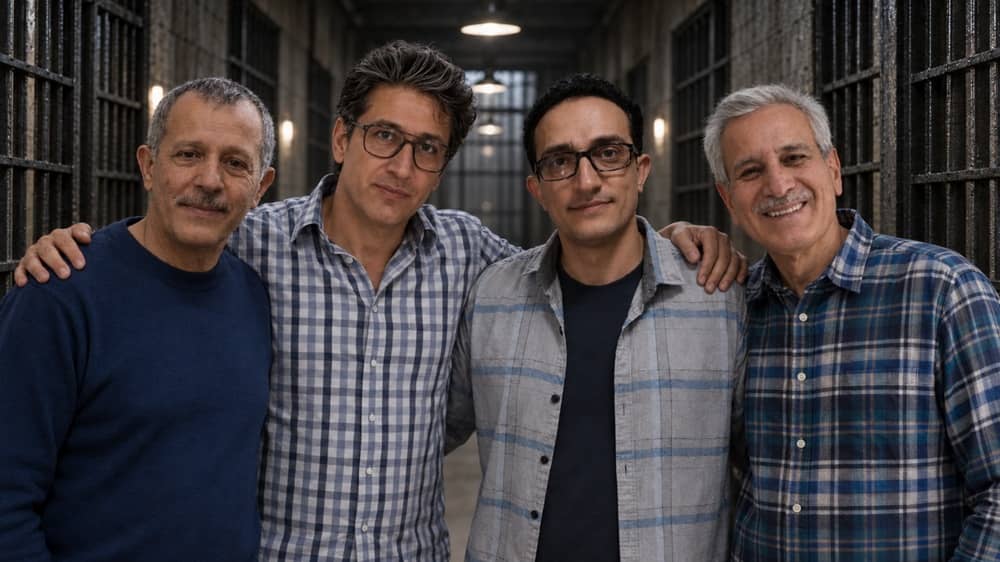
In recent days, four political prisoners held in Ghezel Hesar have sent messages from inside the prison marking the 61st anniversary of the founding of the People’s Mojahedin Organization of Iran. They have insisted that the messages be broadcast by Resistance media despite the threats and consequences they know may follow, stressing that they want their words to reach Iran’s young people and the wider public “at any cost.”
For Khosrow Rahnama, Sepehr Emam-Jomeh, Akbar Bagheri, and Asadollah Hadi, the anniversary was not an occasion for nostalgia. Writing from confinement, they reflected on endurance, organization, sacrifice, and the stubborn persistence of political hope. Their insistence on publication is itself part of the message: they are not writing privately or for the prison archive, but deliberately trying to speak beyond the walls that confine them.
What emerges from their messages is less a commemoration than an argument about why some political movements disappear while others survive repression severe enough to destroy ordinary institutions.
Rahnama begins with history. He traces a line through the Constitutional Revolution, the Jungle Movement, Mohammad Mossadegh’s nationalist movement, and the 1979 revolution. His conclusion is emphatic: courage by itself has repeatedly proved insufficient. What oppressed people require, he argues, is organization capable of accumulating experience and withstanding repression.
“Only organized revolutionary resistance is capable of confronting the inhuman clerical system,” he writes from Ghezel Hesar, the regime’s main institution for state-sanctioned killings and massacres.
‘No wind can extinguish this flame’: Letter by political prisoners in Ghezel Hesar on PMOI founding anniversary https://t.co/eH9qIHXVw0
— People's Mojahedin Organization of Iran (PMOI/MEK) (@Mojahedineng) September 8, 2026
Hence, the meaning of his message is difficult to miss. Rahnama is describing organization not as bureaucracy, but as a playbook—the means by which one generation’s experience survives long enough to become useful to the next.
Sepehr Emamjomeh approaches the same question differently. His message is built around four words: “What if it had not existed?”
He repeats the question across decisive moments in modern Iranian history. What, he asks, would have filled the political space without an organized resistance? What would have become of women’s political role? What would have sustained opposition through repeated waves of repression?
His most revealing question concerns women: “If Maryam had not been there, what historical place would women have had in an age of misogyny?”
The point is larger than one leader. Emamjomeh sees endurance as the ability of a political movement to change internally while confronting a brutal enemy—to create new forms of responsibility rather than merely preserve old ones.
Akbar Bagheri reduces the question of endurance to a single word: sacrifice.
Looking back over six decades of the PMOI’s existence through monarchy, revolution, clerical rule, executions, exile, and repeated crises, he asks how an organization subjected to so much pressure could remain standing. His answer is neither money nor favorable circumstances.
‘No name is more terrifying to the regime’: Political prisoners celebrate PMOI’s 61st anniversary https://t.co/ztd4qeZnC6
— People's Mojahedin Organization of Iran (PMOI/MEK) (@Mojahedineng) September 8, 2026
“Sacrifice is not just a word; it has depth—the depth of giving one’s life,” he writes.
There is an uncomfortable challenge in that sentence. Modern political life is overwhelmingly transactional, operating on what some call “altruistic reciprocity”—a mere trade, after all, that fails to grasp what human beings are truly capable of.
People naturally ask what politics will give them: security, recognition, influence, prosperity, perhaps power.
Bagheri reverses the equation. His question is what a person is prepared to give for a freedom he may never personally enjoy.
That is also why he emphasizes generational continuity, invoking prisoners and dissidents separated by decades in age. For him, a movement remains alive when sacrifice ceases to belong to a heroic past and reappears in people born generations later.
Asadollah Hadi places these personal choices within a broader theory of political struggle. History, he argues, repeatedly pits those with power against those deprived of it.
“The exploiter usually possesses wealth, power, and the instruments of propaganda,” he writes.
After four decades of prison and persecution, Ali Moezzi marks 61 years of PMOI resistance https://t.co/jmbbs0CBxz
— People's Mojahedin Organization of Iran (PMOI/MEK) (@Mojahedineng) September 7, 2026
Yet he immediately identifies the weakness of such power: coercion cannot indefinitely extinguish the demand for sovereignty. Across Iran’s modern history, Hadi argues, repression has repeatedly produced protest, rebellion, and movements seeking to give those eruptions political direction.
Together, the four messages illuminate something that anniversaries often obscure.
Sixty-one years is not impressive simply because a calendar has turned 61 times. Political organizations can continue to exist long after they cease to matter. Longevity becomes meaningful only when ideas, structures, and commitments pass from one generation to another despite the forces trying to interrupt that transmission.
Prison is one such force.
Its purpose is not only to remove a dissident from society. At its most effective, imprisonment separates the present from the future: it convinces the prisoner that the world outside is moving on without him and convinces society that resistance has been isolated.
But these four men write with no illusion that their words are without consequence. They repeatedly insist that their message reach Iran’s young people “at any cost.” In that insistence lies the real force of what they are saying: bravery is not a posture, honesty is not a slogan, and integrity is worth little if it disappears when the price becomes personal.
From Iran’s Prisons and Torture Chambers, Three #Women Political Prisoners Raise Their Voiceshttps://t.co/TzSIbxGuSx
— NCRI-FAC (@iran_policy) September 4, 2026
Their message to an explosive society is therefore carried not only in words but in the risk they knowingly assume by sending them beyond the prison walls. They are prepared to place their own fate behind what they believe—to make their lives, not merely their language, the measure of their convictions.
That is where repression encounters its oldest limit. It can imprison the dissident, threaten him, and raise the cost of speaking. But when a prisoner already understands that cost and chooses to speak anyway, fear begins to lose its monopoly.
The body can be confined. A conviction backed by a willingness to pay for it, even with one’s life, is much harder to contain.