

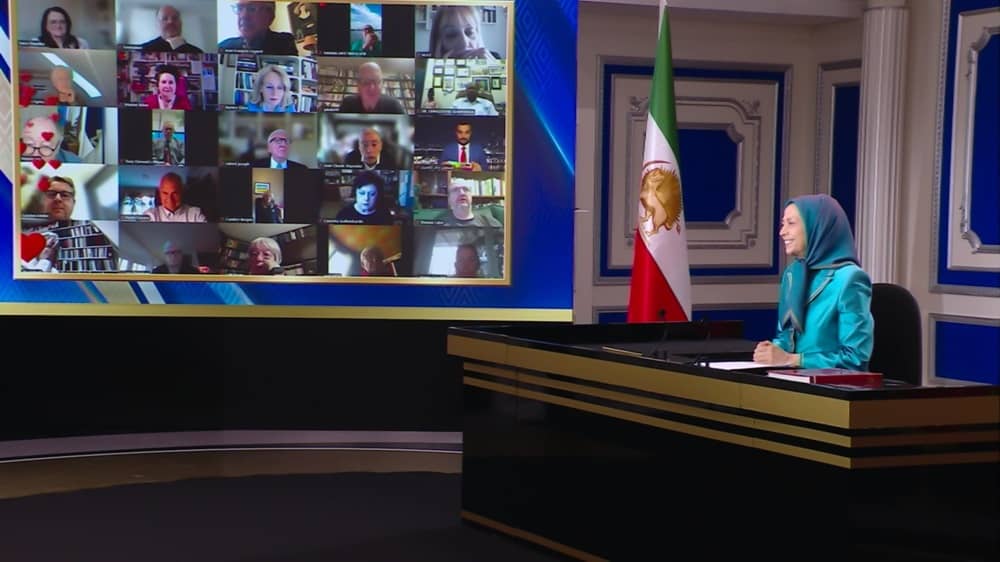
On March 5, 2026, in a landmark online conference titled “Iran at Crossroads: Supporting the NCRI Provisional Government,” a distinguished panel of international political figures and diplomats gathered to support the National Council of Resistance of Iran (NCRI) and its newly announced provisional government. The event highlighted a consensus that the current religious dictatorship has reached its final chapter and that a structured, democratic alternative is ready to lead the transition of power to the Iranian people. Speakers emphasized the legitimacy of the NCRI and its Ten-Point Plan as the only viable roadmap for a secular, democratic republic, while forcefully rejecting both the current clerical regime and any return to the monarchical dictatorship of the past.
Addressing the conference, NCRI President-elect Mrs. Maryam Rajavi declared that the announcement of the provisional government “raises the flag of democracy and people’s sovereignty” at a critical juncture in Iranian history. Mrs. Rajavi noted that the regime’s attempts to maintain control through threats and “fake leadership councils” are failing. “It is impossible for them to escape being overthrown,” she stated, pointing to the PMOI-led Resistance Units as an active force on the ground capable of organizing the final uprising.
Mrs. Rajavi emphasized that the provisional government’s mission is to guarantee the transfer of sovereignty to the people, culminating in free elections for a constituent assembly within six months. This transition is built upon the Resistance’s Ten-Point Plan, which ensures gender equality, the separation of religion and state, and the rights of all ethnicities. Mrs. Maryam Rajavi also warned against “misleading currents” that promote a return to the Shah’s dictatorship, asserting that the Iranian people have sacrificed too much to replace one form of tyranny with another. “This is a struggle between regression and progress,” she concluded.
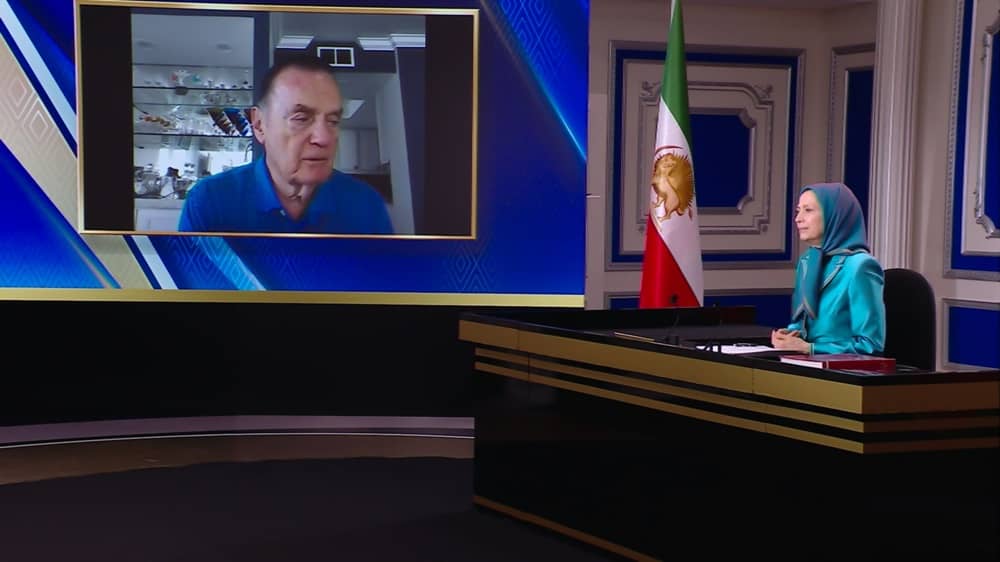
General James Jones, who also served as the 22nd United States National Security Advisor, characterized the events in Iran as the “beginning of the end” for the current regime. Drawing on 15 years of experience observing the NCRI, General Jones praised the “steadfast leadership” of Mrs. Rajavi under the most difficult conditions. He emphasized that for decades, the West’s policy of “appeasement” only emboldened the mullahs, but that the Resistance Units are now proving that Iran’s fate will be decided by its own people.
General Jones saluted the “brave young men and women” of the Resistance Units who continue their struggle despite the regime’s terror. “The fate of Iran will not be decided by foreign powers, nor by remnants of past dictatorships,” General Jones asserted. The former US National Security Advisor stated that when the flag of freedom is finally raised over Tehran, history will remember those who “helped light the path to that victory.”
The former Speaker of the UK House of Commons, John Bercow, offered a scathing critique of those proposing the “son of the Shah” as a viable alternative. Mr. Bercow described the notion as an act of “breathtaking presumption and arrogance,” noting that Reza Pahlavi’s only claim to fame is being the son of a “discredited, reviled, and hounded out” dictator. “He is a return to the past, not a way to the future,” Speaker Bercow asserted.
Speaker Bercow highlighted that the NCRI and Mrs. Rajavi are the true solution because they possess a democratic “prospectus” that has been fought for over 50 years. He praised the thousands of Resistance Units operational across Iran as the heartbeat of the movement. “No to dictatorship, whether by a monarch or by a mullah; whether through a crown or a turban,” the former Speaker of the UK House of Commons stated, urging the international community to recognize the provisional government as the “sunnier, more hopeful future” for Iran.
Online Conference with International Dignitaries Participating Iran at a Crossroads: Support for the announcement of the Provisional Government by the NCRI based on its Ten-Point Plan-
Amid the bombardments in Iran, the lives of prisoners are in greater danger than ever. I call… pic.twitter.com/88l4WKh4lb— Maryam Rajavi (@Maryam_Rajavi) March 5, 2026
Former Colombian Senator Ingrid Betancourt described the current situation as a “historical turning point” created by a profound political vacuum within the Iranian regime. Senator Betancourt argued that in moments of collapse, the international community must support a “responsible and structured path” to prevent chaos. “The NCRI’s initiative for a provisional government deserves serious international attention,” the former Senator stated.
Mrs. Betancourt drew a sharp contrast between the leadership of the Resistance and the remnants of the monarchy. While Mrs. Rajavi was sacrificing her life for democracy, she noted, Reza Pahlavi was “enjoying the privileged life of a wealthy jet setter.” Former Senator Betancourt insisted that “Reza Pahlavi represents the dark past, marked by cruelty and corruption,” and that all democracies must immediately recognize the provisional government. “We stand with the future, not with the past of shame,” Ms. Betancourt concluded.

Former Vice President of the European Parliament, Dr. Alejo Vidal-Quadras, told the conference that for the first time in years, the “end of this criminal regime” is a visible reality. Dr. Vidal-Quadras argued that the regime is facing a “double pressure”—the uprising from within and diplomatic and economic pressure from without. As an European, the former Vice President urged the EU to stop wasting time with “figures of the past who have nothing to offer.”
“The Iranian people have been very clear: No to the Supreme Leader, no to the Shah,” Dr. Vidal-Quadras stated. He highlighted that the goal is a “modern, secular, democratic republic,” and praised the PMOI and NCRI for their decades of sacrifice. “It is a great pride to serve under your banner,” the former Vice President of the European Parliament told Mrs. Rajavi, vowing to stand with the Resistance until the “final hour of victory.”
Online Conference with International Dignitaries Participating
Iran at a Crossroads: Support for the announcement of the Provisional Government by the NCRI based on its Ten-Point Plan-
On February 28, the National Council of Resistance of Iran announced a provisional government… pic.twitter.com/hfLbOKm3qg— Maryam Rajavi (@Maryam_Rajavi) March 5, 2026
Former US Senator Robert Torricelli described the current moment as a “unique opportunity” for the Iranian people to reclaim the revolution that was stolen from them in 1979. Senator Torricelli argued that the NCRI is the only entity capable of filling the current political vacuum. “Why the NCRI? It has professionals that can help put together a provisional government fast. It has resources. It has international credibility,” the former Senator stated.
Senator Torricelli noted that the NCRI’s credibility is rooted in the “price paid in lives” over many years of struggle. He praised Mrs. Rajavi’s “persistence and devotion,” describing it as “without peer” in history. The former Senator from New Jersey emphasized that the NCRI possesses the unique combination of professional expertise, international credibility, and internal resources necessary to immediately fill the political vacuum and prevent further suffering.
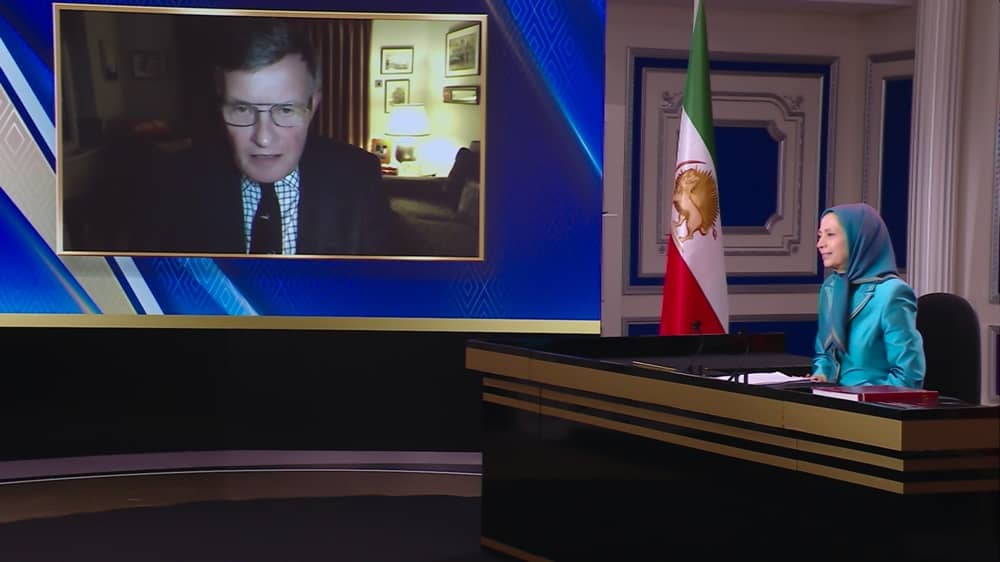
Louis Freeh, the former Director of the FBI, stated that Iran has moved beyond “regime change” and is now in the stage of “regime destruction.” Director Freeh argued that the NCRI is the “only organized democratic opposition” with the network and motivation to manage the coming transition. He emphasized that the leadership of Mrs. Maryam Rajavi is the best suited to guide the new democracy.
“We don’t need a return to the past. We don’t need the inheritors of SAVAK to come in and pretend to be leaders without imagination,” the former FBI Director remarked. Mr. Freeh noted that the “tide is turning” and that the wind is blowing toward freedom. He congratulated the NCRI for its “moral clarity” and bravery, asserting that the provisional government is essential to ensuring that the transition to democracy is orderly and successful.
Ambassador Robert Joseph, former US Under Secretary of State for Arms Control and International Security, stated that the “end of the religious dictatorship is in sight.” Ambassador Joseph warned that while victory is close, it will require even more “resolve and sacrifice.” He identified the NCRI and MEK as the only organizations with the “vision and dedicated Resistance Units on the ground” to meet these challenges.
Ambassador Joseph also dismissed the possibility of a monarchical restoration. “The 1979 revolution was aimed at overthrowing another corrupt and brutal regime, his father’s,” Ambassador Joseph reminded the audience, referring to Reza Pahlavi. The former Under Secretary of State argued that the NCRI’s Ten-Point Plan is the ultimate test of leadership for building a free Iran. He urged all governments to recognize the provisional government as the legitimate representative of the Iranian people’s aspirations.
Iran at a Crossroads:
Supporting the NCRI Provisional Government
Based on Its Ten-Point Planhttps://t.co/sPBsdrd8ia— Maryam Rajavi (@Maryam_Rajavi) March 5, 2026
André Chassaigne, a long-serving Member of the French National Assembly and leader of the Communist Party, emphasized that the decision regarding Iran’s future belongs solely to its people. MP Chassaigne warned against the “false propaganda” of alternatives that would only bring “ruin for the Iranian people,” whether through “recycling the current dictatorship” or the “rebirth of an old one.”
The French MP stated that the NCRI represents a “democratic alternative that has been built over decades.” Member of the French National Assembly Chassaigne expressed his solidarity with the Resistance Units, noting that the “final blow” must come from the organized groups within the country. “Our message is one of confidence and solidarity,” MP Chassaigne concluded, adding that the international community must respect the specific path to freedom chosen by the Iranian Resistance.
French MP Christine Arrighi, who also serves as Secretary of the Finance Committee, highlighted the widespread international support for Mrs. Rajavi’s Ten-Point Plan. Member of the National Assembly Arrighi noted that 4,000 parliamentarians worldwide have endorsed the plan, which guarantees “equality between men and women, the abolition of the death penalty, and the separation of religion and state.”
MP Arrighi called on the international community to “officially recognize the provisional government and establish direct relations with it.” She argued that the embassies of the current regime in European capitals “no longer enjoy legitimacy and must be closed.” The French MP vowed that her colleagues in the National Assembly would continue to work “obstinately” to ensure the democratic opposition is recognized as the “true voice of the Iranian people.”
The former UK Minister, David Jones, praised the “extraordinary courage” of the young people and Resistance Units across all 31 provinces of Iran. Minister Jones stated that the world must “recognize the legitimate right” of the organized resistance to defend itself against the regime’s repression. He specifically called for the UK government to “proscribe the Islamic Revolutionary Guard Corps (IRGC)” and to “declare the regime’s diplomats persona non grata.”
Minister Jones emphasized that the “moral choice is unmistakable.” He argued that the democratic world must “reject both the dictatorship of the Shah in the past and the dictatorship of the mullahs today.” The former UK Minister expressed his full support for the NCRI’s provisional government, stating that he stands with the Iranian people “until they can celebrate the birth of a democratic republic in their country.”
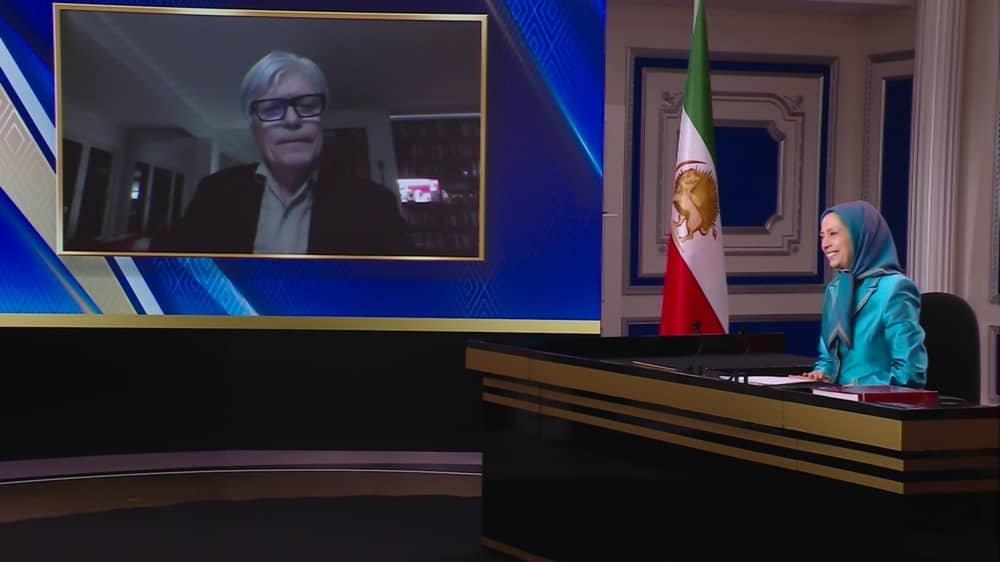
Dr. Liam Fox, who also served as the UK Secretary of State for Defense, stated that the “sacrifice of so many people in Iran to keep the flame of hope alive is historic.” Secretary Fox warned that the current “toxic and criminal regime” will use extreme brutality to survive, making the clarity of the international message vital. He insisted that “no one inside or outside your country has a right to pick winners; the Iranian people have sovereignty.”
Secretary Fox made it “very clear” that a return to an “absolute monarchy” is not part of Iran’s future. He urged the young generation of Iranians to “accept no oppressors and no autocracy.” The former Defense Secretary also touched on the importance of “territorial integrity,” reassuring Iran’s neighbors that a free, democratic Iran would be a source of stability. “The prize in a free Iran… is absolutely immense,” Secretary Fox concluded.
Former Norwegian Minister Ola Elvestuen told the conference that the “mullahs’ regime is in its weakest state in 47 years.” Minister Elvestuen characterized the current situation not just as an uprising, but as a “democratic revolution.” He stated that the “responsibility of the whole democratic world” is to support the NCRI and Mrs. Rajavi’s Ten-Point Plan as the “only solution for the future of Iran.”
Mr. Elvestuen dismissed discussions about the Pahlavi dynasty as a distraction. “The whole discussion about Pahlavi has to be pushed aside; it’s not a possible solution,” the former Minister asserted. He called on all nations to “put their resources” into helping the Iranian Resistance reach its goal of a free and democratic Iran, which he described as a transformation that would benefit “every Iranian, the Middle East, and the whole world.”
Professor Herta Däubler-Gmelin, who previously served as the German Minister of Justice, expressed her deep “admiration and support” for the brave men and women of the Iranian revolution. As a legal expert, Professor Däubler-Gmelin expressed her desire to see “the criminals of the mullah regime, including the justice machine, brought before the International Criminal Court.”
The former Justice Minister emphasized the need for “cooperation among the different opposition groups” that share the vision of a “democratic, free, and human rights-oriented” system. She offered her full support to Mrs. Maryam Rajavi, stating that the suffering of the Iranian people must come to an end. “All our support goes to you,” Professor Däubler-Gmelin concluded, asking the NCRI leadership how the international legal community could better assist in the transition to a just society.