

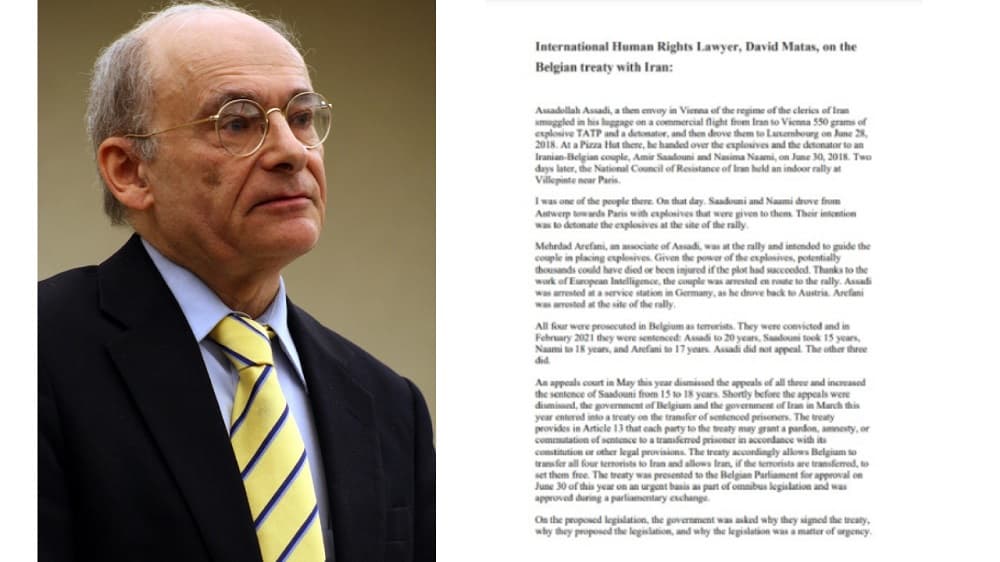
Assadollah Assadi, a then envoy in Vienna of the regime of the clerics of Iran smuggled in his luggage on a commercial flight from Iran to Vienna 550 grams of explosive TATP and a detonator, and then drove them to Luxembourg on June 28, 2018. At a Pizza Hut there, he handed over the explosives and the detonator to an Iranian-Belgian couple, Amir Saadouni and Nasima Naami, on June 30, 2018. Two days later, the National Council of Resistance of Iran held an indoor rally at Villepinte near Paris.
I was one of the people there. On that day. Saadouni and Naami drove from Antwerp towards Paris with explosives that were given to them. Their intention was to detonate the explosives at the site of the rally.
Mehrdad Arefani, an associate of Assadi, was at the rally and intended to guide the couple in placing explosives. Given the power of the explosives, potentially thousands could have died or been injured if the plot had succeeded. Thanks to the work of European Intelligence, the couple was arrested en route to the rally. Assadi was arrested at a service station in Germany, as he drove back to Austria. Arefani was arrested at the site of the rally.
All four were prosecuted in Belgium as terrorists. They were convicted and in February 2021 they were sentenced: Assadi to 20 years, Saadouni took 15 years, Naami to 18 years, and Arefani to 17 years. Assadi did not appeal. The other three did.
An appeals court in May this year dismissed the appeals of all three and increased the sentence of Saadouni from 15 to 18 years. Shortly before the appeals were dismissed, the government of Belgium and the government of Iran in March this year entered into a treaty on the transfer of sentenced prisoners. The treaty provides in Article 13 that each party to the treaty may grant a pardon, amnesty, or commutation of sentence to a transferred prisoner in accordance with its constitution or other legal provisions. The treaty accordingly allows Belgium to transfer all four terrorists to Iran and allows Iran, if the terrorists are transferred, to set them free. The treaty was presented to the Belgian Parliament for approval on June 30 of this year on an urgent basis as part of omnibus legislation and was approved during a parliamentary exchange.
On the proposed legislation, the government was asked why they signed the treaty, why they proposed the legislation, and why the legislation was a matter of urgency. The government spokesperson avoided answering the question. They did not identify any Belgian in Iranian prisoners who might be transferred under the treaty. The only identifiable use of the treaty and the legislation is as a vehicle to allow Iranian diplomat Assadi and the other terrorists to be transferred to Iran and set free. On the day of sentencing in February 2021, there was concern expressed that the government of Belgium would be willing to let Assadi get away by transporting him to Iran.
The Belgian Minister of justice then responded with these words: In general, it is correct that the Iranian regime would like to aim for a deal or a prisoner exchange. I may add immediately, that the principles of our rule of law cannot be the subject of a horse trade, let alone a carpet market. The government of Belgium should remember these words today. The effort to combat terrorism and the need to respect the rule of law requires that Assadi and the other terrorists serve their sentences in Belgium and not be transferred to Iran.
Thank you.