

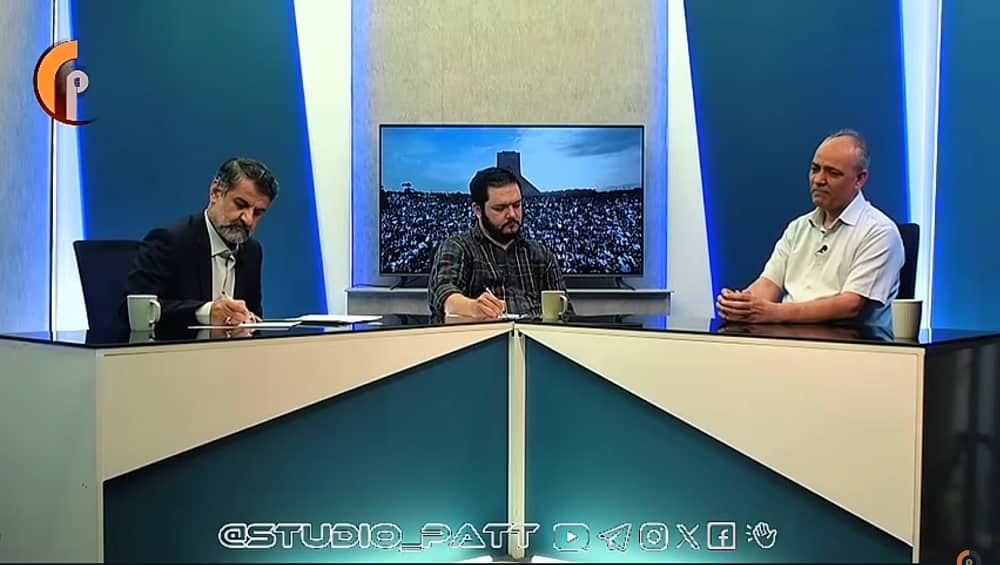
Today, April 6, 2025, the state-run Ham Mihan published a debate between political analysts Ahmad Zeydabadi and former Kayhan editor-in-chief Mehdi Nasiri that inadvertently revealed the regime’s deep-seated fear of the People’s Mojahedin Organization of Iran (PMOI/MEK). Hosted by Studio Pat and titled ‘Reform or Revolution,’ the discussion highlighted the regime’s awareness of the PMOI’s organizational strength and capacity to mobilize dissent.
The debate, titled “Reform or Revolution?” was first posted online on March 16, 2025, with its second episode, as referenced by Ham Mihan, being published on March 18.
While the regime promotes such discussions to create an illusion of ‘freedom of speech’ and controlled opposition, it seeks to channel public discontent through ‘allowed platforms’ as a safety valve, avoiding alignment with genuine dissent.
The MEK’s Growing Influence Sparks Iran Regime’s Fear and Desperationhttps://t.co/2cUTDRbhXp
— NCRI-FAC (@iran_policy) May 23, 2023
During the debate, Ahmad Zeydabadi openly admitted the regime’s inability to confront organized opposition, specifically pointing to the PMOI as the most formidable force capable of challenging the clerical dictatorship. Zeydabadi stated, “You cannot form an organization inside [Iran], but outside, the only organized group is the Mojahedin [PMOI].”
Zeydabadi emphasized the PMOI’s organizational strength, warning, “If the state collapses, the Mojahedin [PMOI] with their 40,000 to 50,000 organized members, will come in, and that will be a disaster.”
Mehdi Nasiri, meanwhile, promoted the ousted Pahlavi regime, claiming that it even enjoys support within Sistan and Baluchestan Province, a region severely neglected and deprived during the monarchial as well as the clerical dictatorships. His attempt to elevate the monarchists as a viable opposition force highlights the regime’s strategy of bolstering factions that pose less of a threat than the PMOI.
The #Iranian Regime’s Calculated Use of Monarchists: A Political Decoyhttps://t.co/yBZ1QJSnHd
— NCRI-FAC (@iran_policy) February 2, 2025
Discussing the possibility of revolution, Zeydabadi argued that popular dissent alone is insufficient to cause regime change unless it is guided by an organized opposition. While acknowledging widespread dissatisfaction among Iranians, he claimed that without a structured group, the possibility of overthrowing the regime remains low.
Zeydabadi also highlighted the fact that, unlike the Shah’s era, where underground organizations such as the PMOI and the Fadaiyan Guerrillas Organization played a key role, today’s communication networks are too transparent for covert operations. Nevertheless, he acknowledged the PMOI’s continued ability to operate as an organized opposition, even under harsh repression.
This latest public discussion demonstrates the Iranian regime’s ongoing anxiety about the PMOI’s ability to present a viable alternative to the current system. The regime’s inability to dismantle the PMOI’s structure, despite years of efforts, suggests that the regime is acutely aware of its own vulnerabilities.
Golrokh Iraee from Evin Prison: Reformists and Monarchists Unite to Preserve Tyranny in #Iranhttps://t.co/5UEiw2HYx5
— NCRI-FAC (@iran_policy) April 4, 2025
Who is Mehdi Nasiri?
Mehdi Nasiri, once an editor-in-chief of the Kayhan newspaper and a representative of the regime’s Supreme Leader Ali Khamenei, has undergone a “notable transformation” in recent years. After decades of loyalty to the clerical dictatorship, Nasiri repositioned himself as a vocal critic of Khamenei, advocating for opposition unity against the regime. In 2024, before traveling to Canada, he proposed an alliance between the so-called reformists and exiled monarchists, specifically naming Reza Pahlavi, the son of the ousted Shah, alongside imprisoned “reformist” figures like Mostafa Tajzadeh.
However, Nasiri’s outreach has been met with suspicion among opposition circles due to his longstanding ties to the regime. Critics argue that his sudden shift and outreach to monarchists may be a calculated move orchestrated by the regime to sow discord among its adversaries. Nasiri’s exclusion of the PMOI from his proposed coalition, coupled with his regime ties, has led many to believe that he aims to boost the monarchist faction as a counterweight to the PMOI’s influence. This tactic aligns with the regime’s historical efforts to exploit ideological rifts, ensuring that the PMOI remains demonized while less threatening factions gain prominence.