

Three-minute read
The lawyer leaned in toward the frail prisoner on death row, his words soft but heavy with bargain: “No need for a TV interview anymore. No written confession. Just tell me, quietly, that you’ll never walk that path again—and you can have your normal life back.”
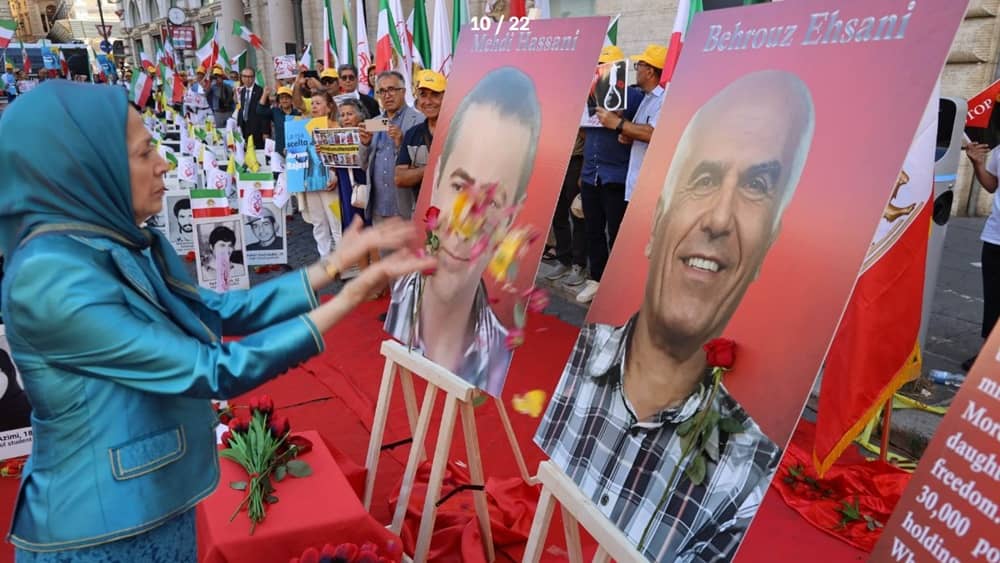
Behrouz Ehsani, 68, sat in silence for a moment, his gaze steady. Then a faint, almost tender smile curved his lips. “I will never,” he said slowly, each word a quiet rebellion, “never bow to your wretched rule.”
Hours later, in the pre-dawn of July 27, 2025, the Iranian regime hanged Ehsani and Mehdi Hassani, 48, a husband and father, for their ties to the People’s Mojahedin Organization of Iran (PMOI). The world’s top executioner thought these gallows would speak of fear. Instead, they declared a promise: the future of Iran belongs to freedom and democracy, no matter how many ropes it takes to try to stop it.
The irony of tyranny
Thirty-seven years ago, 30,000 political prisoners were slaughtered in Iran’s jails—a UN envoy would later call it genocide. Now, decades later, the same rulers replay their own crime, expecting a different outcome: that fear will bury hope.
Fellow prisoners remember Ehsani and Hassani as men full of life, joking with cellmates, tidying their ward to the last day—lovers of life. When survival was offered in exchange for renouncing the Resistance, they refused—not because they longed for death, but because surrender would have spoken a lie: that their cause was unjust, that freedom was not worth the price tens of thousands of fellow freedom fighters had already paid.
On Sunday in Paris, protesters demanded the release of French nationals detained in Iran. Louis Arnaud called out the regime's hostage policies and highlighted the cases of Behrouz Ehsani & Mehdi Hassani, facing execution. #Iran #FreeIran2025 pic.twitter.com/7VCo8Z9Jvz
— SIMAY AZADI TV (@en_simayazadi) February 3, 2025
Why they stood firm
Ehsani and Hassani leaned on a movement that has, for nearly four decades, sacrificed family, comfort, and safety for one thing alone: freedom. The PMOI and the National Council of Resistance of Iran (NCRI) have turned down foreign patrons and strings-attached backing, choosing independence over expedience. This made them “undesirable” to many powers, but earned them the one thing dictatorships cannot buy: the trust of their people.
In a land betrayed by Khomeini’s broken promises after 1979, where political faith was scorched earth, millions have spent decades giving their money, their time, and even their children to a Resistance that does not kneel before tyrants. Western analysts often dismiss this as “cultish.” Yet, history tells us every new faith is branded a cult until it grows too strong to crush.
Behrouz and Mehdi believed that a movement made of such people could only build what they themselves had been denied. These were men and women who had surrendered whole lifetimes—not just the easy phrases of “home” and “years,” but the irreplaceable moments of being alive with those they loved. They missed their children’s childhood, the warmth of family dinners, the soft weight of a handheld in safety. They traded every dream of an ordinary life for one single, fragile promise: that others would one day have what they could not.
🚨 The European Parliament just adopted a resolution condemning Iran’s death sentences against political prisoners Behrouz Ehsani & Mehdi Hassani. The resolution also urges the @EUCouncil to #BlacklistIRGC
CC: @drmaisato #StopExecutionsInIran #SaveMehdiHassani #SaveBehrouzEhsani pic.twitter.com/5r6HkpyIc0
— M. Hanif Jazayeri (@HanifJazayeri) April 3, 2025
And because the price has been so unbearably high, they believed the reward must be freedom, dignity, and the right of every child to grow up unafraid. A movement built on this kind of giving carries within it not the seed of tyranny, but the seed of a brighter dawn—a future where no one has to lose what they lost, where time is no longer stolen by fear. After decades of struggle, endured heartbeat by heartbeat, the test of time has shown what they knew in their bones: a cause nourished only by that level of sacrifice can only bloom into liberty.
A culture of defiance the regime cannot kill
Iran is not the world’s only dictatorship. But it is one of the few places where resistance has never stopped. Dozens of nationwide uprisings, countless local protests, thousands imprisoned or killed—and still the flame burns. Not despite repression, but because of sacrifice. Each death feeds a culture of defiance that even the rope cannot strangle.
The mass-executioner regime accuses the PMOI of “playing with people’s lives.” Yet it offers no answer for the millions of Iranian youths it keeps jobless, the pensioners marching daily for bread, the millions forced into exile who never posed a threat to its power. Had Behrouz and Mehdi bowed their heads and returned to “obedient citizens,” what awaited them? The same quiet, invisible suffering already crushing millions under a corrupt theocracy. They chose dignity instead. And though the NCRI waged a global campaign to save them, the regime tightened the noose. In the end, their names once again broke through walls of censorship and fear, making headlines around the world—just as they once believed they would.
🚨 Urgent Appeal 🚨
Over 250 experts & NGOs urge UN's @volker_turk to act NOW to stop Iran's execution of political prisoners Behrouz Ehsani (69) & Mehdi Hassani (48).
Some signatories include: @DavidAltonHL @AttiasDominique @paulocasaca1 #نه_به_اعدام #StopExecutionsInIran pic.twitter.com/a4SWX03ftp— SIMAY AZADI TV (@en_simayazadi) January 28, 2025
A message that outlives the executioners
Half a century ago, PMOI founders refused SAVAK’s bargain for survival under the Shah, declaring: “Our death will be a message to the next generation. It will testify that tyranny is temporary, freedom is the right of every human being.”
In 2025, Behrouz Ehsani and Mehdi Hassani gave the same answer to a different dictator. Their voices broke through prison walls, censorship, and propaganda to reach every corner of Iran: This regime can take our lives, but it cannot kill the future.
Like the summer of 1988, Tehran has once again killed and lost. Only now it faces a nation poorer, angrier, more aware—and a Resistance stronger than ever. The gallows they built to kill hope have become monuments to their own defeat.
Behrouz Ehsani and Mehdi Hassani face imminent danger of execution after being transferred to Ghezel Hesar Prison. Their death sentences, issued on charges of membership in the People’s Mojahedin Organization of #Iran (PMOI/MEK) have been upheld by the regime’s Supreme Court.
In… pic.twitter.com/1msUcG0mfC— Maryam Rajavi (@Maryam_Rajavi) January 26, 2025