

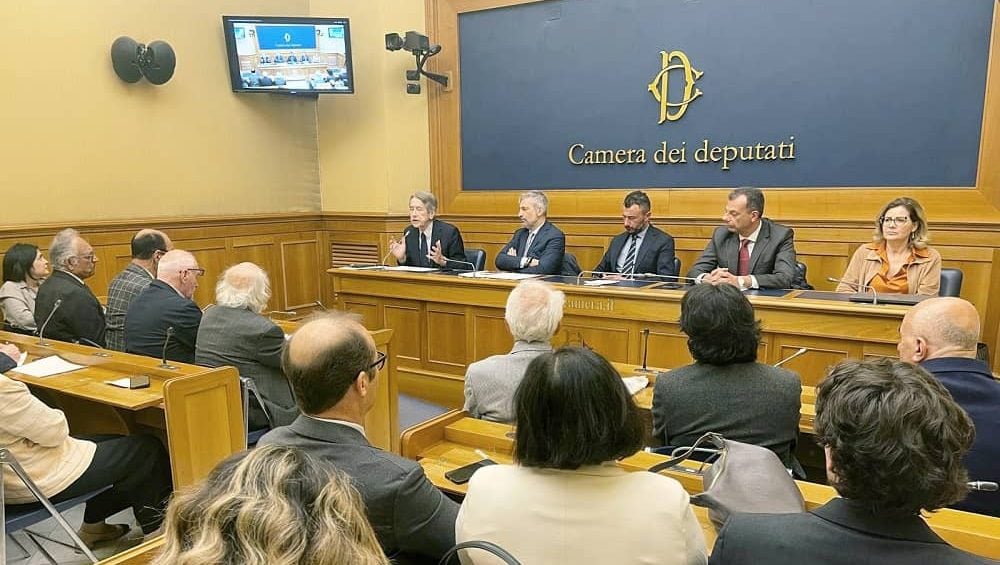
ROME – In a conference at the Italian Parliament on April 16, 2025, prominent lawmakers and dignitaries joined Mrs. Maryam Rajavi, President-elect of the National Council of Resistance of Iran (NCRI), to call for a fundamental shift in European policy toward Iran. The event, titled “The Third Solution to the Iran Issue,” emphasized that appeasement has failed, and only democratic change led by the Iranian people and their organized Resistance can end the threat posed by the theocratic regime.
In her keynote address, Mrs. Maryam Rajavi warned that “the only way to stop the mullahs’ nuclear program is to end their rule.” She outlined how the regime, cornered at home and weakened abroad, has intensified executions and repression to preserve its power. She reported that 1,150 people were executed between March 2024 and March 2025, and five political prisoners were hanged on a single day, April 8. “This regime will never abandon repression, terrorism, or its nuclear ambitions,” she declared, reiterating the need for regime change as the only viable solution.
Mrs. Rajavi urged European governments, particularly Italy, to lead a new EU stance: recognize the Iranian people’s right to overthrow the regime; refer human rights violations to the UN Security Council; trigger the snapback mechanism under Resolution 2231; and support the rights of PMOI members at Ashraf 3. She stressed that a real economic partnership with Iran is impossible under the current dictatorship. “Iran’s economy can only thrive with the end of the religious tyranny and the establishment of democracy,” she said.
Every attempt to change the behavior of the clerical regime, or even to persuade it to scale back its aggressiveness, merely grants the regime new opportunities—opportunities that bring greater insecurity to the world.
The confusion in the West stems from having long ignored the…— Maryam Rajavi (@Maryam_Rajavi) April 16, 2025
Senator Giulio Terzi, former Foreign Minister of Italy and President of the 4th Permanent Senate Commission on European Union Policies in the Italian Senate, delivered a passionate address praising Mrs. Maryam Rajavi and the Iranian Resistance for their perseverance and moral clarity. He recounted the suffering endured by members of the Resistance, particularly in Camp Ashraf and Liberty, and emphasized the international community’s responsibility to stand with those fighting for freedom.
Senator Terzi strongly rejected illusions about regime “moderates,” calling the idea a dangerous myth used to justify appeasement. He condemned the regime’s systemic dissimulation, citing the mutilation of protesters and grotesque punishments as examples of institutionalized sadism. Highlighting the regime’s longstanding clandestine nuclear program—first revealed by the Iranian Resistance in 2002—he warned against any renewed belief that Tehran can be trusted. “Disguise and deception are virtues in this system,” he said.
He also praised the MEK’s exposure of nuclear sites and their central role in resistance, dismissing claims that they lack support in Iran. He urged Italy and Europe to stand with the Iranian people and recognize the Resistance and its Ten-Point Plan as a credible democratic alternative.
Ho partecipato alla Conferenza Stampa su "Violazione dei diritti umani in Iran e la necessità di una nuova politica", che si è tenuta alla Camera dei Deputati, con l'intervento online della Presidente-eletta del Consiglio Nazionale della Resistenza Iraniana, @Maryam_Rajavi.
I… pic.twitter.com/VfLOHhXObj— Giulio Terzi (@GiulioTerzi) April 16, 2025
In her remarks, Senator Gisella Naturale emphasized the moral responsibility of all democratic societies to oppose tyranny and defend fundamental human rights. Expressing deep concern over the alarming 43% increase in executions in Iran compared to the previous year, she condemned the regime’s worsening brutality as “unacceptable” and urged the international community to pause and reflect on the core values of freedom and human dignity.
Senator Naturale also highlighted her role in representing women in Parliament and extended heartfelt solidarity to Iranian women active in the Resistance. She saluted their courage and reiterated her commitment—and that of Italian women parliamentarians—to standing with them in the fight for universal rights. In closing, she thanked Mrs. Maryam Rajavi and conveyed greetings from MP Stefania Gruppioni, who was unable to attend due to institutional obligations.
"Violazione dei diritti umani in Iran e la necessità di una nuova politica"
Conferenza alla camera dei deputati Mercoledi 16 Aprile
Intervento della presidente Maryam Rajavi#StopExecutionsInIran pic.twitter.com/KcrZ9Btfw3— mahmoud hakamian (@HakamianMahmoud) April 17, 2025
Senator Raffaele Speranzon, a member of the Senate Foreign Affairs Committee, underscored that standing with the Iranian people is a moral duty before it is a political stance. He lamented the staggering number of executions—1,153 in one year—alongside the torture, mutilations, and repression of women under the regime.
Emphasizing that Europe must not be misled by superficial diplomatic overtures, he warned that the supposed reformism of Iran’s current president is merely a façade, with the current wave of executions proving continuity, not change. “This is a regime that masks persecution with false openings,” he said, adding that true support must include active recognition of those resisting inside and outside Iran.
He called on Italy to push for international isolation of the regime and promote Mrs. Rajavi’s Ten-Point Plan as a democratic framework for post-regime Iran. “We must break the silence,” he urged, and reject any legitimacy for a regime defined by its brutality.
EVVIVA GLI UOMINI E LE DONNE LIBERE,
ABBASSO L’IRAN DEGLI AYATOLLAH!
A @Montecitorio a sostegno di @Maryam_Rajavi e del @CNRIItalia, assieme agli amici senatori @GiulioTerzi , @RSperanzon e @MarcoScurria. #FreeIran #BlackListIRGC #No2Appeasement 🍀🌍 pic.twitter.com/bMybu2Pepb— Emanuele Pozzolo (@EmanuelePozzolo) April 17, 2025
Senator Marco Scurria, Secretary of the 4th Permanent Committee (European Union Policies) in the Italian Senate, stressed that Iran’s clerical regime is not just a domestic oppressor but a global threat. Drawing a link between Tehran’s influence and global instability, including its ties to Russia’s aggression in Ukraine, Senator Scurria described the regime as a common enemy to all democratic nations.
He expressed deep admiration for Mrs. Rajavi’s leadership and called for strong international recognition of the Iranian Resistance. “Italy must play a central role in supporting a democratic Iran,” he said, urging decisive actions to cut the regime’s international lifelines and stand with the Iranian people.
MP Emanuele Pozzolo, Vice President of the Committee of Parliamentarians for a Free Iran, started his remarks with a sharp condemnation of the Iranian regime’s brutality, focusing especially on the 1,153 executions carried out in just one year. He emphasized that behind each statistic lies a story of repression, often targeting youth and women. MP Pozzolo strongly supported the recognition of the NCRI and the listing of the IRGC as a terrorist entity. He stressed that Western silence and appeasement only embolden Tehran’s crimes. “We must raise our voices louder, and with greater unity, for a free Iran,” he said.
"Violazione dei diritti umani in Iran e la necessità di una nuova politica"
Conferenza alla camera dei deputati
Mercoledi 16 Aprile
Intervengono:
Sala Stampa Montecitorio#StopExecutionsInIran #NCRIAlternative#FreeIran pic.twitter.com/N1pnOWvI1Q— Associazione Giovani Iraniani Residenti in Italia (@GiovaniIraniani) April 16, 2025
Participants hailed Mrs. Rajavi’s Ten-Point Plan as a beacon for a future Iran: a secular, democratic republic that guarantees freedom of expression, gender equality, an end to the death penalty, and a non-nuclear policy.
The conference concluded with a renewed pledge from Italian lawmakers to intensify parliamentary support for the Iranian Resistance and to push Italy and the European Union to adopt a firmer stance against Tehran’s theocratic regime.