

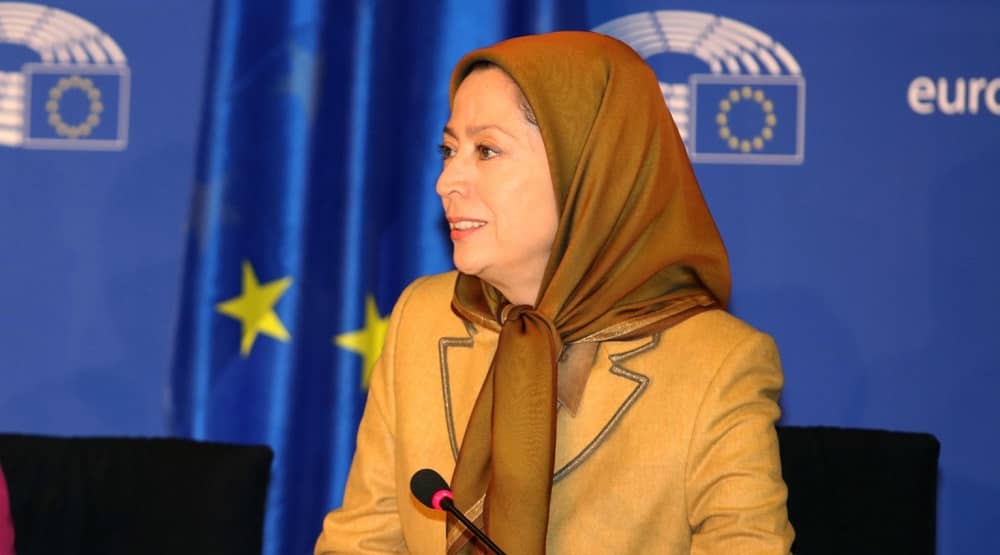
In a recent opinion piece published in the German daily Die Welt, Mrs. Maryam Rajavi, the President-elect of the National Council of Resistance of Iran (NCRI), outlines a comprehensive plan for achieving regime change in Iran. She emphasizes that the recent overthrow of Syrian dictator Bashar al-Assad, a key ally of Tehran’s ruling mullahs, has strategically weakened the Iranian regime, creating a pivotal opportunity for organized resistance.
Mrs. Rajavi highlights that the Iranian regime’s pillars—domestic oppression and regional interference through terrorism and warfare—have been significantly undermined by Assad’s fall. She notes that Iran invested at least $50 billion in Syria between 2012 and 2020, deploying thousands of Islamic Revolutionary Guard Corps (IRGC) fighters to support Assad. This strategy has now failed, leaving the regime vulnerable both domestically and regionally.
Addressing the current unrest within Iranian society, Mrs. Rajavi points to escalating economic collapse, rampant inflation, widespread unemployment, institutional corruption, and particularly the suppression of women as factors that have intensified public dissatisfaction. She asserts that the Iranian populace is poised for another uprising, inspired by Assad’s downfall, which exposes the regime’s vulnerabilities.
After its significant failure in the region, the mullahs’ regime has accelerated its program to build #nuclear weapons to avoid being overthrown. Therefore, it is urgent to activate the Snapback mechanism of the @UN Security Council Resolution 2231. The only way to prevent a… pic.twitter.com/YGB1KfNnqZ
— Maryam Rajavi (@Maryam_Rajavi) December 19, 2024
Crucially, Mrs. Rajavi presents a detailed roadmap for Iran’s future post-regime change. She proposes the establishment of a transitional government for a maximum of six months, tasked with organizing free and fair elections for a constituent assembly. This assembly would then form a new transitional government to draft a constitution for the new republic, ensuring a democratic transition without chaos.
The NCRI President-elect envisions a free Iran founded on democratic principles, including:
- Reliance on electoral legitimacy: Upholding ballot boxes as the sole criterion for legitimacy.
- Emphasis on freedom and gender equality: Ensuring equal rights for women.
- Promotion of autonomy for ethnic groups: Supporting self-determination within a unified nation.
- Guarantee of religious equality: Ensuring equal rights for Shiites, Sunnis, and followers of other religions.
- Separation of religion and state: Establishing a secular government.
- Commitment to regional peace: Advocating for a non-nuclear Iran at peace with its neighbors.
Mrs. Rajavi calls on the European Union to recognize the Iranian people’s right to overthrow the regime and to hold Tehran accountable for its human rights abuses, terrorism, and pursuit of nuclear weapons. She argues that such a policy would promote peace and stability in the region and align Europe with the Iranian people’s aspirations for freedom.