

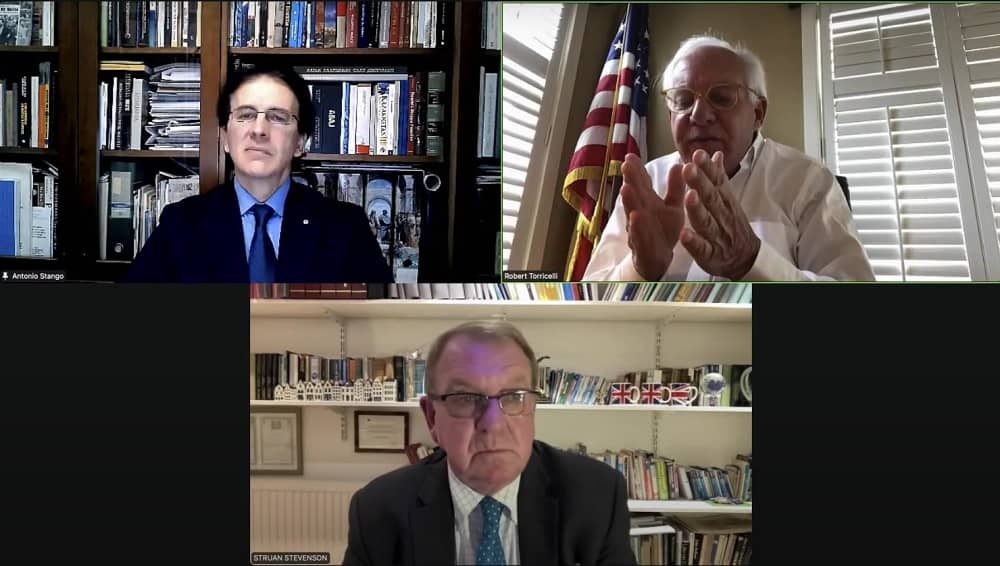
January 16, 2025 – Leading U.S. and European policymakers gathered for an online conference titled “Iran: Time for Change, Policy Options.” The discussions focused on the Iranian regime’s growing vulnerabilities, the international community’s role, and the democratic alternative offered by the National Council of Resistance of Iran (NCRI). Participants emphasized the necessity for a unified approach to counter Tehran’s oppression and support the Iranian people’s aspirations for freedom.
Antonio Stango, President of the Italian Federation for Human Rights, opened the discussion by highlighting the regime’s deteriorating position. “The Iranian regime has been weakened in the region,” he said, pointing to the collapse of its proxies and the readiness of the Iranian people for change. He dismissed the regime’s portrayal of a divide between reformists and hardliners as deceptive. “There is no such thing as two different components in the regime. They are all faithful to the most cruel and human rights-abusing regime in the world,” Stango asserted.
Today I had the privilege to moderate a transatlantic online discussion on #Iran with Senator Robert Torricelli and @STRUANSTEVENSON – analyzing the current deep crisis of the ayatollahs’ regime, the new international scenario, the role of the organized Resistance, and the… https://t.co/GbOOoqKs9m
— Antonio Stango (@AntonioStango) January 16, 2025
The NCRI: A Credible Democratic Alternative
Former U.S. Senator Robert Torricelli emphasized the NCRI’s growing international recognition and readiness to lead a post-regime Iran. “This is not the same movement as it was a decade ago,” Torricelli said. “Today, it has the backing of former prime ministers, secretaries of state, and key military leaders. The NCRI is not just an opposition; it is a government-in-waiting with an organized platform for democratic governance.”
Torricelli highlighted the NCRI’s 10-point plan, which includes commitments to free elections, gender equality, the abolition of the death penalty, and a non-nuclear Iran. “This level of preparation and global support is unparalleled for a resistance movement,” he remarked.
Struan Stevenson, a former Member of the European Parliament, echoed this sentiment. “We have over 3,000 notable figures, including Nobel laureates, supporting Mrs. Rajavi and the NCRI. This is a massive international coalition that recognizes the Iranian people’s right to overthrow the mullahs,” Stevenson said.
The MEK Resistance Units, operating across Iran, were recognized as a driving force behind grassroots opposition to the regime. Former U.S. Senator Robert Torricelli emphasized their role, stating, “The cells of the MEK now operate around Iran. The people independently take to the streets, whether they’re putting slogans on walls, throwing rocks, or holding signs. Whatever they’re doing, this is their revolution, and they are leading it.”
Senator Torricelli: "There's more diplomatic contact internationally with @Mojahedineng and the organized opposition than there is with the government in #Tehran. There's more discourse and a better international following."#FreeIran2025https://t.co/cBe40NWby4
— NCRI-FAC (@iran_policy) January 16, 2025
Regime’s Efforts to Undermine the Resistance
The panel criticized Tehran’s attempts to undermine the NCRI by propping up the remnants of the deposed monarchy. Stevenson singled out Reza Pahlavi, son of the former Shah, as a regime-fueled distraction. “Every time there’s a crisis, Pahlavi resurfaces, pretending to represent the people. But Iranians have made it clear: ‘No to the Sheikh, no to the Shah.’ They reject both tyranny and monarchy,” Stevenson said.
Torricelli agreed, calling Pahlavi’s emergence part of a false narrative designed to discredit the NCRI. “If the Shah didn’t have a son, the mullahs would invent him. He is perfect for their narrative,” he said.
The regime’s repression of dissent was also addressed. Stevenson pointed out the extreme risks faced by resistance members. “Simply writing graffiti supporting the NCRI can result in the death penalty. This is the level of brutality we are dealing with,” he noted.
A Shift in U.S. Policy
Speakers highlighted a significant shift in Washington’s approach to Tehran. Stevenson noted General Keith Kellogg’s recent remarks at an NCRI event, where he affirmed the incoming U.S. administration’s commitment to reimposing maximum pressure policies. “General Kellogg is not a former official; he is shaping policy for the new administration. His presence at the NCRI conference signals a decisive shift,” Stevenson said.
Senator Torricelli: "Those who think that there's not an alternative are searching for an excuse not to have the despotic regime fall in #Tehran. We have a very real alternative in @Mojahedineng and @Maryam_Rajavi and this broad coalition."#FreeIran2025https://t.co/cBe40NWby4
— NCRI-FAC (@iran_policy) January 16, 2025
Torricelli noted that the regime squandered opportunities for dialogue during the Biden presidency. “Joe Biden… was willing to give the regime the benefit of the doubt. Don’t continue with proliferation. Don’t do the centrifuges, don’t do the purifications, don’t strengthen the nuclear infrastructure. We’re open to discussions. You said no,” he stated. “Now, Tehran faces an incoming administration ready to reintroduce maximum pressure and rally a stronger international coalition.”
Hope for Change
The conference concluded with a message of hope for the Iranian people. Torricelli emphasized the inevitability of the regime’s collapse, saying, “This regime’s fall is not a matter of years; it could happen in days when the spark ignites. The IRGC, like other oppressive forces, will crumble when faced with unified public resistance.”
Stevenson praised the NCRI’s readiness to lead. “The NCRI is not just waiting for change; it is prepared to govern. Its 10-point plan offers a clear and democratic future for Iran,” he said. “The West must recognize this and end its appeasement of the regime.”
Speakers called on the international community to adopt a tougher stance against Tehran. “It is time to blacklist the IRGC, shut down Iranian embassies used as terror hubs, and support the resistance forces in Iran,” Stevenson urged.
.@STRUANSTEVENSON: "Every time Reza Pahlavi, who stole billions from the people of Iran, smells an opportunity for a return to power, he suddenly emerges doing news broadcasts and talking to the media."#FreeIran2025https://t.co/P2snAogiHT
— NCRI-FAC (@iran_policy) January 16, 2025
The panel’s message was clear: the Iranian regime is at its weakest point since its inception, and the world must stand firmly with the Iranian people and their democratic opposition to ensure a free and just future for Iran.