

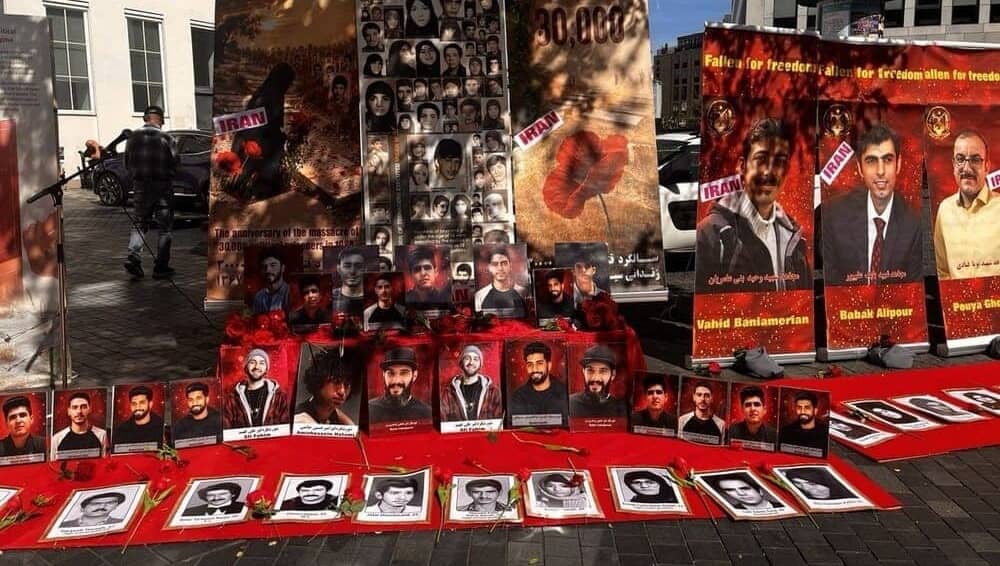
Across major Western capitals and European urban centers, the Iranian diaspora and supporters of the National Council of Resistance of Iran launched a synchronized wave of rallies, political symposia, and public photo exhibitions during the week of August 9 to August 15, 2026. Commemorating the 38th anniversary of the 1988 massacre of 30,000 political prisoners and standing in solidarity with ongoing domestic anti-execution strikes, these international actions drew prominent Western lawmakers, human rights advocates, and cross-factional dissidents. The coordinated global campaign underscored a growing international consensus rejecting both the ruling clerical theocracy and a return to monarchical rule, while mobilizing material and political backing for the domestic resistance movement.
August 13, 2026
In Paris, Iranian supporters of the People’s Mojahedin Organization of Iran (PMOI/MEK) expanded their ongoing public outreach campaign by establishing an extensive book display and photo exhibition in central public spaces. The gathering directly targeted the Iranian regime’s accelerating execution rate and the ongoing imprisonment of youth detained during nationwide uprisings. Organizers engaged the French public and international visitors, utilizing photographic evidence and personal testimonies to illustrate systemic human rights violations. Demonstrators emphasized that the global community must support the Iranian people’s right to establish a secular democratic republic, explicitly rejecting both the current religious dictatorship and any attempt to restore an authoritarian monarchy.
#Copenhagen Rally and Photo Exhibition Commemorate Iran’s #1988Massacre #StopExecutionsInIran #NoImpunity4Mullahshttps://t.co/WjzJ3N4top
— Iran Freedom (@4FreedominIran) August 13, 2026
August 12, 2026
Commemorations honoring the victims of the 1988 political purge mobilized significant turnouts across Scandinavia and Western Europe. In Copenhagen, NCRI supporters hosted a prominent rally and photo exhibition documenting the 1988 executions and the subsequent crackdowns on recent domestic protests. Former Danish Parliamentarian Karin Liltorp addressed the gathering, emphasizing that the extrajudicial execution of political prisoners remains an unpunished crime against humanity that demands sustained international vigilance and judicial accountability. Representatives from Kurdish opposition groups, including Kak Omid of the Democratic Party of Iranian Kurdistan (PDKI), also addressed the rally, demonstrating cross-ethnic solidarity against state repression. Simultaneously in Stockholm, activists mounted a comprehensive memorial exhibition displaying portraits of the 1988 martyrs alongside fallen protesters from recent nationwide demonstrations, reiterating calls for international tribunals. Meanwhile, activists in Paris maintained their central informational hubs, distributing literature detailing the Iranian Resistance’s political roadmap for democratic change.
More pics
2-Paris — August 15, 2026: A photo exhibition honors the victims of the massacre in #Iran, where thousands of political prisoners, MEK members were executed. The exhibition pays tribute to those who gave their lives for a free and democratic Iran.#StopExecutionsInIran pic.twitter.com/tBLaHxnmsy— Iran Freedom (@4FreedominIran) August 16, 2026
August 11, 2026
International solidarity with domestic prison strikes reached a focal point as diaspora groups aligned their demonstrations with the 133rd consecutive week of the “No to Executions Tuesdays” campaign. In Gothenburg, protesters gathered in central public spaces, chanting slogans condemning the state killing machine and demanding the immediate release of all political detainees. Demonstrators explicitly voiced support for NCRI President-elect Maryam Rajavi’s global campaign to abolish the death penalty in Iran, warning that political prisoners face imminent execution as authorities attempt to quash internal dissent. Parallel memorial exhibitions and public demonstrations continued in Stockholm and Paris, where activists highlighted the direct historical link between the 1988 gallows and the contemporary judicial violence implemented by the clerical authorities.
#Bucharest Exhibition Calls for Urgent Action to Stop Executions in Iran #StopExecutionsInIran #FreePoliticalPrisonershttps://t.co/Ud2GwtLgVQ
— Iran Freedom (@4FreedominIran) August 16, 2026
August 10, 2026
A major diplomatic and political rally took place at Queen’s Park in Toronto, bringing together Canadian lawmakers, legal scholars, and human rights champions. The demonstration featured powerful addresses and solidarity statements from former Canadian Minister of Immigration Judy Sgro, Members of Parliament Dan Muys and James Bezan, former Attorney General Irwin Cotler, and international human rights lawyer David Matas. Speakers forcefully condemned the ongoing impunity enjoyed by perpetrators of the 1988 massacre, pointing out that Canada’s Parliament had formally recognized the purge as a crime against humanity. Prominent community figures including Ema Velibeygi, Ali Ziai, and Kak Luqman of the PDKI Eastern Canada chapter emphasized that state terror has failed to extinguish the desire for liberty. The assembly urged Ottawa and the United Nations to lead international legal mechanisms against senior Iranian officials while endorsing the NCRI’s Ten-Point Plan for a secular, non-nuclear democratic republic. Concurrently, supporters in Paris conducted book displays to inform European citizens about the ongoing political crisis.
7-Romania – August 15, 2026: An exhibition highlighting human rights violations in Iran was held in Bucharest by supporters of the PMOI. Organizers called for urgent action to stop the execution of political prisoners in Iran. #StopExecutionsInIran #FreePoliticalPrisoners pic.twitter.com/13tGQdxrtG
— Iran Freedom (@4FreedominIran) August 16, 2026
August 9, 2026
The global diaspora concluded a major three-day fundraising and media drive, marking the completion of the 30th “Free Iran Telethon” in support of the independent satellite network Simay-e Azadi (INTV). Operating entirely on public donations to bypass state censorship, the network received substantial financial pledges from solidarity gatherings in Gothenburg, Toronto, and Paris. In Effretikon, Swiss citizens joined Iranian supporters at a specialized photo display and book table protesting state executions and calling for the unconditional release of political prisoners. Furthermore, members of the Academics in Exile Association in Winchester organized public educational exhibits detailing the regime’s cross-border repression and domestic human rights abuses, gathering citizen signatures on petitions directed to the United Nations.
1-Gothenburg, Sweden — August 11, 2026: MEK supporters strongly condemn the mullahs’ execution machine in Iran, marking Week 133 of “No to Execution Tuesdays.”
Down with the executioner regime! #StopExecutionsInIran #FreePoliticalPrisoners #NoDeathPenalty pic.twitter.com/t70jtDVPKv— Iran Freedom (@4FreedominIran) August 13, 2026
The sustained breadth of international diaspora mobilization throughout the week reflects a pivotal maturation of the opposition movement on the global stage. By securing active participation from Western lawmakers, human rights jurists, and diverse ethnic opposition blocs, the National Council of Resistance of Iran has successfully translated domestic defiance into international political pressure. These global demonstrations highlight that the clerical regime’s domestic campaign of mass executions has failed to break the continuity of the resistance movement, serving instead to alienate Tehran further from the international community. Furthermore, the explicit and uniform rejection of both monarchical restoration and clerical autocracy across every international forum demonstrates a clear political consensus among the diaspora. This alignment reinforces the viability of a democratic alternative capable of guiding Iran toward a secular, representative republic.