

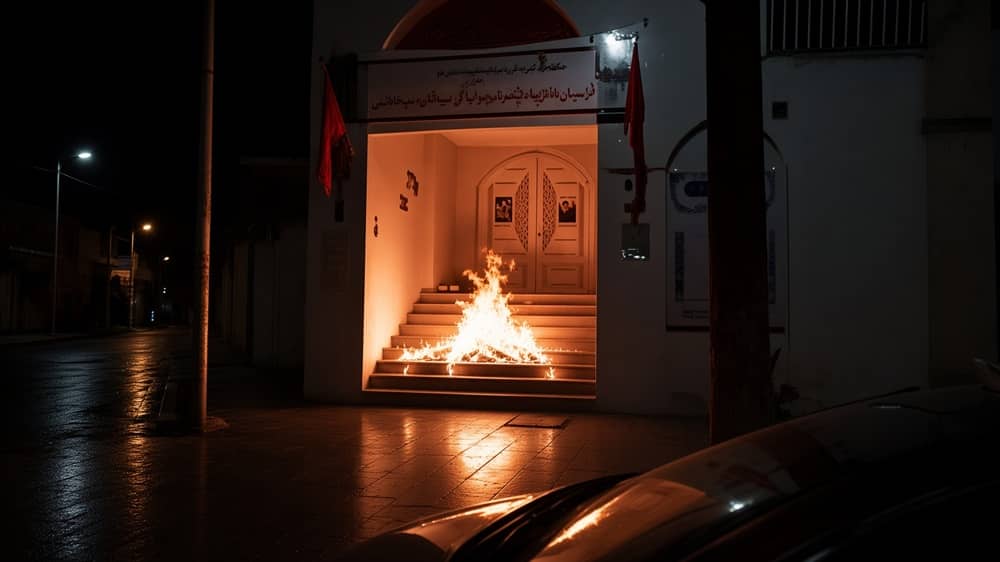
An escalating wave of civil defiance and underground operations continues to fracture the clerical regime’s illusion of total control across Iran. This weekly report, covering the operational window of August 9 to August 15, 2026, reveals a state locked in an unyielding battle against the growing activities of Resistance Units and widespread public discontent. From major metropolitan hubs to volatile border provinces, coordinated networks affiliated with the Iranian Resistance have mounted an expansive campaign comprising anti-execution strikes, the destruction of state propaganda, and targeted sabotage of suppressive centers. Amid a rampant state execution drive aimed at choking off the lingering embers of the January uprising, the regime faces a severe internal crisis where its reliance on the gallows has served only to galvanize an increasingly organized opposition operating within the country’s deepest security layers.
August 14, 2026
In the volatile southeastern region, rebellious youth and organized resistance networks resumed their weekly anti-regime activities in Zahedan. Activists staged public displays and unfurled banners categorically rejecting all forms of dictatorship, aiming their messaging at both the ruling theocracy and the ousted monarchy. Holding placards that read, “Iran will neither submit to the ruling theocracy nor return to a monarchical dictatorship. Iran’s only forward path is the path of true freedom,” the demonstrators underscored the population’s steadfast demand for a democratic republic. Central to this messaging was a definitive rejection of a return to the past, with activists holding signs declaring, “A dictator is a dictator, whether with a turban or a crown,” and “No to shah, no to mullahs”. Demonstrators explicitly championed the “Third Option,” identifying the organized resistance as the sole viable alternative to establish freedom, peace, and independence in the region, while pointing out that the current regime views peace as a “noose” around its neck and relies on conflict for survival.
PMOI/MEK Resistance Units carried out 60 daring operations across Iran to mark the 38th anniversary of the 1988 massacre of political prisoners. They targeted IRGC Basij bases, and centers of fundamentalism and terrorism, and the regime's symbols of repression and corruption. pic.twitter.com/UfmmbTaiUP
— People's Mojahedin Organization of Iran (PMOI/MEK) (@Mojahedineng) August 11, 2026
August 13, 2026
On this date, Resistance Units launched an expansive series of 30 synchronized operations targeting the regime’s machinery of suppression hubs across multiple provinces. In Isfahan, operatives set fire at four separate Islamic Revolutionary Guard Corps (IRGC) Basij bases. Similar attacks and arson targeted Basij command centers in Kermanshah, while in Shiraz, a major blaze targeted the regime’s “Relief Committee,” a state center widely recognized for its role in plunder and suppression. The campaign of arson extended further, with activists tossing Molotov cocktails at Basij headquarters and student Basij units in Mashhad, Sabzevar, and Iranshahr. In Aligudarz, resistance members set fire to the anti-Islamic city council and a state surveillance and espionage headquarters. In a direct challenge to the regime’s supreme authority, operatives also systematically torched propaganda banners and posters of current and former regime figures—including Ruhollah Khomeini, Ali Khamenei, and Mojtaba Khamenei—across Tehran, Shahriar, Zahedan, Birjand, Semirom, Azna, Khorramabad, and Nik Shahr. Concurrently, widespread solidarity operations for the “Simay Azadi” (Iran NTV) national telethon were carried out in Tehran, Karaj, Khorramabad, Sari, Kangavar, Amol, and Langarud, with activists taking immense risks to distribute handwritten leaflets and organize photocalls in public parks and squares to amplify the voice of the resistance.
August 12, 2026
Marking the 38th anniversary of the 1988 massacre of 30,000 political prisoners, an extensive coordinated campaign of 30 revolutionary acts swept across the country. In Tehran, resistance units reclaimed public spaces by plastering walls, columns, residential doors, and vehicles with photographs of the 1988 martyrs, ensuring the regime cannot erase victims like Ashraf Ahmadi, Majid Khademi, and Farahnaz Ahmadi from the public memory. The youth also bravely held photocalls with messages of defiance, declaring that the resistance is “stronger than death, execution, and massacre” and identifying fire as the regime’s only rightful consequence. Posters emphasizing that seeking justice for the fallen is a national obligation were prominently displayed throughout Tehran, Kerman, Tabriz, and Sonqor. The defiance extended to striking graffiti operations in Mashhad and Kermanshah, where activists painted messages swearing by the “boiling blood of the 1988 massacre” and declaring themselves armed and ready in the field to continue the uprising until the perpetrators are overthrown.
Echoes of 1988: How Iran’s Resistance Units keep the spirit of 30,000 martyrs alive https://t.co/wwVSEsNRgv
— People's Mojahedin Organization of Iran (PMOI/MEK) (@Mojahedineng) August 13, 2026
August 11, 2026
In tandem with the “No to Executions Tuesdays” campaign, now entering its 133rd week with support from inmates across 59 prisons, anti-regime activists launched a massive public pushback against the state’s systematic killing of political prisoners. In Arak, activists placed a memorial wreath honoring recently executed dissident Vahid Bani Amerian, promising his memory will live forever in the nation’s heart. Demonstrators in Mashhad and Saqqez issued powerful messages urging the public and international community not to remain silent as the regime executes youth like Arvin Kheirkhahan, Mehdi Khanaki, and Abolfazl Sepahi. Defying the heavy security presence, citizens in Tehran, Tabriz, and Karaj installed placards explicitly warning the regime that every execution fuels the people’s anger, asserting that they will “neither forgive nor forget”. In Isfahan, Eslamshahr, and Yazd, graffiti campaigns painted the executions as the ultimate shame of the rulers and vowed that a thousand storms would rise from the martyrs’ blood. The geographic scope of these protests was vast, stretching to the northern cities of Gorgan, Babol, and Sari, and deeply embedding into western strongholds like Sanandaj, where bold street displays declared that from Kurdistan to Tehran, the nation stands firmly united against the death penalty.
August 9, 2026
A broad wave of 50 revolutionary operations demonstrated profound public alignment with the organized resistance’s political platform and independent media efforts. In Tehran and its suburb Parand, resistance units mounted extensive operations to install banners reading “Death to Khomeini and Khamenei” alongside messages of unwavering support for the resistance leadership. This visual campaign rapidly spread, with dissidents in Tabriz painting “Death to the principle of Velayat-e Faqih” on city walls. In Mashhad, activists engaged in collective operations, posting emblems of the Liberation Army and boldly declaring that the era of both the mullahs and the monarchy is permanently finished. Similar street-level defiance was meticulously organized in Karaj, where placards praising the rebel youth and demanding a democratic republic were installed across key intersections. The campaign penetrated further into regional capitals, with activists in Urmia, Kermanshah, Arak, Qom, Hamedan, Sanandaj, Borujerd, and Iranshahr disseminating tracts and painting graffiti that asserted the only path to liberation is through organized resistance and the dismantling of absolute clerical rule.
PMOI Resistance Units mark anniversary of 1988 massacre with 60 operations across Iran https://t.co/E0hIGDNebI
— People's Mojahedin Organization of Iran (PMOI/MEK) (@Mojahedineng) August 9, 2026
The relentless expansion of underground resistance operations across the nation exposes a fundamental vulnerability in the clerical regime’s strategy of governance through terror. Far from pacifying a rebellious public, the ruling establishment’s escalating reliance on public hangings, summary trials, and prison crackdowns has catastrophically backfired. These aggressive measures have merely catalyzed a deeper political radicalization among the nation’s youth, driving them toward highly organized, systematic sabotage against the state’s security and ideological apparatuses. By desperately attempting to project an image of invincibility through the gallows, the regime has instead laid bare its deep internal deadlock and terminal fragility. The synergy between widespread popular discontent and the meticulously coordinated strikes of the Iranian Resistance demonstrates that the ruling theocracy is failing to contain a society that has irrevocably committed itself to structural and democratic change.
Also read:
The Illusion of the External Enemy: How Domestic Agency Is Redefining Iran’s Future