

Three-minute read
There is a photograph, taken sometime in the early nineteen-sixties of an old man in a village house, writing at a table. He is stooped, thin, under house arrest. His wife is dead. His visitors are rationed to Fridays. The Shah’s soldiers occupy the schoolhouse he built for the local children. The old man is Mohammad Mossadegh, and he is writing an inscription on a book about Algeria.
The book, Algeria and the Mujahid Men, was sent to him in Ahmadabad by Hassan Sadr [1], his legal counsellor who had stood beside him at the International Court of Justice at The Hague. In his handwriting, dated spring of 1962 — the very year Algeria won its independence from France — Dr. Mossadegh wrote: “I believe the publication of this book will have an impact beyond expectations, so that all will know which path they must take in the interest of the country.”
It was not a casual endorsement. A lifelong champion of parliamentary democracy and nonviolent resistance was now, from exile, pointing his compatriots toward the Algerian struggle — a struggle in which a colonized people had paid in hundreds of thousands of lives to break free from imperial domination. Dr. Mossadegh called for resolve. He urged Sadr to read passages aloud, “because in your voice and manner of reading there is a special effect that makes the writing doubly impactful.” He wanted the lesson to reach into bones.
Revisiting the Legacy of Mohammad Mossadegh: A Blueprint for Democratic Governance in #Iran https://t.co/RyeT8s4ISt
— NCRI-FAC (@iran_policy) July 30, 2025
That history of uprising and suppression runs like a wound through modern Iran. The Constitutional Revolution of 1905–1911 gave the country a parliament and heroes — Sattar Khan [2] , the horseman from Tabriz who held out against a royal siege; Baqir Khan [3], his deputy. Russia and Britain conspired to crush the movement; Sattar Khan died broken and forgotten. The Jangal Movement of 1915–1921 saw Mirza Kuchak Khan [4] raise a rebellion in Gilan’s forests against royal corruption and foreign meddling; it was strangled by internal fracture and outside pressure, and Kuchak Khan’s severed head was sent to Tehran as proof. The oil nationalization movement of the early nineteen-fifties produced Dr. Mossadegh himself and his Foreign Minister, Hossein Fatemi [5] — executed by the Shah’s firing squad after the 1953 coup.
In every case, the pattern was identical: Iranians rose. Foreign powers chose their puppet. The movement was crushed. The world moved on, assuming the matter settled.
It never was. On July 16, 1952, Dr. Mossadegh resigned over a constitutional dispute: the Shah refused to let his elected prime minister appoint the war minister. The Shah installed Ahmad Qavam [6] , a veteran courtier prepared to reverse oil nationalization and resume negotiations with Britain. The assumption was that the public would accept the fait accompli.
The greatest shortcoming of Iran’s freedom movements has been the absence of a democratic alternative—a cohesive, organized leadership and a liberation army.
Had these existed, the coup against Dr. Mossadegh would not have succeeded, nor the anti-monarchical revolution would have… pic.twitter.com/qFtJLkaX3O— Maryam Rajavi (@Maryam_Rajavi) August 19, 2025
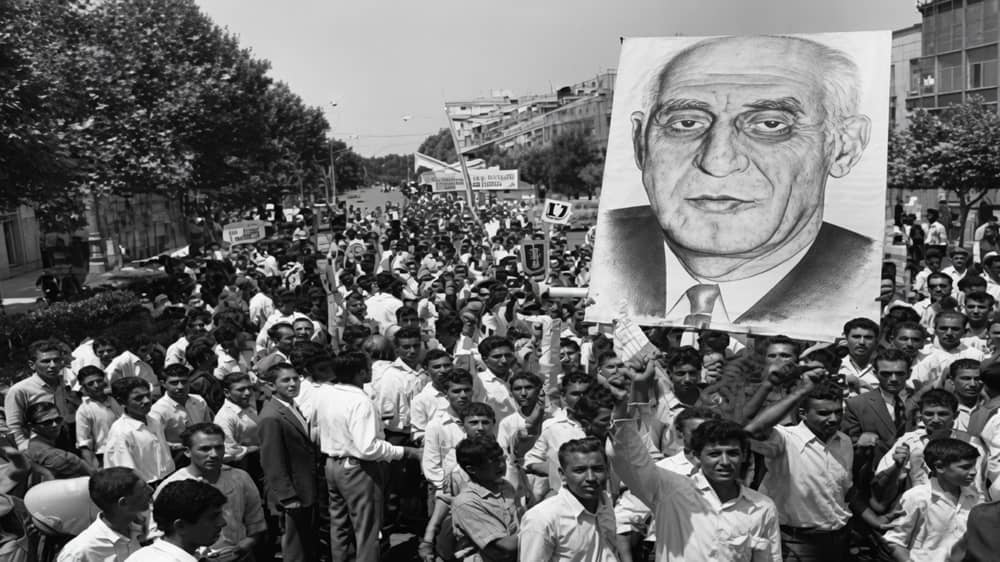
For five days, the people of Iran answered. Bazaars shut down. Strikes erupted across Tehran, Isfahan, Ahvaz, Hamadan, Kermanshah. According to declassified American intelligence documents, sixty-nine people were killed and more than seven hundred and fifty injured. On July 21, 1952, military commanders, fearing mutiny, pulled their troops to the barracks. Qavam resigned. The Shah, shaken, reappointed Dr. Mossadegh and granted him the authority he had demanded.
It was, in the truest sense, a people’s victory — purchased with blood by ordinary Iranians who had simply refused to be told who would govern them.
Twenty-nine years later, on the same anniversary — July 21, 1981 — Massoud Rajavi announced the founding of the National Council of Resistance of Iran in Tehran. The date was no coincidence. By then, Khomeini’s clerical regime had already begun executing opposition members en masse, dismantling the very freedoms Iranians had expected from the 1979 revolution. The NCRI was designed to avoid the structural failures that had doomed every previous democratic movement: the isolation of a single leader, the absence of an organized alternative, the ease with which foreign powers could decapitate a movement by removing one figure. It built a broad coalition — political parties, ethnic representatives, women’s organizations — with an elected leadership, a parliamentary structure, and a platform for a democratic, secular, non-nuclear republic. It learned the lesson that Dr. Mossadegh’s life had taught: a movement built on one person dies with that person; a movement built on a system endures.
Today, in 1953, Dr. Mohammad Mossadegh ordered the Shah to return all public properties confiscated by the Pahlavi family to #Iran's government. pic.twitter.com/cO3LGv4JW4
— NCRI-FAC (@iran_policy) May 11, 2023
And yet, seventy-four years after the 30th of Tir, foreign capitals continue to make the same miscalculation. Some believe the clerical regime can be curbed through military strikes. Others wager on diplomatic accommodation — a negotiated arrangement in which the regime is stabilized, its worst behavior moderated, and the question of what Iranians actually want is indefinitely deferred. Both approaches share a common blindness: the agency of the Iranian people.
This neglect is not cost-free. Every year that foreign powers extend the regime’s life through deal-making or inaction, the suffering deepens — in Iran, across the region, and around the world. The nuclear file festers. The repression intensifies. The exodus of Iran’s brightest accelerates.
July 21, 1952, should have settled the question. When the people of Iran decide to move, no shah, no foreign intelligence service, and no diplomatic framework has ever been able to hold them in place. The lesson from Dr. Mossadegh has been taught. The only question is whether the world is willing to learn it.
[1] Hassan Sadr: A prominent Iranian jurist, scholar, and author. He served as Dr. Mohammad Mossadegh’s legal counselor and was a key member of the Iranian delegation that successfully defended the nationalization of the country’s oil industry at the International Court of Justice in The Hague.
[2] Sattar Khan (1866–1914): Honored with the title “National Commander” (Sardar-e Melli), he was a pivotal military leader of the Iranian Constitutional Revolution. He famously led the resistance of the city of Tabriz against an 11-month siege by royalist forces and their Russian backers.
[3] Baqir Khan (1861–1916): Bestowed with the title “National Leader” (Salar-e Melli), he was a core figure of the Constitutional Revolution. He fought as Sattar Khan’s chief deputy and allied commander during the defense of Tabriz.
[4] Mirza Kuchak Khan (1880–1921): An early 20th-century nationalist and revolutionary who led the Jangal (Forest) Movement in the northern province of Gilan. He fought to establish a republic and resist both domestic royal corruption and foreign (British and Russian) occupation before the movement was defeated in 1921.
[5] Hossein Fatemi (1917–1954): A journalist, politician, and Dr. Mossadegh’s loyal Foreign Minister. He was a driving force behind the nationalization of Iran’s oil industry and a fierce, vocal critic of the monarchy. Following the CIA-backed coup in 1953, he was arrested, tortured, and executed by a royal firing squad.
[6] Ahmad Qavam (1876–1955): Also known by his royal title Qavam al-Saltaneh, he was a powerful, veteran politician who served as Prime Minister of Iran five times. His brief installation as Prime Minister in July 1952, intended to reverse Mossadegh’s policies, triggered the massive nationwide protests (the 30th of Tir uprising) that forced his resignation after just days in power.