

Three-minute read
Iran’s youth, oppressed by the mullahs’ regime, face a bleak reality. In a brutal fight for survival amid Iran’s economic crunch, the future generation trades their organs on the black market, their bodies bartered for a chance at life.
In recent years, the trade of body parts and organs has become a lucrative business in Iran. In a shocking report on March 26, the state-run Tejarat News acknowledged some aspects of this dark trade in Iran.
“Financial desperation unites buyers and sellers in the grim trade of body parts. Now, even Generation Z has entered this market. Not only those born in the 1980s but also in the 2000s haggle over pieces of themselves, like those who sell their kidneys for three to six billion rials,” Tejarat News wrote.
Based on the current dollar exchange rate at the free market, young Iranians auction their future and lives for $6,000 to $8,000.
Tejarat News interviewed several young sellers. Their words illustrate clearly a bleak picture of poverty:
Hamid, merely 16 years old, scours for a kidney recipient, declaring, “A+ blood type. I’ll beat the market.” Desperation oozes as he pleads, “I’ve done the tests, and got parental consent. No issues.”
Sina, 19, echoes the chorus of need. “Money is all I crave,” he cries, offering his O+ kidney for 4.5 billion rials.
Selling Body Parts for Survival: #Iran’s Disturbing Phenomenon Shakes Societyhttps://t.co/bnNkbNZwd1
— NCRI-FAC (@iran_policy) May 15, 2023
Behnam, another 19-year-old, parades his AB+ blood, boasting perfect health. “Notarized consent, all tests are done,” he touts, setting his kidney’s price at 4.5 billion rials.
Simin, born in 2002, joins the macabre dance, insisting, “O+ blood, 4 billion rials minimum. Money is my lifeline.”
Even Saeed, at 20, pledges his kidney, a last resort to mortgage his home. “3.6 billion rials,” he bargains, his desperation a chilling testament to the market’s grip.
Participating in the organ trade carries grave risks and dire outcomes for all involved. The human body’s delicate balance is disrupted by the extraction of vital organs, leading to profound physical and mental repercussions.
Procedures outside regulated medical environments heighten the risk of infections, surgical mishaps, and enduring health problems. Furthermore, the emotional trauma of organ donation and the ethical and legal dilemmas it entails can inflict lasting damage on an individual’s welfare.
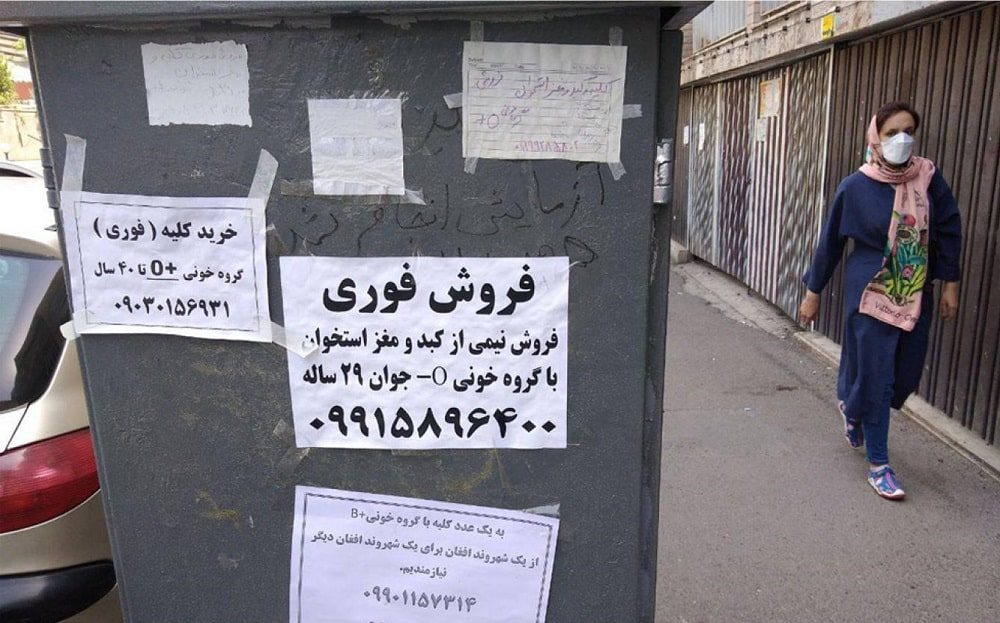
In Iran, the ugly trade of selling body parts is an old tale, its evidence plastered on walls nationwide, in advertisements offering organs, including bone marrow, hearts, and corneas.
In a chilling expose back in 2019, the Iranian Resistance shed light on the thriving organ market within Iran’s borders. Desperate individuals, mostly young adults, find themselves pushed to the brink of selling their kidneys or other vital body parts, with some older citizens also resorting to this desperate measure. Despite the abundance of organs from the youth, buyers face no scarcity in finding what they seek.
As the Iranian regime continues to plunder the nation’s natural resources to finance its clandestine activities, more Iranians plummet into the abyss of poverty each passing day.
My latest commentary: "How Much is a Baby Worth in #Iran?" https://t.co/dYm0DyvIe8
— Ali Safavi (@amsafavi) April 21, 2022
Iran, despite its wealth in natural resources, falls victim to the regime’s corruption and warmongering. Behzad Nabavi, a former high-ranking official, revealed in a September 19, 2021 interview with state-run Aftab-News, that four institutions control a staggering 60 percent of the country’s wealth, including Setad Ejraie Farman Imam, Khatam al-Anbiya Base, Astan-e Quds, and Islamic Revolution Mostazafan Foundation. These entities, directly under the supreme leader Ali Khamenei’s command, hold immense financial power:
- Setad Ejraie Farman Imam, with assets estimated at around $95 billion, received a substantial boost in 2010 when Khamenei transferred nearly $1 billion worth of assets from Astan-e Abdol-Azim to Setad.
- The Mostazafan Foundation, awarded a significant development project by the Ministry of Roads and Urban Development in 2016, owns vast farmland in northeastern Iran, covering at least 990,000 acres valued at over $20 billion. Additionally, it holds significant real estate assets across multiple provinces.
- Astan-e Quds controls a significant portion of urban land in Mashhad city, totaling 43.5 percent, along with extensive real estate holdings and endowments in numerous provinces.
- The Khatam Headquarters boasts oil contracts exceeding $25 billion, as stated by the director of the National Iranian Oil Company to state-run news agency IRNA.
Hence, it’s no surprise that Iranians, particularly the youth, yearn for regime change, evident in their active participation in recent nationwide uprisings.