

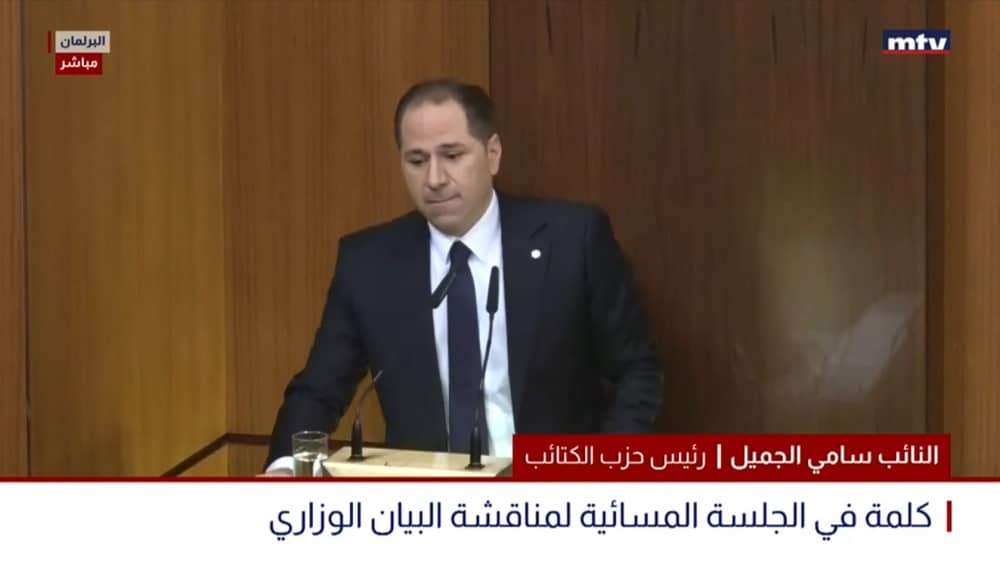
Lebanon’s political landscape is once again at a critical juncture, as calls intensify for the disarmament of Hezbollah. During an interview with LBC on April 4, 2025, Sami Gemayel, leader of the Kataeb Party, stated unequivocally that the issue of Hezbollah’s weapons is “no longer up for discussion.” He denounced the continued presence of arms outside state control as a blatant violation of the Lebanese constitution, national laws, and the principle of equality among citizens.
According to Gemayel, reconciliation among Lebanese factions should not serve as a pretext to maintain Hezbollah’s illegal weapons. He accused the Iranian regime, along with the Syrian government and Hezbollah, of deliberately obstructing national unity in Lebanon for years. “Today, after five decades, we have a real opportunity for dialogue and building a future together,” Gemayel asserted.
Gemayel emphasized that genuine reconciliation must be founded on truth-telling and mutual respect among Lebanon’s diverse communities. “As long as some believe they can impose their will by force of arms, we will never achieve national consensus,” he stated.

Meanwhile, Morgan Ortagus, the United States Deputy Special Envoy for Middle East Affairs, arrived in Beirut for talks with Lebanese officials, including President Michel Aoun. According to Lebanese media, the discussions centered on the situation in southern and eastern Lebanon, economic reforms, anti-corruption measures, and notably, the disarmament of Hezbollah. This visit follows Ortagus’s previous declaration on February 8, 2025, that Hezbollah should be excluded from Lebanon’s future government, labeling its era of “terrorizing” as over.
Furthermore, the two leading senators of the U.S. Senate Foreign Relations Committee, Jim Risch (R-ID) and Jeanne Shaheen (D-NH), warned that U.S. military assistance to Beirut could be reevaluated unless the Lebanese Army addresses “security challenges in the south.” In a statement quoted by Al-Arabiya, the senators said, “The United States must be prepared to enhance its aid to the Lebanese army to support the rapid implementation of cease-fire obligations. However, any hesitation by the Lebanese army to address security challenges in the south would be deeply concerning and would force the United States to reevaluate its approach.” They also emphasized the importance of cutting Hezbollah’s financial networks and empowering the Lebanese Army as “the legitimate guarantor of the Lebanese people’s security.”

Gemayel’s remarks echoed these concerns, stating that the continued presence of Hezbollah’s weapons disrupts national sovereignty and undermines Lebanon’s ability to pursue peace and stability. He argued that Hezbollah’s arms, backed by Tehran, represent a tool of coercion that perpetuates Lebanon’s divisions.
As Lebanon faces severe economic and political crises, the issue of Hezbollah’s weapons remains a central obstacle to achieving stability. With the U.S. now linking financial aid to tangible progress on disarmament, pressure is mounting on Lebanese officials to confront the influence of Hezbollah and its Iranian backers.