

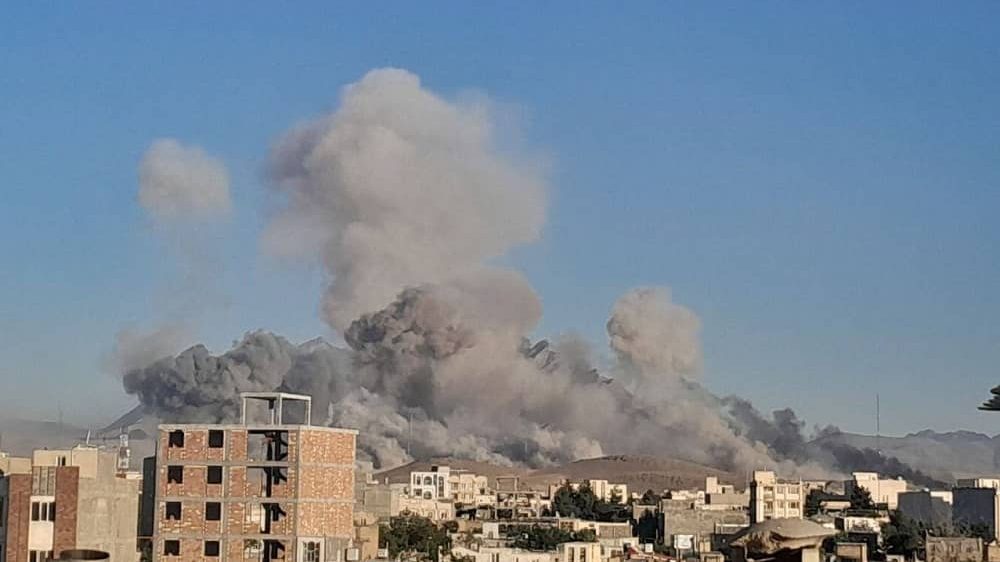
On the ninth day of the Iran-Israel war, air raid sirens and explosions echoed across Iran, with cities including Tehran, Karaj, Isfahan, Qom, and Zanjan experiencing heavy air defense activity starting around 2:30 a.m. Saturday. According to regime-linked Telegram channel Chand Saniyeh, missile defense systems were active across central and eastern Tehran. Noor News confirmed renewed anti-aircraft activity after a 15-hour lull.
The Israeli military, as cited by Times of Israel, said Iran had launched five ballistic missiles with no confirmed hits. In contrast, the Iranian regime, through Tasnim News Agency, claimed extensive drone and missile attacks on Israeli military infrastructure, including Ben Gurion Airport and airbases such as Nevatim and Hatzerim. The IRGC announced this as the eighteenth wave of retaliation.
Israel, for its part, confirmed a targeted strike on a residential building in Qom’s Salarieh neighborhood that resulted in the death of Mohammad Saeed Izadi, a senior Quds Force commander overseeing operations in the Palestinian territories. Israeli Defense Minister Yisrael Katz said Izadi played a critical role in planning and coordinating the October 7 attacks and was head of the so-called “Abu Jihad Unit” responsible for external operations. Iranian media, however, presented conflicting reports — highlighting the death of a 16-year-old, identified as Ehsan Ghasemi, with no official confirmation of Izadi’s death by the IRGC.
Iran said that it would not discuss the future of its nuclear program while under attack by Israel as European efforts to coax Tehran back into negotiations showed little sign of progress https://t.co/BZm93AS8oq pic.twitter.com/uWTI4fY7qF
— Reuters (@Reuters) June 21, 2025
The war’s physical toll inside Iran is now undeniable. Tasnim confirmed Israeli drone strikes on IRGC facilities in Bostanabad, resulting in casualties. While official numbers were not disclosed, images from regime outlets show extensive damage. Other regime-linked channels confirmed direct hits in District 3 of Tehran and visual confirmation of plumes of smoke rising over Lavizan.
Meanwhile, Israeli airstrikes reached new depths inside Iran. AP reported air raids on an industrial complex in Rasht and the first confirmed strikes on the Lavizan military district in northern Tehran. In Khondab, central Iran, the International Atomic Energy Agency (IAEA) confirmed that key structures at the heavy water facility were damaged. Though the site was not active at the time, the agency acknowledged structural impact. Iranian authorities quickly denounced the strike but omitted the IAEA’s role in verifying damage in regime outlets.
Domestically, Iran has ramped up internal propaganda and security. State television glorified mass regime-organized rallies dubbed “Friday of Rage and Victory,” with chants of “Death to America” and “Death to Israel.” Slogans such as “The blood in our veins is a gift to our leader” were broadcast nationwide. Meanwhile, Judiciary Chief Ejei and Tehran Prosecutor Salehi emphasized round-the-clock readiness to ensure what they described as “psychological and physical security” in the capital.
Israel claims it has already set back Iran’s presumed nuclear programme by at least two years, a day after US President Donald Trump warned that Tehran has a 'maximum' of two weeks to avoid possible American air strikes
Read more: https://t.co/7pl2FH1Dgn
— AFP News Agency (@AFP) June 21, 2025
While publicly rejecting talks with the United States, the regime appears to be using this stance as a calculated tactic to ease internal and external pressure. Foreign Minister Abbas Araghchi, quoted by Tasnim while in Istanbul, claimed there had been “no contact” with American officials and labeled the U.S. a “partner in Israeli aggression.” However, behind this rhetoric, he confirmed that European governments and the EU foreign policy chief had initiated talks scheduled for Geneva, focused on nuclear and regional issues. Araghchi insisted that the regime’s missile program — central to its military escalation — is off the table, calling it “defensive” and “non-negotiable,” a framing widely seen as an attempt to shield the regime’s arsenal from scrutiny under the guise of sovereignty.
Inside Iran, Reuters reported that hundreds of American citizens left the country overland in the past week. Many faced delays and harassment, and two were reportedly detained. This has unfolded amid increasing digital restrictions. Internet access in Iran remains tightly controlled, as the regime enforces what experts describe as a “digital apartheid” — using blackouts, throttling, and surveillance to contain unrest and suppress independent communication during wartime.
Live: Israel strikes Iran's Isfahan nuclear site as war continues into 9th days
➡️ https://t.co/m76lGSy7St pic.twitter.com/zX1OyQYA4g— FRANCE 24 (@FRANCE24) June 21, 2025
Regionally, Tehran’s diplomatic line hardens. Officials including Araghchi, parliamentary speaker Ghalibaf, Masoud Pezeshkian, and IRGC veteran Mohsen Rezaei declared Iran would not accept either a “forced war” or an “imposed peace.” Rezaee warned that accepting a ceasefire under pressure would cost Iran “ten times more” than continued conflict. Ghalibaf dismissed Western threats, stating that Iran “is not the West,” and Pezeshkian vowed “painful retaliation” unless attacks cease unconditionally.
Meanwhile, in Vienna and New York, the regime has launched legal complaints against IAEA Director Rafael Grossi and the UN Security Council, accusing them of inaction. Ali Larijani, a key advisor to Khamenei, criticized Grossi by name, threatening retribution after the war and accusing him of leaking information to the West.