

THIS PAGE WILL BE UPDATED WITH THE LATEST NEWS
UPDATE: 4:30 PM CEST
Between Turban and Crown: Why Reza Pahlavi Is No Answer to Iran’s Crisis

As the day of reckoning draws nearer for Iran’s theocratic rulers, Reza Pahlavi – the exiled heir to a toppled monarchy whose 37-year reign was marked by brutal repression, the savaging of civil liberties, and the decimation of Iran’s democratic opposition – once again seeks to present himself as the nation’s redeemer, just as he attempted during the 2022 nationwide uprising. It was under his father’s autocratic rule that the seeds of the current theocracy were sown, handing the country to the mullahs on a silver platter.
Now, ensconced in luxury and sustained by fortunes widely believed to have been looted from Iran’s national wealth, Pahlavi postures as a savior – despite never having held public office, led a democratic institution, or risked anything for the freedom of the Iranian people. Draped in the faded trappings of monarchist nostalgia, he offers no vision for a democratic future – only a reactionary return to a discredited and despotic past.
UPDATE: 10:00 AM CEST
44 Years On, Iran’s Resistance Units Echo the Defiant Spirit of the June 20 Uprising
As Iran commemorates the 44th anniversary of the June 20, 1981, uprising—a pivotal moment in the nation’s struggle for freedom—the defiant spirit of that day is being rekindled on the streets of its cities. In a series of coordinated anti-regime activities in June 2025, the Resistance Units affiliated with the People’s Mojahedin Organization of Iran (PMOI/MEK) have demonstrated that the flame of resistance burns brighter than ever.
On June 18, just ahead of the anniversary, these units plastered walls in major cities including Tehran, Mashhad, Qazvin, Zanjan, Yazd, Ardabil, Bandar Abbas, Semnan, and Farsan with powerful slogans and images. These acts serve as a bold declaration that the four-decade-long struggle against the clerical regime continues with unwavering resolve, sending a clear message that the resistance is organized, widespread, and active.
Iran-Israel Conflict Escalates: Day 7 Sees Strikes on Nuclear Sites, Civilian Casualties, and Rising Diplomatic Pressure

The conflict between Iran and Israel escalated sharply on its seventh day, June 19, with both sides launching significant attacks on sensitive targets, including nuclear facilities and civilian areas. As the death toll mounted, international leaders increased pressure for a ceasefire, while the Iranian regime faced diplomatic fallout and made significant changes to its military leadership. An Israeli military spokesperson confirmed on Thursday, June 19, that strikes had hit nuclear sites in Bushehr, Isfahan, and Natanz (Reuters). Further attacks targeted Iran’s Arak heavy water reactor, part of the regime’s sprawling nuclear program (Associated Press). The International Atomic Energy Agency (IAEA) later clarified that the Khondab (formerly Arak) heavy water research reactor was hit. The IAEA noted that the reactor was not yet operational and contained no nuclear material, resulting in no radiological effects.
Paris Exhibition Sheds Light on Iran’s Human Rights Crisis and Advocates for Democratic Change

Paris, France – June 19, 2025 – Supporters of the People’s Mojahedin Organization of Iran (PMOI/MEK) held a compelling exhibition in Paris to denounce the Iranian regime’s escalating human rights abuses, with a special focus on the recent surge in executions across the country.
Berlin Exhibition Denounces Iranian Regime’s Human Rights Violations and Urges Global Action

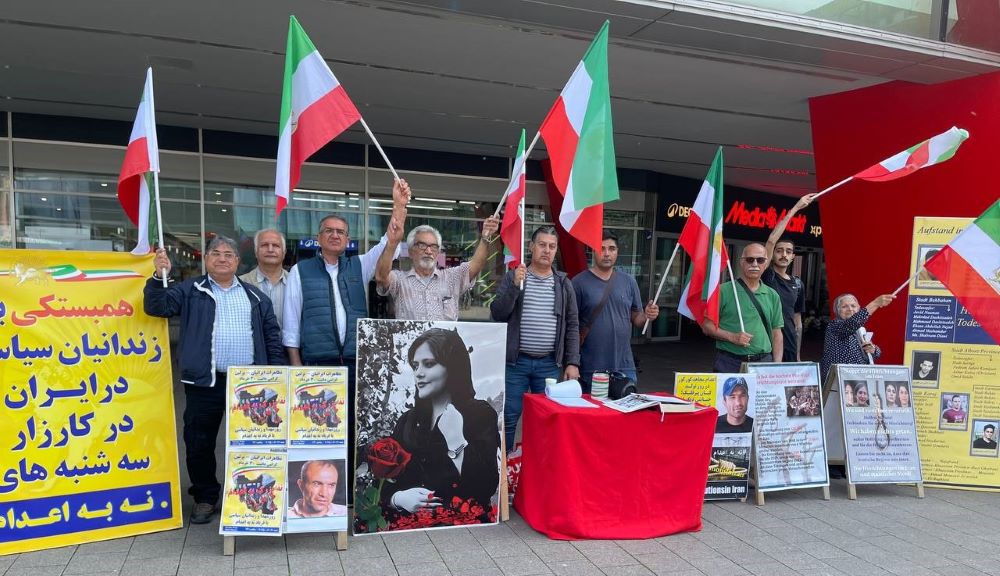
Berlin, Germany – June 18, 2025 – Supporters of the People’s Mojahedin Organization of Iran (PMOI/MEK) organized an exhibition to denounce the Iranian regime’s escalating human rights abuses, with a particular focus on the increasing death sentences handed down to political prisoners.
MEK Supporters in Hamburg Denounce Iran’s Human Rights Abuses and Rising Execution Rates

Hamburg, Germany – June 17, 2025: Supporters of the People’s Mojahedin Organization of Iran (PMOI/MEK) gathered to protest the Iranian regime’s escalating human rights abuses, particularly the death sentences imposed on political prisoners.
Mass Arrests in Iran: Alarming Escalation of Repression Under the Pretext of “Wartime Conditions”
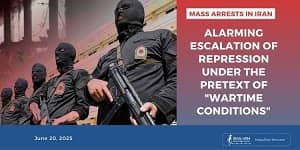
In the wake of recent Israeli airstrikes, the Iranian government has launched a new wave of widespread crackdowns across the country, citing “wartime conditions” and an intensified security atmosphere. The arrest of hundreds of citizens in various provinces over recent days has once again raised serious concerns over grave human rights violations, especially regarding freedom of expression and the right to fair judicial proceedings.
Since June 14, 2025, at least 300 individuals have been arrested across different provinces in Iran, mostly on vague charges such as “espionage,” “disturbing public opinion,” and even “media support for Israel.” Human rights sources believe that this figure represents only a fraction of the actual number of arrests.
Execution of Esmail Fekri: Growing Concerns Over Judicial Process in Security-Related Cases

On the morning of Monday, June 16, 2025, the death sentence of Esmail Fekri, accused of “espionage for Mossad,” was carried out at Ghezel Hesar Prison in Karaj, Iran. According to state-affiliated Iranian media, Fekri had previously been arrested on charges of “transmitting classified information to Israel” and was later sentenced to death following judicial proceedings.
This is the second execution related to the same case in recent months. Mohsen Langar-Neshin, another defendant in the case, was also executed at the same prison on April 30, 2025. Both individuals had been transferred from Ward 4 of Evin Prison to Ghezel Hesar prior to the implementation of their sentences.
Serious Concerns Over the Fate of 16-Year-Old Benyamin Kouhkan

In a continuation of the widespread crackdown on detainees from the 2022 nationwide protests in Iran, the Revolutionary Court in Zahedan sentenced two young Baloch men, Yasin Kabdani and Mohammad Darvish Narouei, to death on charges of “enmity against God (moharebeh)” and “corruption on earth” on Monday, June 16, 2025. At the same time, concerns have intensified regarding the fate of Benyamin Kouhkan, a 16-year-old boy who was arrested in the same case.
According to reliable human rights sources, on the same day, the final hearing for all three defendants was held. Following the session, Benyamin Kouhkan was transferred from the juvenile correctional ward to solitary confinement. Since then, he has had no contact with his family, and judicial authorities have refused to provide any official information about his condition or the status of his case.
War, Internet Blackout, Anxiety; Connection with Iran Has Been Severed
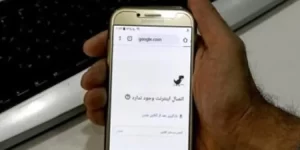
The widespread internet blackout in Iran has eliminated the ability to communicate with people inside the country. In such a situation, accurate information about the condition of citizens amid wartime circumstances is not being published, and the regime’s narratives are not considered reliable by the public. Since Thursday, June 19, internet access in Iran has been effectively cut off entirely, eliminating the possibility of independent reporting on the current situation by journalists and citizen-reporters.
Since Thursday, the internet has been almost completely cut off across Iran. This is not merely a technical disruption but a deliberate and organized act by Iran’s regime.
While Iran’s regime has not even sounded air raid sirens for its citizens, it has resorted to a total internet shutdown—the only remaining tool for communication, spreading awareness, and even saving lives. On the other hand, Iranians living abroad now face serious obstacles in communicating with their families inside the country, and the ongoing wartime conditions have intensified the psychological distress caused by this disconnection.