

Three-minute read
The 2026 Iran war, which erupted on 28 February and ended in the fragile Islamabad Accords of early April, laid bare a stark reality: Iran’s two most visible contenders for power are united not by vision, but by their willingness to sacrifice the country itself to secure rule.
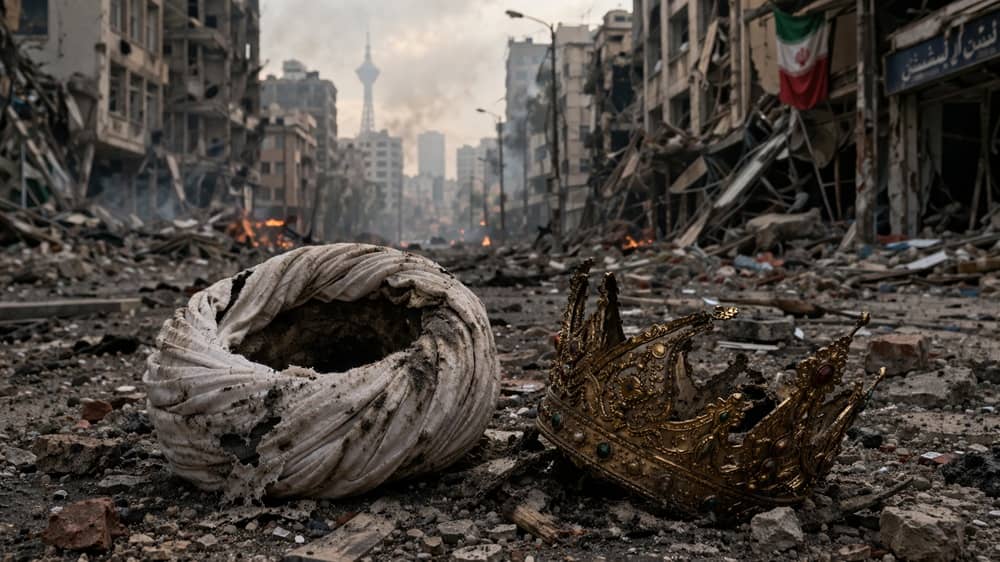
On one side, the clerical establishment demonstrated—yet again—that its only guiding principle is survival at any cost. On the other, Reza Pahlavi and his monarchist camp showed that their path to power rests not on Iranian society, but on foreign military force—even at the cost of the country’s total destruction, including its infrastructure and its people.
Neither represents a viable future. Both are prepared to see Iran burn to rule over its ashes.
Welcoming the ceasefire and expressing hope that it will lead to the end of the war and pave the way for peace and freedom.https://t.co/XXyjgE2TdR pic.twitter.com/rBsOih4c9u
— Maryam Rajavi (@Maryam_Rajavi) April 8, 2026
The Clerical Regime: Survival at Any Cost
The rapid appointment of Mojtaba Khamenei as Supreme Leader following his father’s assassination on day one of the war confirms what the Iranian Resistance had warned against: the “Clerical regime” is dead. By bypassing clerical meritocracy for hereditary succession, the regime has effectively become the very thing it claimed to overthrow in 1979—a dynastic autocracy.
Under Mojtaba, the Islamic Revolutionary Guard Corps consolidated control, formalizing a system long dominated by security institutions. But the war’s real significance lies in how the regime performed across three critical arenas: domestic stability, regional influence, and international standing.
Domestically, the regime emerged significantly weaker. The war exposed its inability to defend national airspace, protect infrastructure, or shield the population from widespread disruption. Public anger—already deep after years of repression—has intensified. Not because expectations were newly broken, but because the regime once again demonstrated that the population’s welfare plays no role in its decision-making. Its priority remained unchanged: survival, even at the cost of national devastation.
"The regime did not pick #Mojtaba_Khamenei in spite of his security face. It picked him because of it. His notoriety, far from disqualifying him inside the ruling core, made him useful: he is legible to the regime’s own forces as a continuity candidate who will neither surrender…
— NCRI-FAC (@iran_policy) March 9, 2026
Regionally, Iran’s position deteriorated sharply. The attempt to weaponize the Strait of Hormuz failed to produce leverage and instead reinforced the perception among neighboring states that the regime is a source of instability that cannot be contained through engagement. The war accelerated a shift toward distancing and containment by regional actors.
Internationally, the regime exited the conflict more isolated than before. Its inability to convert escalation into concessions, combined with the visible degradation of its military capabilities, weakened both deterrence and diplomatic leverage. The war did not strengthen its hand—it narrowed it.
Yet across all three arenas, one pattern remained constant: none of these costs altered the regime’s behavior. Economic contraction, infrastructure damage, and strategic setbacks did not trigger recalibration. The system demonstrated that it is structurally prepared to absorb national damage as long as its own survival is preserved.
The regime is weaker in every measurable dimension—even in its determination to endure.
The clerical dictatorship is again doing to the world economy what it has done for decades to people, governments and entire societies: taking hostages.#IranWar https://t.co/LiXkqu7QaH
— NCRI-FAC (@iran_policy) March 25, 2026
Monarchists: Power Through Destruction
If the regime revealed its willingness to destroy the country to stay in power, the monarchist camp revealed something equally stark: a willingness to see that destruction happen in order to take power.
Reza Pahlavi and his supporters’ position reflect a long-standing pattern—reliance on foreign force as the primary driver of political change, echoing the dependency that defined the final years of the Pahlavi monarchy.
Throughout the conflict, this camp openly welcomed and encouraged the strikes. More strikingly, they went further—explicitly calling for the targeting of Iran’s infrastructure as a means to weaken the regime. Statements from prominent monarchist voices, including figures such as Saeed Ghasseminejad, Reza Pahlavi’s key man reflected a readiness to escalate pressure even when it meant deepening the country’s economic and social collapse.
This is the critical point: for this camp, the destruction of infrastructure was not an unintended consequence—it was framed as a necessary step toward regime change.
#Iran News: State-Run Newspaper Says Reza Pahlavi and Monarchists Have Served Clerical Regimehttps://t.co/iey2VpMKXU
— NCRI-FAC (@iran_policy) April 8, 2025
At the same time, claims of internal support collapsed under scrutiny. Assertions that tens of thousands of military or security personnel were prepared to defect never materialized. No organized network—from labor unions to student groups—mobilized under monarchist leadership.
The issue goes beyond a lack of organization. There is no evidence of even an unstructured social base inside Iran willing to rally behind this project. The movement remains overwhelmingly external—visible in media, but absent on the ground. What amplified Reza Pahlavi’s name in Western media and across social media was not genuine popular momentum, but false advertising and propaganda.

This disconnect is compounded by internal behavior that further alienates potential allies: harassment campaigns, fragmentation, and hostility toward other dissidents.
The result is a political current that seeks power without the foundational elements required to sustain it: neither grassroots legitimacy nor institutional presence—only external leverage.
A Shared Logic: Power Over Country
Despite their rhetoric, both camps converge on a shared logic: the pursuit of power justifies the acceptance—even the encouragement—of national destruction.
This has immediate consequences. The war has further stripped away lingering illusions about the Pahlavi camp, exposing a political current willing to see the country’s infrastructure destroyed and its people pushed to the brink in pursuit of power. Rather than expanding its appeal, this has deepened public distrust and will likely accelerate the distancing of a population unwilling to rally behind a figure perceived as seeking the throne at any cost.
In this context, the trajectory becomes clearer: more Iranians will gravitate toward movements that prioritize the country’s interests over personal ambition—forces that offer not rhetoric or dependency on foreign intervention, but a credible, internally rooted path to real regime change.