

Three-minute read
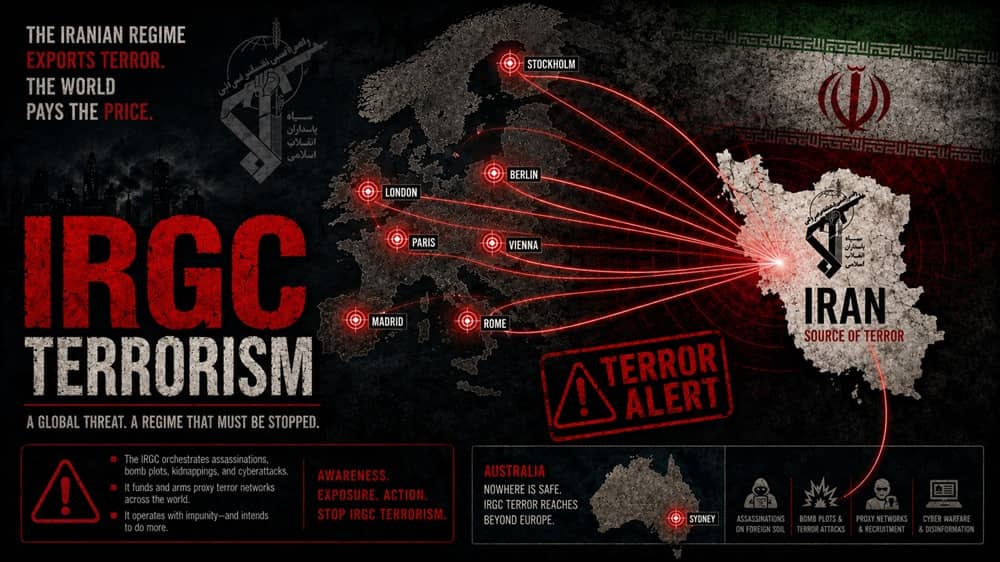
On June 24, 2026, Australia’s domestic intelligence chief disclosed a sobering reality: Iran’s Islamic Revolutionary Guard Corps (IRGC) had used overseas cutouts and criminal networks to direct covert arson attacks against domestic civilian targets in Sydney and Melbourne. This revelation laid bare the operational details behind Canberra’s unprecedented diplomatic response the previous year. In August 2025, Australia expelled the regime’s ambassador—the first such expulsion since World War II—and moved to designate the IRGC a terrorist organization.
Canberra’s decisive stance stands in stark contrast to decades of Western policy. The fundamental question raised by the IRGC’s reach into the Indo-Pacific is not why the Islamic Republic felt confident enough to direct covert violence on democratic soil, but what made it so bold. The answer lies in a deeply entrenched pattern of Western concessions that has systematically taught Tehran its state-sponsored violence carries no lasting consequences.
Four Decades of Hostage Diplomacy
This playbook is far from a modern aberration; it is a foundational pillar of the regime’s foreign policy stretching back more than forty years. The regime has long institutionalized hostage-taking as a primary instrument of statecraft, successfully extorting Western democracies to bypass international accountability and shield its operatives from justice.
THREAD
For more than four decades, the clerical regime in #Iran has consistently blackmailed other nations and considered #extremism as "leverage". 1/9https://t.co/ieaaOkZb6y pic.twitter.com/W9u5BJHXqs— NCRI-FAC (@iran_policy) September 6, 2022
The recent European track record illustrates how reliably this calculus still operates. In 2018, intelligence agencies foiled a bomb plot targeting a major Free Iran rally outside Paris. The architect, a senior Iranian diplomat named Assadollah Assadi, was convicted by a Belgian court and sentenced to twenty years. Yet the triumph of law was brief. Tehran immediately seized a Belgian aid worker as leverage. Brussels ultimately buckled, ratifying a bespoke prisoner-exchange treaty and returning Assadi to a hero’s welcome in May 2024.
The Hamid Noury case followed an identical script. Arrested in Sweden in 2019 for his role in the regime’s 1988 massacre of political prisoners, Noury was sentenced to life imprisonment. Once again, the leading state sponsor of terror took hostages. Once again, a Western democracy capitulated, trading a convicted executioner for its citizens in June 2024. These serial capitulations sent an unmistakable signal: accountability is entirely negotiable, provided the regime seizes enough human leverage.
"While the executive apparatus desperately signals a willingness for dialogue to stop the #economic bleeding, military commanders and their legislative allies double down on regional blackmail, explicitly tying the crisis to the blockade of the #Strait_of_Hormuz," writes…
— NCRI-FAC (@iran_policy) April 24, 2026
Silencing the Opposition
Emboldened by these successes, the regime has expanded its demands from judicial immunity to political censorship. On June 19, 2026, French authorities banned a 100,000-strong democratic march organized by the National Council of Resistance of Iran (NCRI) in Paris. The prohibition came just hours after a high-level telephone call between the French and Iranian foreign ministers. Furthermore, the decision issued by the Administrative Tribunal of Paris on 20 June 2026 confirmed the prohibition of the demonstration that had been planned to protest the escalating wave of executions in Iran. However, the court’s ruling identified the risk as coming from the Iranian regime and from monarchist elements aligned with Reza Pahlavi, including groups using the name, symbols and legacy of SAVAK, the Shah’s notorious former secret police.
The ruling refers to reports and threats submitted shortly before the demonstration, including messages bearing the SAVAK symbol and threatening to “plant a bomb” if the authorities allowed the protest to go ahead. It also records that the planned procession, because of the expected presence of PMOI/MEK supporters, was considered exposed to a major risk of attack either by the Iranian regime or by Iranian monarchist groups hostile to the PMOI. In addition, the court noted that an active monarchist figure, Mohammad Sadeghi Ahangar, had publicly urged his followers to “block the path” of the procession.
These findings raise a serious question about the proportionality and fairness of the response. If the threat came from the Iranian regime, its proxies, or monarchist elements invoking SAVAK, the proper response should have been to investigate, hold accountable and restrain those responsible for the threats. Instead, the victims of that repression — Iranians seeking to demonstrate against executions, torture and state violence in their own country — were the ones prevented from exercising their democratic right to protest. In effect, the ban punished those targeted by transnational repression rather than those carrying it out.
The #Iranian regime aired an interview with Asadollah Assadi, its convicted diplomat #terrorist, who was jailed in Belgium for a foiled 2018 bomb plot in Paris. This move seeks to bolster its hostage-taking diplomacy for both domestic and international audiences. pic.twitter.com/SIhC5faqkK
— NCRI-FAC (@iran_policy) August 6, 2024
A Strategic Reckoning
Western countries have long operated under the assumption that isolating or restricting the organized Iranian Resistance—the movement the regime identifies as its primary internal threat—is a low-cost concession to preserve a fragile regional equilibrium.
This assumption is increasingly contradicted by geopolitical realities. Yielding to asymmetric pressure has not produced a more moderate interlocutor. Instead, the downstream consequences of an unpunished Iranian regional strategy are felt directly by Western societies—manifesting in domestic security alerts, inflated trade costs, and the strain placed on democratic institutions by shifting geopolitical dynamics.
The organized Iranian Resistance is not the West’s liability; it is the regime’s ultimate vulnerability. That is why Tehran invests so heavily in persuading foreign capitals to suppress it. Australia’s decisive actions serve as a vital rebuke to systemic compliance. Yet the true danger of continued appeasement goes far beyond localized arson. Left unchecked, an emboldened regime may soon orchestrate catastrophic global atrocities that completely dwarf the cross-border terror attacks of the past—shattering the modern international order and inflicting a scale of suffering that forces the West to realize, too late, that abandoning fundamental principles does not buy peace, but merely compounds the ultimate price of impunity.