

THIS PAGE WILL BE UPDATED WITH THE LATEST NEWS
UPDATE: 10:00 AM CEST
Iran Attack on Israel ‘Ineffective’ But A ‘Significant Escalation’: White House

National Security Adviser Jake Sullivan says that the Iranian missile attack on Israel was “defeated and ineffective” and that the U.S. military coordinated with the Israeli Defense Forces (IDF) to repel the strikes.
Iran launched nearly 200 ballistic missiles towards targets in Israel on Tuesday, Sullivan said at a Tuesday White House briefing, noting the move was a “significant escalation.”
The strikes were in response to the deaths of Hezbollah and Hamas leaders, Iran says. The move comes after weeks of Israeli strikes against Tehran’s proxies in the region.
Iran Launches More Than 180 Ballistic Missiles at Israel

Israel says Iran has launched more than 180 missiles towards the country in a large-scale attack that has further heightened fears of an all-out regional war.
Millions of people rushed to shelters before explosions lit up the night skies above Tel Aviv and Jerusalem. A man was killed by falling missile debris in the city of Jericho in the occupied West Bank, Palestinian officials said.
Israel’s Prime Minister Benjamin Netanyahu said Iran had made a “big mistake” and “will pay for it”.
Iranian state TV said Iran had fired 200 missiles towards Israel. These included hypersonic weapons, it said, while the Islamic Revolutionary Guard Corps said the strikes were in retaliation for the killings of the leaders of its allies Hezbollah and Hamas.
UPDATE: 7:00 AM CEST
School Safety Crisis in Iran: Dilapidated Buildings and Neglect Put Students at Risk
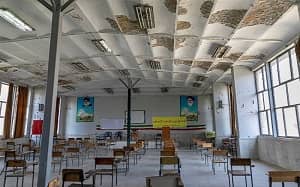
The deteriorating state of schools in Iran has become a critical issue, with years of neglect leaving students exposed to serious safety risks. Despite ongoing discussions about closing unsafe and overcrowded schools, little progress has been made.
Many schools have outlived their structural lifespan, and incidents such as fires and collapsing walls continue to endanger students. Even private schools operating in old residential buildings lack sufficient safety measures. While the authorities are aware of these problems, economic challenges and persistent neglect have prevented any meaningful action from being taken.
Years ago, the government promised to demolish worn-out schools, but these pledges have gone unfulfilled. Worse still, some schools are now facing issues of ground subsidence, further compromising their stability.
Iran’s Energy Crisis Deepens: Gas Shortages and Limited Investment Threaten Industries

As autumn begins and winter approaches, Iran’s national electricity company, Tavanir, issued a notice warning of impending gas shortages and urging citizens to conserve energy. The announcement highlighted the growing pressure on Iran’s energy system due to falling temperatures in the northern half of the country, which has driven up natural gas consumption. Tavanir stressed that energy consumption management—both electricity and gas—is critical for maintaining fuel reserves for power plants. It pointed out that the majority of Iran’s electricity is generated using gas in thermal power plants, making the country highly dependent on this fuel source. The company emphasized that maintaining a stable electricity supply depends on public cooperation in reducing energy use and more efficient energy management.
1,590 Iranian Nurses Resign in One Year
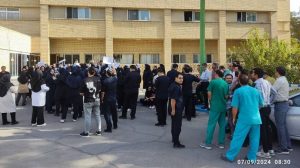
Salman Eshaqi, the spokesperson for the Health Commission of the regime’s Majlis (parliament), revealed shocking statistics regarding nurses resigning due to professional issues, stating that “1,590 nurses resigned last year, and the number of resignations and withdrawals from nursing is two to three times higher than the number of migrations.”
Eshaqi also noted that according to official statistics, 2,000 nurses apply annually to leave the country. According to this Majlis member, 2,000 Iranian nurses are currently working in Denmark, while there are only 300,000 nurses in Iran. He further quoted the president of the Nursing Organization, stating that “in some provinces, there is only one nurse for every eight to nine newborns.”
September 2024 Monthly Report – Iran Human Rights Monitor (Iran HRM)
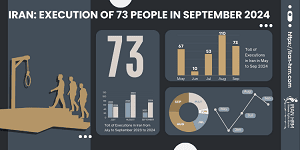
The Iran Human Rights Monitor (Iran HRM) has endeavored in its monthly report to provide an overview of the human rights situation in Iran for the month of September 2024. However, given that the judiciary in Iran continues to extensively employ executions as the most ruthless and inhumane form of punishment, the focus of this report is on executions and death sentences in Iran.
Based on the statistics recorded by the Center for Statistics and Documentation of Iran Human Rights Monitor (Iran HRM), and with extensive research conducted in this area, the final number of executions in September 2024 has been obtained. Although we emphasize that the actual figures are significantly higher, as most executions in Iran are carried out without media coverage and in media silence.
MEK Supporters in Essen Organized an Exhibition in Support of Iranian Political Prisoners and Against Executions in Iran

Essen, Germany—September 28, 2024: Freedom-loving Iranians and supporters of the People’s Mojahedin Organization of Iran (PMOI/MEK) held an exhibition protesting the Iranian regime’s rising wave of executions. They also demanded the immediate release of all political prisoners held by the mullahs’ regime.