

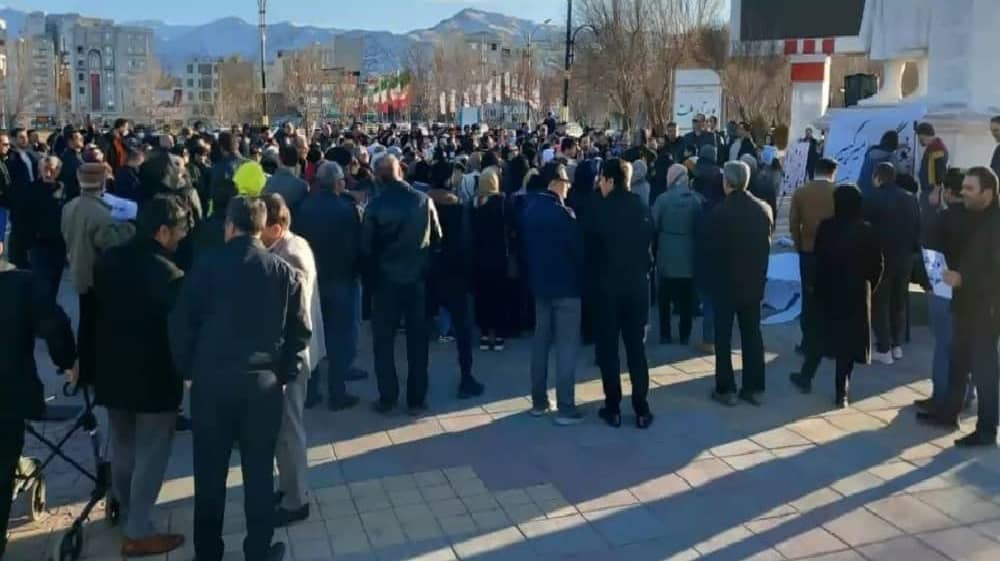
THIS PAGE WILL BE UPDATED WITH THE LATEST NEWS
UPDATE: 10:30 PM CET
U.S. Commander Warns of Iran’s Ongoing Nuclear Ambitions
In a Senate Armed Services Subcommittee hearing, U.S. Strategic Command Chief General Anthony Cotton warned that the regime in Iran “continues to pursue uranium enrichment,” highlighting the clerical regime’s persistent nuclear ambitions as a core threat to global security.

Testifying alongside U.S. Space Command’s General Stephen Whiting, Cotton stressed that the U.S. must modernize its nuclear deterrent systems to meet emerging threats, including from Iran. “Our mission has never been more important,” he said, noting that Tehran’s nuclear activity remains a serious concern amid broader instability.
Lawmakers voiced bipartisan alarm over the Iranian regime’s role in destabilizing the region, with some urging faster deployment of missile defense systems. The hearing underscored the regime’s enrichment program as a key challenge in U.S. strategic planning.
UPDATE: 7:30 PM CET
Iran Oil-Filled Tankers Build Up Off Malaysia as Sanctions Mount

Close to a dozen US-sanctioned tankers are idling off Malaysia with Iranian crude, with some having been stationed in the oil-transfer hub for more than a month — possible sign of slowing logistics for the sensitive trade to China.
At least 11 tankers with the Persian Gulf state’s barrels have either come to a halt off Malaysia this week, or are moving at very low speeds, according to ship-tracking data compiled by Bloomberg. The ships, holding close to 17 million barrels, are clustered in an area east of the Malaysian peninsular, a popular spot for ship-to-ship transfers of Iranian oil.
Iran Hostage Ploys Ensnare Europe in a Costly Complicity

While the international community, including the Trump administration, has rightly concentrated on Iran’s pursuit of nuclear weapons and its destabilizing role in regional conflicts like Yemen, Tehran’s exploitation of Western citizens as hostages has received comparatively less attention. Hostage-taking by Iran is hardly a recent phenomenon. It began as early as November 1979 — when American diplomats were captured by the Islamic Republic — and has remained a key element of the regime’s statecraft ever since.
Abductions, which are overseen by the highest authorities, have proven lucrative for Tehran with hostages from the United States and Europe used to secure political and financial concessions.
UPDATE: 5:30 PM CET
United States Files Civil Forfeiture Complaint for $47 Million in Proceeds from the Sale of 1 Million Barrels of Iranian Oil

A civil forfeiture complaint was filed today in the U.S. District Court for the District of Columbia alleging that $47 million in proceeds from the sale of nearly one million barrels of Iranian petroleum is forfeitable as property of, or affording a person a source of influence over, the Islamic Revolutionary Guard Corps (IRGC) or its Qods Force (IRGC-QF), designated Foreign Terrorist Organizations (FTOs).
The forfeiture complaint alleges a scheme between 2022 and 2024 to facilitate the shipment, storage, and sale of Iranian petroleum products for the benefit of the IRGC and IRGC-QF. The facilitators used deceptive practices to masquerade the Iranian oil as Malaysian, including by manipulating the tanker’s automatic identification system (AIS) to conceal that it onboarded the oil from a port in Iran. The facilitators presented falsified documents to the Croatian storage and port facility, claiming that the oil was Malaysian. The facilitators paid for storage fees associated with the oil’s storage in Croatia in U.S. dollars, transactions that were conducted through U.S. financial institutions that would have refused the transactions had they known they were associated with Iranian oil. The petroleum product was sold in 2024, and the United States seized $47 million in proceeds from that sale.
UPDATE: 1:30 PM CET
Kennedy Champions No Dollars for Dictators Act to Stop U.S. Tax Dollars from Flowing to Russia, China, Iran

WASHINGTON – Sen. John Kennedy (R-La.) today introduced the No Dollars for Dictators Act of 2025 to prevent state sponsors of terrorism and perpetrators of genocide from receiving American tax dollars via special drawing rights from the International Monetary Fund (IMF) without congressional approval.
“The Biden administration allowed China, Russia, Iran and Syria to collect billions of dollars from the IMF without ever consulting Congress. My bill would ensure that Congress has a say before the IMF doles out American tax dollars to countries that hate us,” said Kennedy.
Sens. John Barrasso (R-Wyo.), Marsha Blackburn (R-Tenn.), Chuck Grassley (R-Iowa), Jim Justice (R-W. Va.) and Rick Scott (R-Fla.) cosponsored the bill.
UPDATE: 8:00 AM CET
Iran Marks New Year with Protests Across Sectors
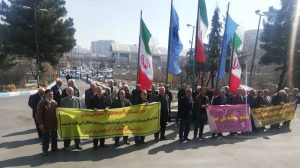
As the Iranian New Year begins, cities across the country are witnessing a renewed wave of protests, driven by worsening living conditions, deepening poverty, and institutionalized corruption. On March 25 and 26, protests erupted in several provinces, including Isfahan, Kerman, Tehran, and Khuzestan, reflecting widespread discontent with the regime’s oppressive and exploitative policies.
In Isfahan, a group of farmers staged a protest in front of the regional water authority, demanding their rightful water shares. Protesters denounced unjust water policies and the mismanagement of resources by regime-affiliated entities. The protest took place as the Zayandeh Rud, the largest river in central Iran, has nearly dried up in large sections due to poor planning, excessive water diversion by state-backed entities, and years of drought.
The Role of Regime Mismanagement in Iran’s Recurring Flood Disasters
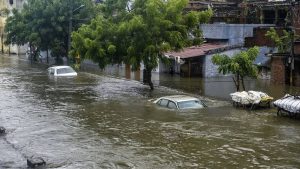
At the start of the new Persian calendar year, flooding in the provinces of Isfahan, Ilam, Bushehr, Chaharmahal and Bakhtiari, Khuzestan, Fars, Qazvin, Lorestan, Kermanshah, Gilan, and Kohgiluyeh and Boyer-Ahmad, along with landslides in various regions, caused significant damage to the people. Flooding is a hydrologic event resulting from the complex interaction of climatic, geographic, and human factors. In spring, increased rainfall and snowmelt naturally raise the water volume entering river systems. When the soil’s absorption capacity, vegetation cover, and natural and artificial infrastructures are exceeded, the excess water turns into floodwaters that overflow from main channels into plains, riverbanks, and eventually residential and agricultural areas. This process is not only unsurprising but can be predicted and managed through climate data analysis.
The Growing Threat of the Iranian Regime and the Dangers of an Appeasement Policy

The latest Annual Threat Assessment of the U.S. Intelligence Community paints a stark picture of the Iranian regime’s ambitions and threats.
From its expanding military and nuclear capabilities to its cyber warfare and proxy conflicts, the regime remains one of the most destabilizing forces in the Middle East. Despite its internal struggles, including economic decline and societal discontent, Tehran continues to pursue aggressive strategies to ensure its survival and expand its regional influence.
Given these realities, any policy of appeasement or further concessions risks emboldening a regime that has repeatedly demonstrated its willingness to use violence, terrorism, and repression to achieve its goals.
A Disturbing 90% Rise in the Execution of Women Amid Iran’s Execution Spree in 1403

A Disturbing 90% Rise in the Execution of Women Amid Iran’s Execution Spree – In the Iranian year 1403 (March 20, 2024 – March 20, 2025), the clerical regime in Iran carried out 1,153 executions across 94 prisons, marking a 42% increase compared to the previous year. This figure—already staggering—likely underrepresents the full scale of the atrocity, as many executions go unrecorded in remote prisons.
The victims include 38 women, seven juvenile offenders, and seven prisoners who were hanged in public in scenes of extraordinary brutality.
This wave of executions represents the highest annual total in recent years and coincides with growing internal instability and fear of a nationwide uprising.
Wave of Faculty Exodus Reaches Iran’s Major Universities

Mohammad Jalili, head of the Faculty Recruitment Center at Iranian regime’s Ministry of Health, has warned that the exodus of faculty members has now reached the country’s major universities. According to Jalili, these professors either continue working in their fields outside the university system or leave the country altogether.
In an interview with the state-run Shafaqna website on Sunday, March 23, Jalili described the situation of faculty migration from medical universities as “deeply concerning.” He stressed that professors are among the country’s elite, in whom significant investments have been made, and that they should not be lost so easily.
He suggested measures such as elevating faculty members’ status and respect in society, improving their living and financial conditions, and easing the process of recruiting and retaining top talent as key solutions to prevent university professors from leaving.
The Situation of Political Prisoners on Death Row in Iran – Part 4
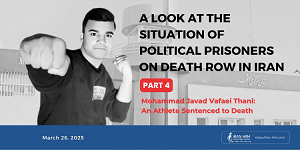
The issuance of death sentences against political prisoners in Iran is one of the most severe human rights violations in the country. The Iranian regime uses charges such as “Moharebeh” (enmity against God) and “Efsad-e Fil Arz” (corruption on earth) as tools to suppress protesters, political activists, and dissidents. Prisoners who are subjected to torture, denied access to independent legal representation, and tried in secret courts ultimately face death sentences based not on real evidence but on forced confessions.
This report is the fourth installment in a special series on political prisoners sentenced to death in Iran. In previous editions, we covered the cases of Behrouz Ehsani Eslamloo, Mehdi Hasani, Manouchehr Fallah, and Abolhassan Montazer. In this issue, we focus on the case of Mohammad Javad Vafaei Thani, a political prisoner on death row in Vakil Abad Prison, Mashhad.
Suspicious Death of Another Baluch Prisoner: Suicide or Murder?
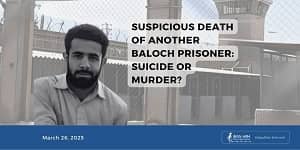
On Saturday, March 22, 2025, reports emerged regarding the suspicious death of a Baloch prisoner named Mehrdad Nabotzehi, 27, in Chabahar Prison. Prison authorities have declared the cause of death as “suicide by hanging with a rope.” However, his family and fellow inmates have rejected this claim, asserting that he was murdered inside the prison.
Mehrdad Nabotzehi was arrested five years ago on murder charges in Rask County and had been imprisoned in Chabahar since then. Yesterday, his body was found in one of the prison’s restrooms. Prison officials claimed he hanged himself with a rope, but his family and some fellow inmates have cast doubt on this narrative, raising suspicions of intentional murder.
Zurich Exhibition Condemns Executions and Calls for Action Against Iranian Regime

Zurich, Switzerland – March 24, 2025: At the beginning of the Iranian New Year 1404, سupporters of the People’s Mojahedin Organization of Iran (PMOI/MEK) organized an exhibition denouncing the death sentences imposed on political prisoners linked to the PMOI and exposing human rights violations by the Iranian regime. The event shed light on the dire conditions faced by political prisoners and demanded their immediate release.
Gothenburg, March 25, 2025: MEK Supporters Rally in Support of the ‘No to Executions Tuesdays’ Campaign

Gothenburg, Sweden – March 25, 2025: Supporters of the People’s Mojahedin Organization of Iran (PMOI/MEK) held a rally in solidarity with the No to Executions Tuesdays Campaign, marking the twenty-seventh consecutive week of their solidarity movement. The campaign is a response to the Iranian regime’s continued executions in its prisons.