

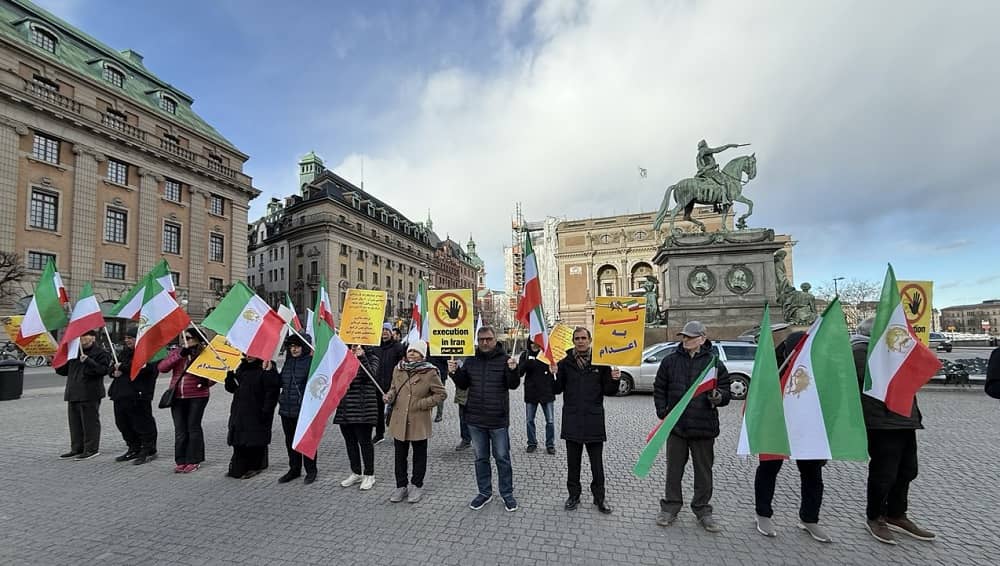
THIS PAGE WILL BE UPDATED WITH THE LATEST NEWS
UPDATE: 6:30 PM CEST
US Energy Secretary Says We Can Stop Iran’s Oil Exports
ABU DHABI, April 11 (Reuters) – U.S. Energy Secretary Chris Wright said on Friday that the United States could stop Iran’s oil exports as part of President Donald Trump’s plan to pressure Tehran over its nuclear programme.
The January return to the White House of Trump, who in his first term withdrew the U.S. from a 2015 nuclear accord with Tehran and clamped down on its oil exports, has again brought a tougher approach to the Middle Eastern power over its nuclear work.
Wright, speaking to Reuters on a visit to Abu Dhabi, said he thought the Gulf allies of the United States were extremely concerned about a nuclear-powered Iran and shared the U.S. resolve that this is an outcome that is in no one’s best interest.
EU to Target Nine Iranians Over Citizen Detentions, Diplomats Say
PARIS/BERLIN, April 11 (Reuters) – European Union foreign ministers will target nine Iranians linked to what the bloc calls a policy of state-sponsored hostage-taking in new sanctions expected to be adopted on Monday, two European diplomats said.
In recent years, Iran’s elite Revolutionary Guards have arrested dozens of dual nationals and foreigners, mostly on charges related to espionage and security. Among them are at least 20 European citizens, diplomats say.
Rights groups have accused Iran of trying to extract concessions from countries through such arrests, allegations denied by Iran, which does not recognise dual nationality.
UPDATE: 2:00 PM CEST
Iran: UN Experts Call for Immediate Halt to Imminent Amputation Sentences for Theft

GENEVA – UN human rights experts* today expressed grave concern at the imminent risk of finger amputation for three men detained in Iran and called for immediate intervention to prevent this irreversible punishment.
“These planned amputations violate the absolute prohibition of torture and ill-treatment,” the experts said. “Iran must immediately stop this severe corporal punishment, which violates international human rights standards.”
The three men were convicted of theft in November 2019 and sentenced to amputation under Article 278 of the Islamic Penal Code. Iran’s Supreme Court upheld the verdict in May 2020, despite allegations that their confessions were extracted under torture.
Together with @DrAliceEdwards, special rapporteur on torture, I request immediate intervention by the State to halt these amputation sentences from being carried out. https://t.co/uUmeHpwHee
— Mai Sato (@drmaisato.bsky.social) (@drmaisato) April 10, 2025
UPDATE: 1:00 PM CEST
Iran: The Untold Story — Ambassador Lincoln Bloomfield

Ambassador Lincoln Bloomfield sits down with Tim and talks about the weaknesses of the existing rulers of Iran. Is it real or is it perceived? Bloomfield explores the possibilities of this unique moment in time, discusses alternatives to the sitting regime, and shares what advice he would give to President Trump when it comes to dealing with Iran.
Some international observers think the current government of the Islamic Republic of Iran is in a very vulnerable state after the defeats of Iran’s three proxy groups, Hamas, Hezbolla,h and the Houthis. Weakened in the region, some think regime change may be on the horizon.
Iran: The Untold Story — Dr. Kazem Kazerounian
Dr. Kazem Kazerounian is a Professor of Mechanical Engineering at the University of Connecticut, where he served for a dozen years as Dean of the College of Engineering. He is also a proud Iranian American. He talks about his own perspective of Iranian life under the current regime, and whether the Shah of Iran’s son, Reza Pahlavi, is a viable alternative to govern the nation.
Some international observers think the current government of the Islamic Republic of Iran is in a very vulnerable state after the defeats of Iran’s three proxy groups, Hamas, Hezbollah and the Houthis. Weakened in the region, some think regime change may be on the horizon.
The West’s Disastrous Surrender to Iran’s Hostage Diplomacy

Since its founding in 1979, the Islamic Republic of Iran has treated hostage diplomacy not as an aberration but as a deliberate and calculated instrument of statecraft. The United States embassy takeover that same year—during which American diplomats were held for 444 days—wasn’t merely a revolutionary outburst; it was a template. Tehran realized early that seizing foreign nationals could yield more than just headlines. It could alter the calculus of international negotiations, shape domestic politics abroad, and extract high-value concessions. In one case, it may have even influenced the outcome of a U.S. presidential election.
UPDATE: 9:00 AM CEST
No, Iran Didn’t Abandon the Houthis. It Just Wants Trump to Think So.

If you were confused by the Telegraph article on Iran “abandoning” the Houthis, you’re not alone. That narrative is precisely the kind of strategic ambiguity Iran has long relied on, inviting speculation while concealing intent. But this moment isn’t just about misinformation. It’s about signaling. The anonymous official leaking the headline appears to be offering the perception of restraint, not to change facts on the ground, but to buy time, test reactions, and shape how those facts are read in Washington, Riyadh, and beyond.
While Iran may have repositioned some personnel as the Telegraph claims, there is no credible evidence of pulling back support from the Houthis or a wholesale “abandonment.” Tehran still has its ambassador in Sanaa who advises the Houthis and maintains a significant covert operational presence in Yemen through the Islamic Revolutionary Guard Corps (IRGC), specifically its Quds Force. Moreover, General Abdul Reza Shahlai, a senior Quds Force commander who has been active in Yemen since at least 2011–2012, serves on the Houthis’ Jihadis council. The IRGC’s presence in Yemen is linked to its so-called “6000 branch,” which oversees operations across the Arabian Peninsula.
US Targets China Oil Storage Terminal in New Iran-Related Sanctions
WASHINGTON, April 10 (Reuters) – The Trump administration imposed sanctions on Iranian oil trading networks on Thursday, including on a China-based crude oil storage terminal linked via a pipeline to an independent refinery, just days before direct talks between the U.S. and Iran.
The sanctions came after Secretary of State Marco Rubio said the U.S. will hold direct talks with Iran on Saturday in Oman. President Donald Trump said on Monday that Iran would be in “great danger” if the talks were unsuccessful.
Chairman Lawler Celebrates Enhanced Iran Sanctions Act Passing House Foreign Affairs Committee
Washington, D.C. – 4/9/2025… Today, Chairman Mike Lawler (NY-17) of the Middle East and North Africa Subcommittee released the following statement in response to the Enhanced Iran Sanctions Act passing the House Foreign Affairs Committee by voice vote.
The Enhanced Iran Sanctions Act expands secondary sanctions on foreign entities that facilitate Iran’s illegal oil trade, making it clear that the U.S. will not tolerate those who enable the Iranian regime’s dangerous activities. Chairman Lawler and Ranking Member Sheila Cherfilus–McCormick (FL-20) introduced the bipartisan bill in the 119th Congress this past February.
“Today’s passage of the Enhanced Iran Sanctions Act in Committee marks a critical step toward holding Iran accountable for its destabilizing actions and curbing its access to the funds that go toward terrorism and undermine global security. This bill is a direct response to Iran’s exploitation of weak spots in the global sanctions framework and its continued attempts to skirt international efforts to limit its malign influence,” said Chairman Mike Lawler.
The Enhanced Iran Sanctions Act that I introduced with @CongresswomanSC just passed @HouseForeignGOP by voice vote. This bill authorizes much needed sanctions that strengthens the maximum pressure campaign to hold Iran and its terror network accountable. pic.twitter.com/yx11c6ancS
— Congressman Mike Lawler (@RepMikeLawler) April 9, 2025
U.S. Congress Introduces Bill to Investigate Iranian Oligarchs and Parastatal Entities
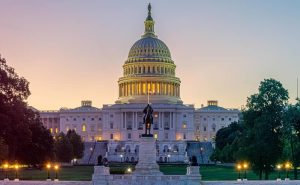
The U.S. House of Representatives has introduced legislation aimed at increasing transparency around Iran’s ruling elite and economic networks. H.R. 348, officially titled the Stop Corrupt Iranian Oligarchs and Entities Act, mandates a detailed report on senior Iranian political figures, oligarchs, and parastatal entities. The bipartisan bill was introduced by Representatives David Kustoff (R-TN) and Josh Gottheimer (D-NJ) and referred to both the House Foreign Affairs and Financial Services Committees.
The bill requires the Secretary of the Treasury, in coordination with the State Department and the Director of National Intelligence, to submit the report within 180 days. The report must identify the most significant oligarchs and senior officials in Iran, assess their ties to the regime’s president Masoud Pezeshkian, and other ruling elites, and outline signs of corruption, including income sources and foreign business affiliations.
It also calls for the identification of parastatal entities—defined as those with at least 25% state ownership and over $2 billion in 2016 revenues—detailing their role in Iran’s economy, leadership structures, and non-Iranian business ties.
The bill further seeks an assessment of how Iranian oligarchs and state-linked entities may influence critical U.S. sectors such as banking, real estate, and insurance. It directs the Treasury to evaluate the potential impact of additional sanctions, including adding such entities to the Specially Designated Nationals (SDN) list maintained by the Office of Foreign Assets Control (OFAC).
If enacted, H.R. 348 could pave the way for stronger sanctions and financial restrictions on Tehran’s economic network, as part of ongoing U.S. efforts to pressure the regime over its corruption, repression, and malign activities.
Treasury Targets Network Transporting Hundreds of Millions of Dollars’ Worth of Iranian Petroleum
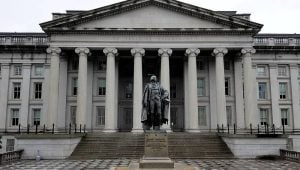
WASHINGTON — Today, the Department of the Treasury’s Office of Foreign Assets Control (OFAC) is designating United Arab Emirates (UAE)-based Indian national Jugwinder Singh Brar (Brar), who owns multiple shipping companies that boast a fleet of nearly 30 vessels, many of which operate as part of Iran’s “shadow fleet.” OFAC is also designating two UAE- and two India-based entities that own and operate Brar’s vessels that have transported Iranian oil on behalf of the National Iranian Oil Company (NIOC) and the Iranian military. Brar’s vessels engage in high-risk ship-to-ship (STS) transfers of Iranian petroleum in waters off Iraq, Iran, the UAE, and the Gulf of Oman. These cargoes then reach other facilitators who blend the oil or fuel with products from other countries and falsify shipping documents to conceal links to Iran, allowing these cargoes to reach the international market.
UN Human Rights Council Adopts Resolution on the Situation of Human Rights in Iran

Iceland’s first session as a member of the United Nations Human Rights Council 2025-2027 concluded on 5 April. Thirty-two resolutions were adopted by the Human Rights Council during the 58th session after six weeks of negotiations. The resolution that addresses the situation of human rights in the Islamic Republic of Iran, put forward by a core group led by Iceland, was adopted by vote with broad cross-regional support.
“It is encouraging to see such strong support for the resolution on the human rights situation Iran led by Iceland. By adopting the resolution, the Human Rights Council expresses its support for the people of Iran and offers hope for accountability of the widespread human rights violations and abuses committed in the country,” says the Minister for Foreign Affairs, Þorgerður Katrín Gunnarsdóttir. The resolution was adopted by 24 votes in favor, 8 votes against and 15 abstentions.
UPDATE: 7:00 AM CEST
The Explosive Atmosphere in Iran Hints at A Social Eruption
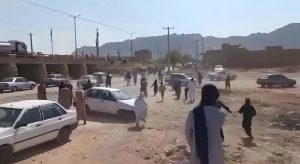
In today’s Iran, all signs point to an explosive atmosphere, one that even the regime and state-affiliated analysts have acknowledged.
A statement by the IRGC on “Quds Day” (a name the regime has given to the last Friday of the holy month of Ramadan), published on March 31, appears to be an effort to showcase power and national unity in the face of foreign threats. The statement describes the Quds Day rally as a “new unveiling of the soft power and the vast social capital of the Islamic Republic” and frames it as a response to “the enemy’s toxic propaganda.” Yet beneath these grandiose words lies a tacit admission: society is under “peak economic pressure” and the “atmosphere created by infiltration and sedition movements” is expanding. The repeated emphasis on “social cohesion” and warnings about “social divides” that pave the way for enemy influence point to the regime’s recognition of the fragility of the current situation.
Iran’s Regime in Disarray Ahead of Nuclear Talks with the U.S.
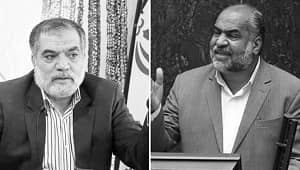
After the U.S. administration announced the return of the maximum pressure policy and U.S. President Donald Trump threatened that the Iranian regime must choose between negotiation and military action, regime supreme leader Ali Khamenei stated in his speech on February 7, 2025: “Negotiating with the United States… one should not negotiate with such a government, negotiating is not rational, it is not wise, it is not honorable.”
Two months later, there is now news of negotiations in Oman.
On Monday night, April 7, 2025, Trump, responding to reporters’ questions and encouraging the regime to negotiate, said: “We are dealing with them directly and maybe a deal is going to be made. That would be great, it would be really great for Iran.” Contrary to the Iranian regime’s repeated denials regarding direct talks, the U.S. President explicitly declared that negotiations will be held directly on Saturday and at a very high level.
Iran Nuclear Threat Reaches “Extreme Danger” Level, Report Warns

April 2025 – The threat posed by Iran’s nuclear program has significantly worsened since February 2024, reaching an “Extreme Danger” level according to a new report by the Institute for Science and International Security. The report, titled “The Iran Threat Geiger Counter: Extreme Danger Grows,” assigns a total threat score of 157 out of a possible 180, up from 151 in the previous assessment.
- Enhanced Nuclear Capabilities: Iran possesses greater nuclear weapon capabilities and shorter timeframes to build them. It has enough 60 percent enriched uranium (highly enriched uranium or HEU) to potentially create a nuclear explosive directly.
Iran: Text Messages Sent to Families of Girls Regarding Hijab

Although the Iranian regime’s new mandatory hijab law has not yet been officially announced, Mohsen Mazaheri, Secretary of the Enjoining Good and Forbidding Evil Committee in Isfahan (central Iran), defended the practice of sending text messages to the families of women and girls who engage in civil disobedience against the mandatory hijab. He stated that this is a routine action and is done for various issues.
On Tuesday, April 8, Mazaheri told the state-affiliated newspaper Ham-Mihan that he supports sending hijab-related text messages to families of women and girls, saying: “Giving a warning is, above all, about preserving the dignity of individuals. The warnings are given very privately and confidentially, so that no one else finds out.”
He added: “This is a normal action and, according to the law, it is carried out for all issues, not just this one (hijab).”
Global Protests Erupt Against Execution of Five Political Prisoners in Iran

April 9, 2025 — In response to the brutal execution of five political prisoners in Mashhad by the Iranian regime, freedom-loving Iranians and supporters of the People’s Mojahedin Organization of Iran (PMOI/MEK) and the National Council of Resistance of Iran (NCRI) have staged protests and exhibitions across Europe to condemn the clerical regime’s crimes and demand justice.