

THIS PAGE WILL BE UPDATED WITH THE LATEST NEWS
UPDATE: 8:30 PM CEST
Iran, FdI: Alarming Level of Executions in the Country

(AGENPARL) – Mon 28 July 2025 – “The atrocities committed by the regime are steadily increasing and demand a clear response from the international community—especially in the face of Tehran’s completely arbitrary use of the death penalty. The numbers continue to rise, painting an already grim picture: 975 executions in 2024 and nearly 600 so far in 2025. The recent news of the hanging of two members of the political opposition movement MEK/PMOI confirms a defining trait of the Islamic Republic since its founding in 1979—using the death penalty to crush all forms of dissent. The darkest chapter of this pattern occurred in 1988, when at least 30,000 MEK/PMOI members were executed in just one month.
As members of the Inter-Parliamentary Committee for a Free Iran—which brings together Senators and Deputies from nearly all political parties in the Italian Parliament—we firmly condemn the executions of Behrouz Ehsani (69) and Mehdi Hassani (48), carried out on July 27 at Ghezel Hesar Prison, after more than three years of imprisonment and various forms of torture.”
Iran: Horrifying Secret Executions Amid Mounting Political Repression

Responding to the arbitrary executions of tortured political dissidents, Behrouz Ehsani, 69, and Mehdi Hassani, 48, in secret in Ghezel Hesar prison in Karaj, Alborz province, on 27 July, Kristine Beckerle, Deputy Regional Director for the Middle East and North Africa at Amnesty International, said: “Behrouz Ehsani and Mehdi Hassani were executed arbitrarily amid Iran’s horrific execution crisis, which has resulted in nearly 700 people hanged this year. They were executed in secret without notice to them or their families after a grossly unfair trial by a Revolutionary Court. They were denied access to their lawyers for nearly two years before a trial that lasted only five minutes and during which they were not allowed to speak in their own defense. Forced ‘confessions’ extracted through beatings, prolonged solitary confinement and threats to further harm them and their families were used as evidence to convict them.”
UPDATE: 6:30 PM CEST
International Community Must Act to Prevent a Repeat of Iran’s 1988 Massacre

We call on the global community to urgently confront the escalating wave of political executions and entrenched impunity in Iran. The risk of another mass atrocity, reminiscent of the 1988 massacre, is alarmingly real. On 7 July 2025, Fars News—linked to the Revolutionary Guards (IRGC)—published an editorial praising the 1988 executions of over 30,000 political prisoners as a ‘successful historical experience’. The editorial, entitled ‘Why the 1988 Executions Should Be Repeated’, openly advocated for similar measures against current detainees, framing political dissent as a threat to national security. This rhetoric reflects a dangerous effort to normalise state-sponsored killings.
On 12 July 2025, three opposition activists—Farshad Etemadi-Far, Masoud Jamei, and Alireza Mardasi—were sentenced to death by Branch 1 of the Ahvaz Revolutionary Court after two years of torture, accused of ‘waging war on God’ (moharebeh) over their support for the opposition PMOI (MEK). In July 2025, the Supreme Court rejected a fourth request for judicial review for political prisoners Behrouz Ehsani and Mehdi Hassani, leaving them at imminent risk on death row. There are currently dozens of political prisoners on death row on similar charges.
UPDATE: 3:30 PM CEST
Iran Planning to Execute 30,000 In Repeat of Horror 1988 ‘Massacre’ as Part of Desperate Crackdown, Insiders Fear

IRAN’S merciless regime is plotting to kill tens of thousands of prisoners in a repeat of the 1988 massacre, insiders fear.
Rattled supreme leader Ali Khamenei has ordered a surge in executions – turning hangings into public spectacles in a chilling warning to dissidents. It comes as callous mullahs yesterday hanged two political prisoners who had been jailed on trumped-up charges. Mehdi Hassani, 48, and Behrouz Ehsani, 70, were killed in cold blood for daring to oppose the barbaric regime they were forced to live under.
Earlier this year, The Sun shared a haunting voice message from dad-of-three Hassani as he lambasted the cruelty of mullahs.
Ehsani meanwhile bravely vowed he was “ready” to sacrifice his life in the ongoing fight for freedom for the Iranian people.
West Urged to Step in Over ‘Awful Tyrannical’ Iran as Two Dissidents Executed

Olympian Sharron Davies today warned the West had to stop mollifying Iran’s murderous mullahs as two more dissidents opposed to the Ayatollah were hanged at dawn. Davies has been a passionate advocate of democracy in Iran since 1988 when the Ayatollah Khomeini ordered a mass slaughter of 30,000 Iranians, many of them popular sportsmen and women, who had taken a stand against his fascist theocracy.
They did not and yesterday political prisoners Behrouz Ehsani and Mehdi Hassani were hanged at first light in Qezelhessar Prison. They were charged with the medieval “moharebeh” (waging war against God), “corruption on earth”, together with “baghi” (armed rebellion), membership of the People’s Mojahedin Organization of Iran (PMOI), collecting classified information, and conspiring against national security.
UPDATE: 11:00 AM CEST
The Next Iranian Revolution Will Be Led by Women

Modern Iran has endured two enduring strains of dictatorship. The first, a monarchy under the Shah, ended on February 11, 1979, when a massive popular uprising overthrew Mohammad Reza Pahlavi. Yet, the hope for freedom that fueled that revolution was swiftly betrayed. Progressive and freedom-seeking forces—many of them previously imprisoned by the Shah’s notorious secret police, SAVAK—were crushed once again, this time under the weight of a rising theocracy. Ayatollah Khomeini, cloaked in revolutionary legitimacy, seized power and established a new order built on two foundations: ruthless domestic repression and the export of fundamentalism and terror.
Central to the resistance against both these regimes has been the unflinching resolve of Iranian women. Their leadership is not incidental—it is rooted in decades of political engagement that predate the revolution. Even under the Shah, countless women were harassed, imprisoned, and in some cases executed for their dissent. This spirit of resistance only deepened under the clerical regime, where misogyny became not just policy but ideology—an essential tool for maintaining control.
UPDATE: 9:00 AM CEST
Iran Protests Weekly: Nationwide Anger Boils over Water Shortages, Corruption, and Injustice

In the scorching heat of summer, Iranians across the country are taking to the streets to protest the clerical regime’s catastrophic mismanagement, which has deprived them of basic necessities like water and electricity. The destructive and plundering policies of the past four decades have pushed the nation to a breaking point, with citizens increasingly blaming the regime’s systemic corruption and looting of national wealth for their suffering.
Anniversary of the 1988 Massacre: Silence is Not an Option—A Crime in Progress
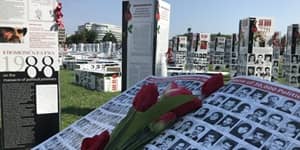
On the anniversary of that crime against humanity, the mullahs’ regime executed two PMOI political prisoners—amid growing signs that history is on the verge of repeating itself
In the early hours of Sunday, July 27, 2025—on the eve of the anniversary of the 1988 massacre of over 30,000 political prisoners—two PMOI political prisoners, Behrouz Ehsani and Mehdi Hassani, were executed by the inhuman regime of the mullahs in Ghezel Hesar Prison after three years of torture aimed at extracting forced confessions.
At the height of its weakness and in the final days of its disgraceful rule, the mullahs’ regime sent a clear message with this cowardly act: its primary war is with the people of Iran, and its main concern is to prevent another uprising that could bring down its entire foundation.
Hoda Mehreganfar, 38, in Critical Condition in Adel Abad Prison

Hoda Mehreganfar, a political prisoner held in Adelabad Prison in Shiraz, is facing a severe health crisis following the recurrence of an endometrioma cyst.
Despite clear medical warnings, she has been denied access to specialized healthcare services.
Before her arrest, Mehreganfar had undergone surgery related to this condition. However, with the resurgence of symptoms, she is now in urgent need of an ultrasound and examination by a gynecologist. The prison’s general practitioner, after examining her, warned of the risk of the cyst enlarging or rupturing and emphasized that continued treatment is contingent upon referral to a specialist.
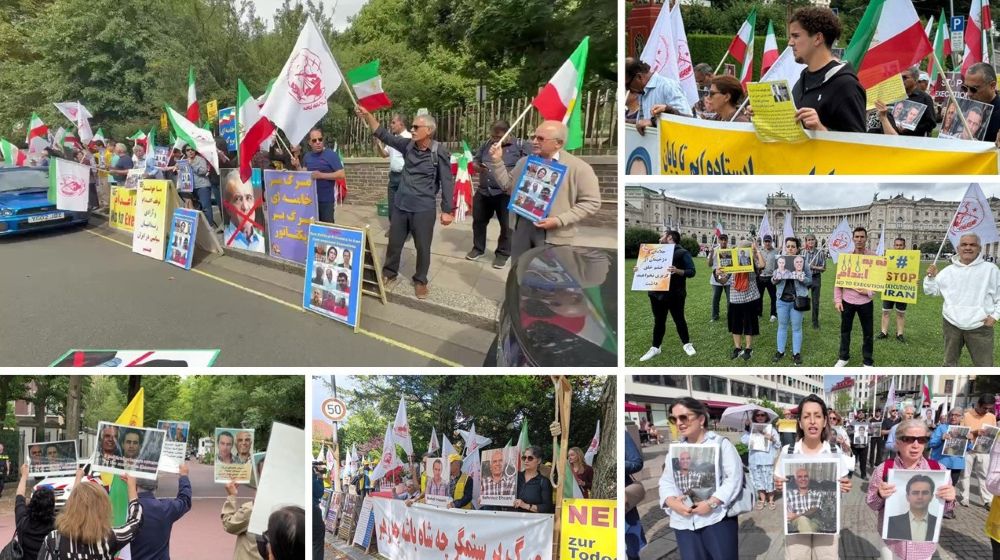
Global Protests Condemn Execution of PMOI Political Prisoners Behrouz Ehsani and Mehdi Hassani in Iran

July 27, 2025 — In a shocking act of state violence, the Iranian regime executed two political prisoners in Tehran: Behrouz Ehsani and Mehdi Hassani. Both were members of the People’s Mojahedin Organization of Iran (PMOI/MEK).
This brutal act has sparked outrage across the Iranian diaspora. Protests broke out in multiple cities across Europe and beyond. Supporters of the National Council of Resistance of Iran (NCRI) and the PMOI gathered in front of Iranian embassies to condemn the killings and demand international action.
European Troika’s Snapback Threat Sparks Global Debate on Iran’s Nuclear Future

The snapback mechanism, embedded in the Joint Comprehensive Plan of Action (JCPOA) and UN Security Council Resolution 2231, allows for the automatic reinstatement of international sanctions against Iran in case of significant non-compliance. Following the U.S. withdrawal from the JCPOA in 2018, tensions between Iran and the European Troika (UK, France, and Germany) have escalated. The Troika has threatened to activate the snapback mechanism by the end of August 2025 if nuclear talks fail to progress. These threats have prompted varied responses from Iranian officials, other nations, and international political figures. This article impartially examines the positions of officials and political figures.
Seyyed Abbas Araghchi, Iranian Foreign Minister: In a letter to UN Secretary-General António Guterres and EU High Representative Kaja Kallas, he stated: “Due to repeated violations of JCPOA commitments, the European Troika lacks the legal, political, and moral authority to invoke the snapback mechanism” (Source: Tasnim).
Water And Electricity Supply Crisis; Efforts for the Rapid Transfer of Water to Tehran
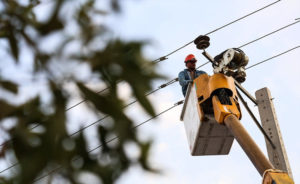
Amid a severe water crisis in Iran and growing public complaints over water cuts, Massoud Pezeshkian, the Iranian regime’s president, visited several dams in Alborz province, including Karaj Dam and Taleqan Dam.
On the evening of Thursday, July 24, following his visit to the Taleqan Dam water transfer project to Tehran, Pezeshkian told reporters: “As you can see, according to reports, the water level behind the Taleqan Dam has dropped by nearly 48 meters, which is a serious warning for the drinking water supply of the capital and nearby cities.”
He promised that efforts are underway to “rapidly transfer water from Taleqan to offset the water crisis in Alborz and Tehran provinces.”