


THIS PAGE WILL BE UPDATED WITH THE LATEST NEWS
UPDATE: 1:30 PM CEST
Iran Faces Power Struggle Over Nuclear Talks Management

A renewed debate is simmering in Tehran over whether Iran’s nuclear file should remain under the Foreign Ministry or be returned to the Supreme National Security Council (SNSC), after Ali Larijani’s reinstatement as the council’s secretary sparked speculation of a shift in control. Foreign Minister Abbas Araghchi dismissed the rumors, telling the Khabar Online news site, which is close to Larijani and had floated the possibility, that “there is currently no such plan on the agenda, and I do not think it will happen.”
His comments appeared aimed at cooling media chatter over a redistribution of authority, fueled by Larijani’s comeback and the council’s historic dominance in shaping nuclear strategy.
UPDATE: 10:30 AM CEST
Pahlavi’s Iran ‘Transition Plan’ Is an Invitation for Authoritarianism

On August 1, 2025, Reza Pahlavi unveiled what he describes as a roadmap for Iran’s future — a document allegedly crafted by experts under his supervision and disseminated through NUFDI, his promotional apparatus. Marketed as a post-regime transition plan, it reads less like a democratic blueprint and more like a manual for consolidating unchecked power in the hands of a single unelected figure.
At the heart of the proposal lies an 18- to 36-month “Transitional Period,” which can be extended indefinitely. During this time, all branches of state authority would report to one man: the self-appointed “Leader of the National Uprising,” Reza Pahlavi.
The proposed “Transition System” comprises three entities: the National Uprising Body, the Transitional Government, and the Transitional Court — which, while superficially resembling the legislative, executive, and judicial branches, are in practice entirely subordinate to Pahlavi. He would appoint, oversee, and dismiss all members of these bodies at will, with no institutional constraints.
UPDATE: 8:00 AM CEST
Unmasking The Dual Tracks of Tehran’s Global Terror Machine

Recent revelations from the National Council of Resistance of Iran (NCRI) have exposed a chilling evolution in the Iranian regime’s state-sponsored terrorism, confirming that it operates as a core instrument of state policy under the direct authority of Supreme Leader Ali Khamenei. A detailed report released in August 2025 unmasks a newly centralized command structure and a dangerous two-pronged strategy for executing attacks on foreign soil: using official diplomats for high-value targets while outsourcing assassinations to criminal gangs to maintain plausible deniability.
Urgent Call from Manchester to Save Iranian Political Prisoners Facing Execution

Manchester, UK – August 14, 2025 – The Academics in Exile Association, in solidarity with the People’s Mojahedin Organization of Iran (PMOI/MEK), organized an exhibition and bookstall in Manchester to condemn the execution of Iranian political prisoners by the regime’s ruling clerics.
Iranian Women’s Association of Australia Holds Human Rights Meeting at NSW Parliament

Sydney, NSW – 7 August 2025 – The Iranian Women’s Association of Australia convened a special meeting on Thursday, August 7, at the Jubilee Room of the New South Wales Parliament to address the ongoing struggle for freedom and human rights in Iran. The event also focused on exploring ways Australia, and NSW in particular, can demonstrate meaningful solidarity and support for the Iranian people.
Representatives from the Ethnic Communities Council of NSW (ECCNSW), including three executives, attended the meeting to express their support. During the session, Amir Salem presented a motion that received unanimous backing and applause from participants.
The gathering underscored the growing commitment within the Australian community to stand with Iranians in their pursuit of justice, equality, and democratic freedoms.
Families of Five Political Prisoners Sentenced to Death Expressed Concern Over Continued Lack of News About Them
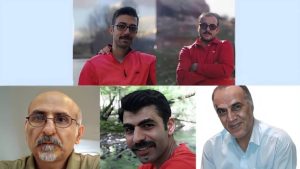
A week after the transfer of Ali Akbar Daneshvarkar, Mohammad Taghavi, Pouya Ghobadi, Vahid Beni-Amerian, and Babak Alipour—five political prisoners sentenced to death—from Greater Tehran Prison to Ghezel Hesar Prison, there has been no information about their condition. This uncertainty about their fate has caused deep concern among their families. Judicial and security officials, along with Ghezel Hesar prison authorities, have refused to grant visits or phone calls, or to provide any answers to the families’ inquiries.
Gorgan Bay on the Brink of Disappearance as Caspian Sea Retreat Accelerates

Iran’s first internationally registered bay faces ecological collapse, threatening biodiversity, fisheries, and northern Iran’s climate stability. Gorgan Bay, Iran’s first wetland and bay to be internationally registered under the Ramsar Convention, is on the verge of drying up completely. Once a thriving aquatic ecosystem rich in biodiversity, the bay has lost much of its water due to a sharp drop in levels and extensive retreat—triggering severe ecological damage and widespread loss of animal life.
More than eight years have passed since the formation of the Gorgan Bay Rescue Task Force, yet none of its plans have succeeded in halting the decline. Before dredging of the bay’s water channels began in March 2023, around 46% of the wetland had already dried up. At the current pace, more than half of Gorgan Bay is expected to lose its water entirely in the near future.